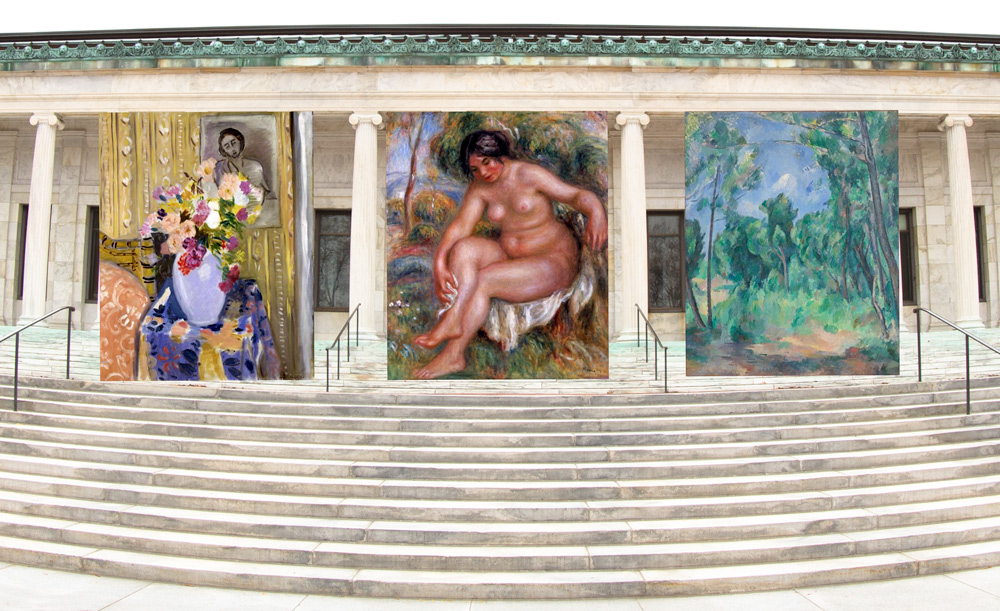
A critique on the museum’s 5-year plan for growth
as reported by The Blade
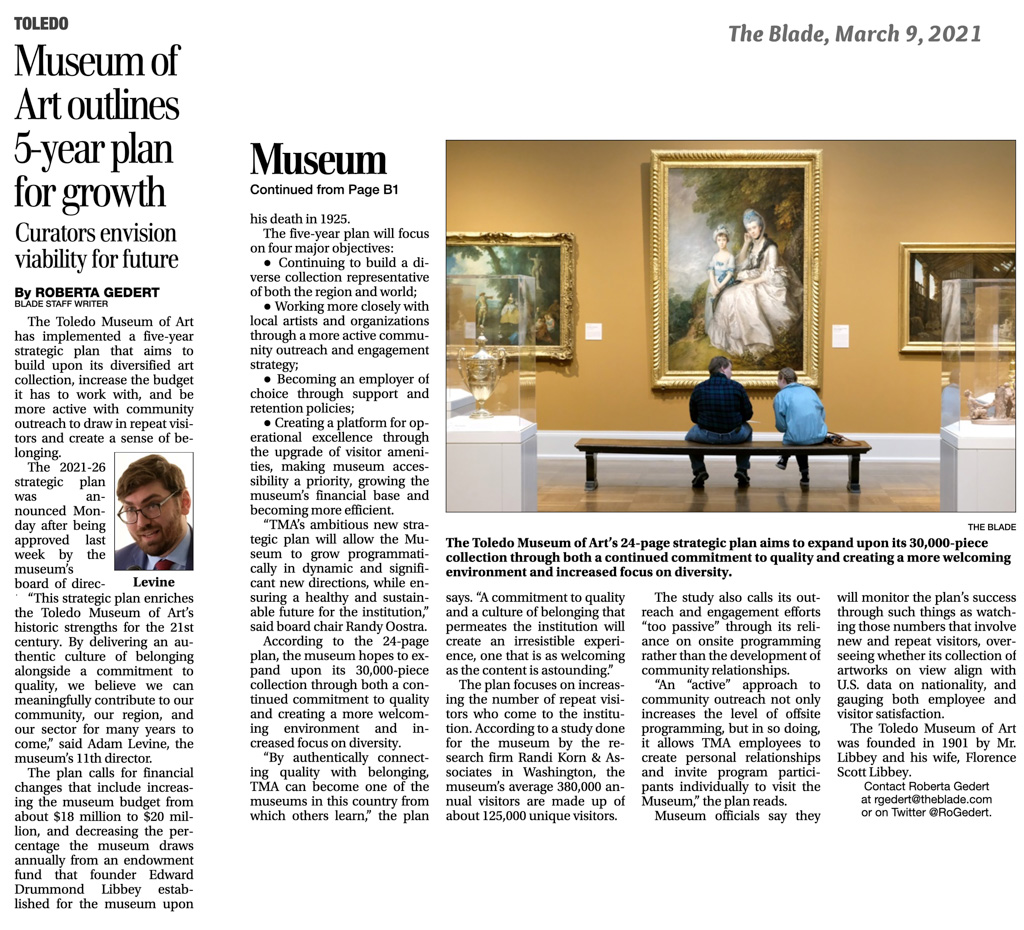
The last paragraph in the above article.
In the spirit of community involvement, I’m compelled to offer some feedback on the recent article in The Blade about the museum’s future. But first a discussion about the last paragraph in the article, “The Toledo Museum of Art was founded in 1901 by Mr. Libbey and his wife, Florence Scott Libbey.” That’s incorrect – The Toledo Museum of Art was founded by a group of artists.
Don’t get me wrong – I don’t mean to say that Libbey was not important in the establishment of the museum – he was by far the chief benefactor in establishing the Toledo Museum of Art. But to say that he and his wife founded it is like throwing the museum’s populist history down the memory hole.
There are many near-contemporaneous accounts of how the Toledo Museum of Art was founded by a group of artists.
This is how Osthaus is described in the Toledo Museum of Art’s own collection:
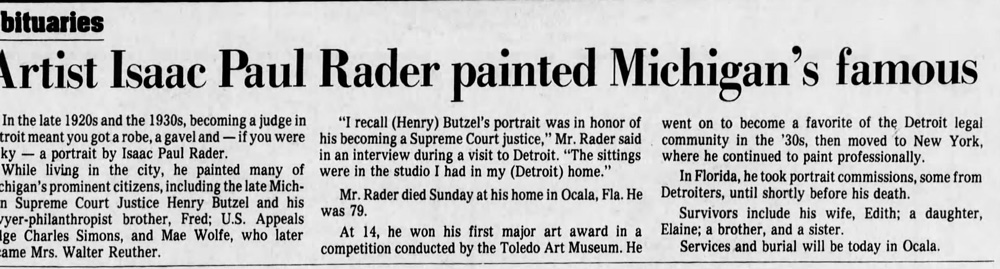
The Blade, October 29, 1926. Obituary of George W. Stevens, the museum’s long-time second director, founding member of the Tile Club, the group of artists responsible for “procuring a museum of Toledo.”
The Blade, September 30, 1922: “Museum Idea Takes Form” In 1893, the painter, Thomas Parkhurst formed the Tile Club, a group consisting of artists and architects in 1893. In 1900 the club had its first exhibition at Parkhurst’s store on Superior St. Out of that event grew a movement. After the exhibition, the group of artists and architects was so enthused and fired up with the idea of establishing a home for art in Toledo that they got together with George Stevens as the leader, and talked art museum day and night. Robinson Locke, son of David R. Locke of Petroleum V. Nasby letters fame, helped through The Blade. Finally, George Stevens, “in an inspired moment” elicited the co-operation of Edward Drummond Libbey, who gave them the use of an old building on Madison Ave. and 12th Street to use for the museum, but they needed money…
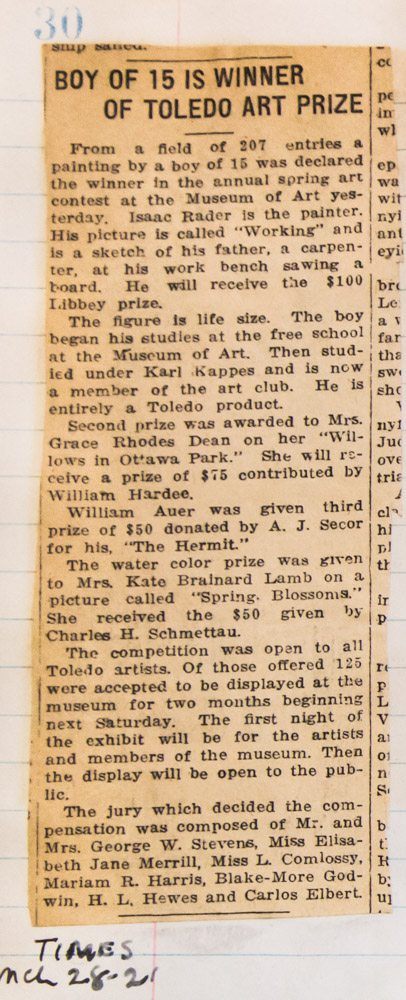
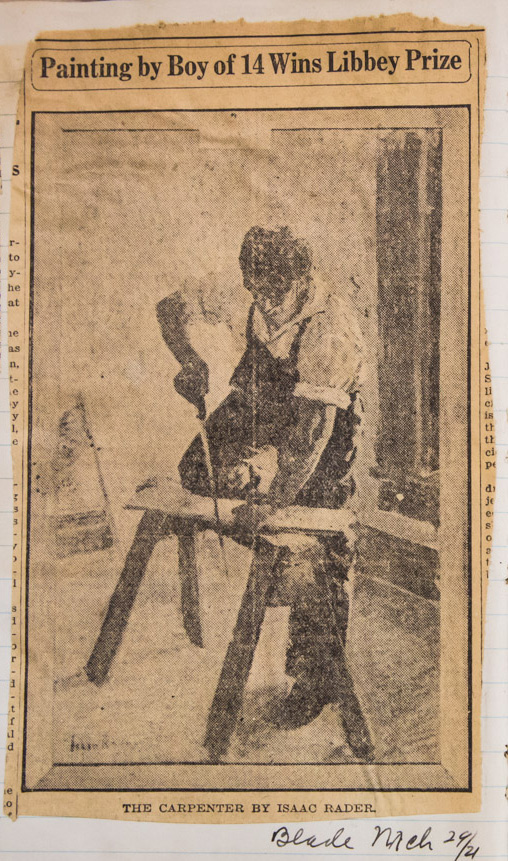
The Blade, March 27, 1923The Blade, March 27, 1923
Edward Drummond Libbey was the biggest benefactor, and he encouraged community involvement because everyone wanted a museum that belonged to the people. Libbey matched donations, and children collected pennies to contribute to the building fund.
The Toledo Museum of Art was always OUR museum….
Nearly all cities of any size in the country have their museums and galleries, which are fast becoming a necessity….We owe it to ourselves, to the school children of Toledo, and to the future generations to see that our good work shall continue, that we lay a foundation so solid and so complete that the future citizens of Toledo will look back upon this, our pioneer work, with praise and appreciation. — Edward Drummond Libbey. First annual report of The Toledo Museum of Art.
By the Seventies, the museum was in high gear: it was a leading teaching museum, providing annually about eight Educational Fellowships, training museum professionals from all over the country, who also helped with the free children’s Saturday classes that drew around 2,000 children per week. The Toledo Museum of Art ranked in the top 10 American art museums for popularity and assets. It was the center of the community art scene, with not only Saturday classes for grade school and high school students, but for its small but superior college art program in the basement of the museum, the Toledo Museum of Art School of Design, which extended to adult classes. That really brought in the community.
The museum also had monthly shows featuring local artists from 1933 to 1970, 540 in total, for both men and women artists. Beginning in 1918 it hosted the annual Toledo Area Artists Exhibition, celebrating the local art community. The museum was alive with community involvement.
The Blade, February 15, 1993
In the 1990’s, the museum’s School of Design and much of the adult education ended when the Frank Gehry building was built, which was connected to the east side of the museum. The University of Toledo’s School of Visual Arts occupies the space, taking over for the museum’s School of Design. The extensive children’s Saturday class program slipped away. The Saturday class program that had served the community for many decades became a sorry shadow of what it used to be.
What have they done to OUR museum?
Brian Kennedy, director of the museum from 2010 to 2019
In 2014, under the new director Brian Kennedy’s watch, the venerable, 95-year old tradition of the Toledo Area Artists Exhibition came to a shameful demise when the Toledo Museum of Art opened the show to entries from Detroit, Cleveland and Columbus, populations nine times the size of the Toledo region, while simultaneously limiting the show to only 27 artists. To add insult to injury, they stuffed it with Toledo Museum of Art insiders, mostly men. Additionally, the show was totally devoid of diversity, the absence of which is not the norm and has never been the norm for our TAA show. See a full account of the 2014 show on this website, in the tag cloud in the footer of this page.
In 2011, Brian Kennedy presented his five-year strategic plan. I remember him saying that if art classes were available at one place in town, they were not necessary in two places because that’s redundant, we should save resources. Kennedy’s “basic principles” projected on the screen contradicted what he was saying there, as would his subsequent actions to what was projected on the screen.
An overhead slide projected at Brian Kennedy’s presentation of his “5-year Strategic Plan.” at the 93rd TAA jury dinner, August 2011.
In 2015, a few months after the 2014 TAA show debacle, I was at the museum attending the senior curator Larry Nichol’s gallery talk about a particular painting we were sitting on front of in the gallery, when at the end, he asked the small group of people before him, mostly age 45 and up, how to bring younger people in. I raised my hand and said, bring your children’s classes back. Bring the TAA show back. Bring the monthly local shows back. He said, “noted.”
What did they expect would happen to attendance at the museum, when they take everything away that enlivened the art community, from classes for children and adults to lending a wall for a local art show?
Yoga on the steps of the museum if you are between 24 and 45. July 2014
The exclusive, discriminatory “Circle 2445” membership effort designed to bring in the museum’s desired younger members was short-lived. The overt ageist discrimination insulted many people.
click on letter to see more…
In other ways too, the Museum became unresponsive to the Toledo community. For example, here’s a story having to do with Toledo’s first artist, William H. Machen, who died in 1911. Over the years, his descendants have approached the museum for advice, once in 1941 and again in 2015 — see the contrast in responses between the third museum director, Blake-More Godwin and the ninth director, Brian Kennedy…
In 2019, Brian Kennedy resigned after only eight years to become the director of the Peabody Essex Museum in Salem, Massachusetts. (Which might be a fine historical museum that is owned by Harvard University, but it doesn’t hold a candle to the great Toledo Museum of Art.)
Now then, back to the subject of this post, a critique of the new 5-year plan as outlined in the above screen-shotted March 9, 2021 Blade article…
the new 5-year strategic plan
to continue to build on its diverse collection... Well that’s good, because Edward Drummond Libbey’s bequest stipulates that half of the money taken from the fund in any given year must go to buying new art.
working more closely with local artists through a more active outreach and engagement strategy… Does this mean they will bring our Toledo Area Artists Exhibition back? Have they forgotten the relationship they used to have with local artists? I hope they will read my blog post, it’s outlined above!
becoming an employer of choice through support and retention policies…Hasn’t the Toledo Museum of Art ALWAYS been an employer of choice? Or are they talking about the museum guards, whom for many years were hired from our community of senior citizens, but about 10 years ago the museum started replacing senior citizens with young people, who just aren’t sticking with the job like the seniors did.
creating a platform for operational excellence through the upgrade of visitor amenities, making museum access a priority, growing the museum’s financial base and becoming more efficient…
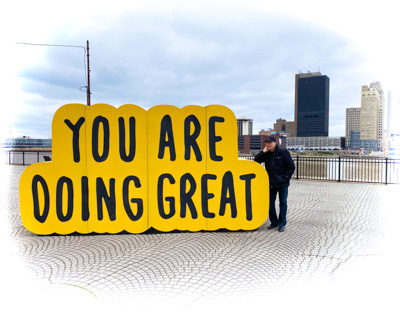
Are we doing great?
Culture of Belonging
and Authentic Integration
of great art and everyday community
As if words, regardless of deeds, will make it so.
That’s exactly what the Toledo Museum of Art used to do. The Toledo Museum of Art didn’t have to try to be authentic — the Museum oozed with authenticity and community involvement. That’s because it was our museum – it belonged to the people of Toledo – it was Edward Drummond Libbey and the artist founders’ intention – funded in part with the pennies of the children who have since become our forefathers.
Will the Toledo Museum of Art bring back our venerable, prestigious Toledo Area Artists Exhibition? Will they bring our classes back? Will the Museum ever be the center of the working artist community again? Or will it continue to be a place for yoga on the front steps for the 24-45 crowd, and “baby and me” looking-at-art classes in the galleries for bored (but sufficiently young) parents?
The artists of Toledo can’t wait to find out.
The last authentic Toledo Area Artists Exhibition, 2013, and the 94th TAA Awards Ceremony at the Peristyle. Brian Kennedy and Amy Gilman handing out awards. The prestigious juried exhibition has launched many young artists’ careers.
The Blade 1999 photo used for James Machen's online news obituary.
James Machen died on November 7, 2020 at the age of 91. Thanks to James Machen, a member of one of the oldest families in Toledo, we have paintings showing how Toledo looked at the very beginning. His great uncle, William H. Machen was Toledo’s earliest known artist, who migrated from Holland to Toledo in 1848. James Machen actively preserved his ancestor’s artwork and history. In doing so, he greatly honored his family, while also greatly honoring his community.
James Machen’s obituary, The Blade, November 11, 2020James Machen and William Machen’s Painting Number 1. April 18, 2010.David and Jim Machen posing next to their ancestor’s painting of the Ten-Mile Creek. February 19, 2012.Jim Machen with his restored rendition of William Machen’s Station No. 4, April 16, 2015.Jim Machen’s William Machen’s restored Station No. 1 in a church in the Philippines, 2018.
Toledo in 1852 by William H. Machen. Gift to the Toledo Lucas County Public Library by James Machen in 1999.Chosen for James Machen’s online Blade news obituary is this very official yet very poignant photo from 1999 of the Toledo Lucas County Library commemorating James Machen and his gift of this painting, Toledo in 1852.
James Machen’s family history going back to the twelfth century:
The authoritative, comprehensive random sampling survey of late-seventies iconic world-of-advertising and subjective definitive targeting, as I knew it, with some art thrown in.
“Some twelve years ago a hundred or more citizens agreed to give ten dollars a year each for the purpose of starting a Toledo Museum of Art. They did not make the mistake of calling themselves club, society or association, but took the name of the thing itself which they wished to create; and so this thing that had no existence other than a name had to be conjured forth into some tangible and visible form. An art association might have existed indefinitely performing its functions admirably without even getting beyond the proportions of an association. However, they had the temerity to christen their hopes by the ambitious title ‘The Toledo Museum of Art’ and it thereupon became incumbent upon them to produce at once a result to justify the name.” Mrs. George Stevens, from a paper read at the Fourth Annual Convention of the American Federation of Arts, held in Washington, D.C. 1913.
excerpts from Nina Spalding Stevens’ book, A Man and a Dream
George Stevens was really the first real director of the museum, although he was the second. His wife, Nina, served as the assistant director. Edward Drummond Libbey was the president of the museum and the main benefactor. They were great friends. In regard to the creation of the museum, they had an interesting synergy as to the way Libbey would teasingly challenge them to the task of raising say $50,000, that he would then double. This went on for 25 years until they died — Libbey in 1925, and George Stevens in 1926. Nina Stevens wrote this memoir in 1939. Before creating the Toledo Museum, George had experience as a circus performer, poet, advertising man, theater manager, opera singer, tourist guide, actor and newspaper columnist. Nina was a writer and artist born in Port Huron, Michigan. Bold, progressive, daring, courageous and outrageous, they epitomized the collective personality and creative force of Toledo.
How George and Nina met, 1902 p. 24
I met George Stevens first in Toledo, where he lived, and I was visiting. He always insisted that I married him, and perhaps after all he was right. I think that I must have fallen immediately in love with him. We talked eagerly through a dinner, and after dinner, when I suddenly felt a distinctly antagonistic atmosphere all about us. I was monopolizing one who belonged to them all. After he had been duly recaptured by them, he sat at the piano and played and sang while they crowded around, joining in the choruses. He sang a tender little love song, looking at me, as I was the guest, and it made my heart turn over. It was a nice sensation, and I liked it. He walked home with me, notwithstanding that I had come with another man, quite as though it were his right, and I liked that too. The next day he arranged his engagements to spend the evening with me. Again we talked, really talked, about our ideals, our ambitions, our writing, for that was what we were both anxious to do. We never attained our goal. It was that desire which brought us together and made us interested in each other but within a year we were to turn whole-heartedly to another work, both of us, and pursue it together for twenty-four years.
George Stevens Manifesto published in the Blade, January 13, 1912.
George Stevens becomes director, 1903 p. 30
The Museum was founded in 1901. The idea of a Museum of Art for Toledo emanated from the Tile Club, a group of artists of whom George was one. He was also one of the one hundred and twenty-six charter members of the Museum and on the Nominating Committee of its Trustees. His direction of the Museum began in 1903, and came about with characteristic unexpectedness.
One afternoon in October of that year, the fifteenth, I see from the records, Charlie Ashley dropped in to our apartment in the Monticello. “I’ve just come from a meeting of the Trustees of the Museum,” he said, “and we have decided to give up the project. Whiting [who was the secretary] has resigned and there seems to be nothing else to do.” After some discussion, in which, as I remember, George expressed deep regret, Charlie said, “If we had a man like you as director perhaps we might make a success of it”.…..”Well, why not?”said George, with not even a glance in my direction. Within twenty-four hours his nomination was proposed to the president, Mr. Libbey, and signed, sealed and settled forever. And that is how George Stevens became the Director of the Toledo Museum of Art.
Florence Scott Libbey and Edward Drummund Libbey in Egypt. Toledo Museum of Art Archives
Libbey’s fundraising proposal to deed the building, 1908 p. 104
In a year of such depression that the Trustees sat and looked at the floor when raising money was mentioned, Mr. Libbey had promised to deed the Madison Avenue property then occupied by the Museum, to the association if George could raise fifty thousand dollars by May, and something had to be done about it. George and Carl Spitzer organized the campaign. The meeting was set for Saturday afternoon, and the Trustees filed out from it as though they had just attended a funeral. There was the possibility that they had, but George would not admit it.
Mr. Newton’s deathbed bequest, 1908 p. 105
We were breakfasting with Mr. Gosline the next morning. Mr. A. L. Spitzer, Carl’s father, was there. George, full of enthusiasm and confidence, outlined his plans, and Mr. Spitzer said, “I will start the campaign by pledging one thousand dollars.” We all danced around in excitement. We had lunch with Carl and Edna Spitzer, and during the luncheon we made a list of all the people we could think of who might give a sou.” There’s old Newton,” said Carl, “who should be interested, but he’s dying.” George and I looked at each other and said “Mr. Hattersley” in unison. “Go and call him up and ask when you can see him.” I flew from the table. “Right away,” was the answer I came back with. I left the luncheon and ran the little car down to his house. He heard me through, about the children, the influence on the town, etc., etc., and said he would talk with Mr. Newton, but as he was waiting to die, and his affairs were all in order, Mr. Hattersley doubted very much if anything could be done about it. That night he called me up to say, “I gave Newton the talk just as you gave it to me. He wants you to come to see him tomorrow afternoon at two o’clock.”
I had never seen death, nor its approach, and always had feared and avoided it, but now something stronger than fear was dominant in me. George was not even sympathetic. “What shall I say?” I asked. “Never worry about what you have to say. The other person will always do the saying and give you your cue.”
I found a solitary old man with a long white beard in a red flannel nightshirt, sitting in a straight-backed yellow oak chair, his feet on the rounds of another chair on which were a pitcher of water, a glass, and a bottle of whiskey, his hands folded over the crook of a cane, his chin on his hands. There he sat awaiting death. The nurse, on our way up the staircase, whispered to me that he had only two more days at most. I sat down, and his large hollow eyes searched my face as he slowly asked me questions which I quietly and with awe answered. Then he handed me a note for five thousand dollars all made out and ready for me, which he said must be discounted at the bank. Before I could express my gratitude to him he said, “Go downstairs and take all the books on art that you can find, besides the pile which the nurse has made. And send this afternoon for my paintings. Goodbye, and thank you for coming.” That was all. He died the next afternoon.
Building fund created, 1908 p. 109
Museums were being built and wanted directors. Several most tempting offers were received by him, but the Toledo Museum had become his child and he would see it through. He believed in its future and would not abandon it. These offers gave him courage, however, at the end of 1907, to make an appeal to Mr. Libbey, the President, and to the Trustees, for a Museum building. He argued that as long as, we occupied a temporary rented building no one felt like making gifts of any great importance, but once in a permanent Museum on our own ground, the rest would come.
Then it was that Mr. Libbey offered to deed to the association the property which the Museum was occupying if George and the Trustees would raise fifty thousand dollars by the first of May, 1908. This was the start, and, as I have already said, in the face of one of the most serious depressions of a quarter of a century, the money was raised, and more, which so pleased Mr. Libbey that instead of giving the old property to the Museum, he doubled this sum and added to his gift the present site of the Toledo Museum of Art. This had been the estate of Mrs. Libbey’s father, Mr. Maurice A. Scott.
The twenty thousand children who had attended the talks at the Museum voluntarily gave pennies to the Museum fund which, when George had made a great mound of them in a downtown bank window, with rather a touching poster, gave us considerable publicity, not only in Toledo, but in the nation, and helped the campaign appreciably.
Stevens’ dues collecting techniques p. 112
The Reinhardt Exhibit and the Roullier Collection, which had become annual events, the Toledo painters, the men and women artists being now combined, the Camera Club Exhibition and some ten other collections which could be paid for with our small funds, required time and management. Yet it had all been accomplished with one secretary, one young woman at the entrance desk who also did the typing, one janitor and an occasional evening’s help of the Woodruffs, who ran an art shop. In the year the secretary had added one hundred new members and George wrote in his Museum News most characteristically:
Since September last we have added just one hundred new members to our list, all good names – men and women who are really interested. We now have over five hundred supporting members eager to pay their dues without making us spend twenty dollars worth of time to find out when we can call again for that ten dollars. On the rolls of every organization, as on the books of every business concern, there is always a goodly percentage of dead-beats, hangers-on, good-for-nothings and professional irresponsibles. With these we no longer have an acquaintance. They have been swiftly and quietly dropped from our rolls. Perhaps they are wondering why our face is seen no more in their land. Well, let them wonder. We are conducting a Museum and not a collection agency. We have’ demonstrated the fact that there are enough loyal, responsible public-spirited citizens in Toledo to support a first-class Museum of Art.
He of course took pains to send this number to all the members whom he had characterized so unflatteringly, with the amusing result that several were insulted into sending their checks. One man wrote him a letter saying, I’m neither a dead-beat, a hanger-on, a good-for-nothing nor a professional irresponsible, but I always delay sending my check until I have received three of your personal follow-up letters, with which I amuse my family and my friends for days. You will receive my check promptly after this.
For some time George and I had gone ourselves, in spare moments, to offices and homes to try to collect back dues. It was a most illuminating psychological study. There were people within the circle of our own acquaintances who felt it their God-given right to take all the advantages of the Museum without paying for them. To handle these cases and not incur their enmity took some tact. They would put us off smilingly, or tell us to come again, or to go and see their wives or husbands. George’s outburst in the Museum News was the result of many of these encounters. Sometimes we said very well, we would report their answers to the Trustees it the meeting which was to take place next day. That usually produced a checkbook. It was a great relief to have Miss Brown, the secretary, take charge of this collecting.
Another campaign for funds (1911) p. 154
Before the new Museum was opened, there had to be still another campaign for funds. The outside of the building was complete, but an additional one hundred and twenty-five thousand dollars was needed for the interior. Mr. Libbey offered twenty-five thousand dollars if George and the Trustees would raise the one hundred thousand. And they did. George’s psychology proved correct. There stood the Museum now on its own ground, concrete evidence of perpetuity. It was no future project, this, but the Toledo Museum of Art in marble and mortar, ready to take its place in the life of the city. While the money did not exactly pour itself into our laps, still it came, this larger sum, much more easily than that first fifty thousand.
President Taft visits the museum, 1912 p. 168
The American Sculpture Society filled the entrance court with interesting works, among them a bust of Wm. H. Taft, who was then President.
While this bust was still on exhibition, the President came to Toledo to make a speech, and at the same time paid a visit to the Museum. George in his wheel chair and black Joe pushing him, Mayor Whitlock, Mr. Secor, the Vice President, Mrs. Secor, and Mrs. Sidney Spitzer, were there to receive him. The entrance to the Museum was lighted up, and Campbell and the guards on the steps awaited the moment of his arrival. The appointed moment came and passed, the guards in their best new uniforms were covered with snow, Campbell swept and re-swept a path to the street, and still we waited. Suddenly a face appeared at one of the windows and announced that the President was down at a back entrance, which was locked and barred. All our efforts had been concentrated on the front. The keys of the back door were in Campbell’s pocket. I, in evening dress, tore down through the snow to find him in the street and together the two of us rushed back into the Museum and down endless stairs and halls and shakily unlocked the bars and doors outside of which the President was waiting. The President smiled blandly but his aide snapped at me, “Do you realize that you have kept the President of the United States waiting fifteen minutes in this storm?” I snapped back, “We did not expect you to bring the President of the United States to the shipping room door.” Whereupon the highest dignitary in the land took my arm and twinkled at me some pleasantry about it being the appropriate place to deposit heavy loads, and we all laughed.
George Stevens meets Blake-More Godwin (1914?) p. 183
One day came a letter from Princeton, from a postgraduate student, setting forth clearly and simply his qualifications for Museum work, a letter so compelling that George sent for the writer to come and discuss the matter. That was Blake-More Godwin.
He arrived unexpectedly just as we were all driving up the river to picnic on the rocks, the Goslines, Carl and Sidney Spitzers, the Bells, the Secors and the Goodbodys, so we took him along. What an introduction he got to his life’s work at the Museum! After supper, which was most successfully delectable in the sunset, when George with his best bass rod was out on a point of rock casting for small-mouthed black bass, and the rest of us were lying about under the high bank that towered above us, none of us giving a thought to the clouds beyond the bank, suddenly, with a crack of thunder, a primeval deluge and night fell upon us. Unable to see a thing, we tried madly to put the picnic dishes back in the various baskets. Some of the fittings, I’m sure, have not found their right places yet. George took down his rod and thrust it at me to carry. Always our first concern was to keep him dry and warm and free from impediments. In the scramble up the bank, we chose what in the dark looked like a path. It developed into a torrent rushing over a clay bottom. When we got back to our house to dry out and finish the evening before a log fire, clay was clinging to our legs up to our knees under our skirts, and before the flames the men’s trousers grew as stiff as pottery. We scraped off what we could from them, gasping with laughter, and became almost hysterical when Blake explained in a gentle drawl that they were “the only pants he had” expecting to have arrived for a business talk and to leave immediately. I think we all took him to our hearts at that moment.
Early the next morning I drove out again from town and recovered all I could of what we had lost, including George’s rod, of whose absence I spoke not a word until it was safely returned. Blake stayed in bed until his clothes were cleaned while George sat beside him and they held the important “conference” for which the young man had come. It was a conference that was to bring to George not only a future efficient Director of the Museum but a dear son in their relationship and a lovely and devoted daughter. When I came back from the picnic ground I was presented to “the new Curator of the Museum.
King Albert’s visit to the museum, 1915 p. 191
George, for the occasion, had put on a suit that had just come home from the presser. In some unaccountable way, due no doubt to the malice so well known in inanimate objects, this suit had come back with a long ravelling hanging down from the back of his coat, like a tail. I noticed it just before the royal party arrived and tried to call his attention to it, but George was so busy talking with Mr. and Mrs. Libbey, or telling people where to stand so as to make the best effect that he paid no attention to me and I could not lure him into the office to remove that ludicrous tail just where a tail ought to be. So picking up the only available scissors near me, some long paper shears, I tried to stalk him from behind and cut it off right there. There was no time to be lost and I took a chance of not being seen. Alas, Mrs. Hineline, the clever writer on the morning Times, of all people did see me, and that homely incident appeared in her account next day of the glory and panoply of the royal visit. She saw an amusing contrast which made us home people very homely indeed.
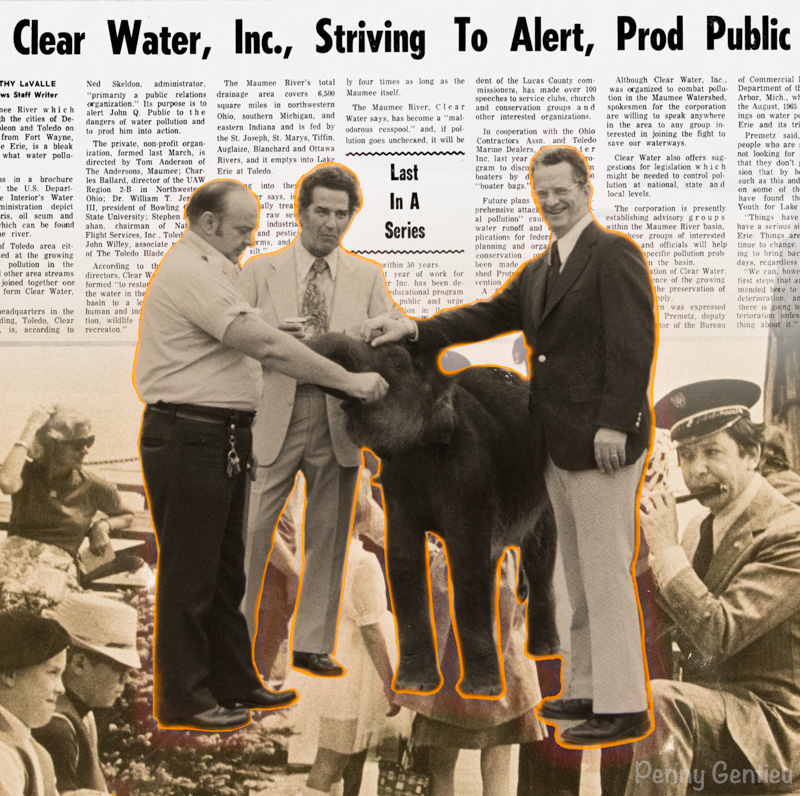
1916 endowment fund campaign and the high cost of stupidity p. 194
The campaign for an endowment fund of six hundred thousand dollars was closed December twenty-sixth, 1916. The full amount was obtained within less than six weeks. Of this Mr. Libbey gave four hundred thousand dollars. In 1917 George announced to the Trustees that the Museum must be doubled in size. “Do you know,” he wrote, “that the high cost of living is not our greatest menace? Will you believe me when I say it is the high cost of stupidity? We know all about how to create spineless cactus, seedless oranges and edible grapefruit, but we are apt to overlook the fact that we could improve the human brain to the same degree and with the same expediency if we so desired. Our education is, or has been, lopsided. Art is a most necessary expedient in our lives which we have overlooked entirely. Art should enter into every human activity, into the making of our homes, and the building of our cities – into every product of the manufacturer, and into every detail of merchandising. Fifty per cent of everything we fashion without the aid of art is money wasted. The laws governing art are well defined and are readily understood by a child. After the brain becomes ossified in the adult, however, it is hard to introduce any new ideas. The plastic mind of the child immediately grasps the principles of color harmony, of composition, of balance, of rhythm and those other and similar elements which create beauty, utility and perfection. By our present rule-of-thumb methods when we have learned to live we are about ready to die. Every month five thousand children visit the Toledo Museum of Art. They come of their own volition. Art is the panacea for most of our ills and must prevail if we are to be a great nation.”
Campaigning Libbey in Paris, 1922 p. 200
George was not feeling very well that summer, and our finances were rather low, what with the trip I was taking, and the death of his mother, but he felt that such a wonderful opportunity to talk to Mr. Libbey about the needs of the Museum must not be neglected. We were their guests, from Paris back to Paris, by way of Burgos, Madrid and Seville, by automobile, then George and I returned to our work in Toledo.
Through it all, George, of course, had lost no time or chance in pressing the subject of the Museum upon Mr. Libbey. Mr. Libbey mischievously countered these maneuvers by asking George to raise another two million dollars on his return to Toledo. Poor George! By this time he had asked so much money from the people of Toledo that he could scarcely look Washington, or Lincoln, or whoever it was at that time on a dollar bill, in the face. He took the thing very much to heart, and was not at all his gay and humorous self. It was a battle of wits between the two men.
Secor donates paintings, 1922 p. 201
That same year Mr. Arthur J. Secor, the Vice President of the Museum, came to George’s office one Sunday afternoon and said, “I watch the procession of people, men, women, children, passing by my house on Sunday, a never ending file up the street to the Museum, and I turn around and look at my collection of paintings and feet selfish. I am giving them all to the Museum tomorrow.” It was a gift that aggregated half a million dollars. I think George almost fainted at this great sudden and unexpected gesture. The whole city rejoiced. Mr. Libbey gave a reception for Mr. and Mrs. Secor at the Museum when the paintings were installed. They were mostly of the Barbizon school, and very fine examples. One of them, a Rousseau, was invited to the great retrospective exhibition of French art at the Paris Exposition of 1937.
Libbey doubles the size of the museum at the cost of $850,000, 1923 p. 204
The great announcement was made in 1923 that Mr. Libbey would himself “double the present unit of the Museum, at an estimated cost of eight hundred and fifty thousand dollars.” This seemed to be the answer to all of George’s life.
Libbey dies and leaves the museum a fortune, 1925 p. 208
Mr. Libbey was the first of the two men to die. He caught a cold and then pneumonia, and his great, kindly and helpful life was over. just as suddenly as that. The whole city went into mourning. Even the public schools were closed. A great part of Mr. Libbey’s fortune was left to the Museum. George’s fears for the future of the institution were stilled. Plans which are not workable after the departure of the originator are not destined for eternity. When the torch is flung far with the certitude of capture by those whose outstretched hands are ready to grasp and carry on for a space, that is success. To march on in a new time, under altered conditions, with fresh conceptions of those ideals, is intelligent loyalty. That George did not live to know the complete fulfillment of his plan has seemed very bitter to me, but sometimes for a moment I see clearly, as one finds suddenly a patch of blue in the shifting clouds, and I know.
Adam Weinberg was a truly great, forward thinking, community oriented Toledo Museum Fellow, presently the Director of the Whitney Museum of American Art. I photographed him in a cornfield in 1979.
Toledo Museum of Art, repair the damage you have done to the community of artists.
In 2010, perhaps when the museum was between directors, the acting director and Amy Gilman of the museum made a proposal to the Federation, that they would get great jurors with their museum connections and make Toledo artists famous. Maybe not in those exact words, but that’s what the Federation heard. Whatever the exact words were, the museum’s “intention” of commandeering the show was to help the community by making a better Toledo Area Artists show by getting more prestigious jurors, an intention reported in The Blade in 2010 and 2011.
The museum judged it themselves the first year, in 2011, saying that they were introducing the new director, Brian Kennedy, to the community. They used a Mellon Fellow and New York artist and writer Joe Fig the second year.
This year, instead of making the show for the community, the museum extended it to cover a population 15 times greater than the population of the Toledo area. They had their Mellon Fellow, Halona Norton-Westbrook, judge it all by herself. She put in only 11 Toledo area artists, including two museum employees, the husband of a museum employee, one former employee with former contentious museum relationship, the two most recent past presidents of the Federation, the group that had charge of the show when the museum took it over in 2011. Hence, most of the Toledo area artists chosen by the museum were insiders. 17 other artists were from other cities.
The population of Greater Detroit alone is five times that of the Toledo metro area. So you can see that a show that was highly competitive in our local area, has become instantly 10-15 times more competitive by adding a 150 mile radius encompassing 4 cities much larger than Toledo, plus several other cities with more advantage than Toledo, such as Ann Arbor and Grand Rapids, Michigan. And why is this good for our community? For countless area artists like my daughter, the odds are they will never have a chance.
Toledo Museum of Art, is it necessary to take our community show away from us to get a grant? Get Fellows at our museum like Adam Weinberg, the current Director of the Whitney Museum of American Art. He was a charismatic, community oriented Fellow, who worked at the Toledo Museum of Art in the late 1970’s. Put someone like Adam Weinberg in charge of the TAA show. Make the jurying process fair again with objective, outside jurors having no connections to the community. Make it professional, and make it for Toledo area artists, because that is the legacy of Edward Drummond Libbey, and that is the legacy of the Toledo Museum of Art.
Break it off completely with the Federation. Most of the artists groups dropped out of the Federation after the museum took over the show in 2011, leaving mainly universities and college groups. It used to be composed of groups of artists, not schools, and we don’t need to debate to know that educational institutions do not serve the interests of individual artists — they serve their own institutional interests, and so these institutions do not deserve a seat at this table.
For the previous 94 years, the Toledo area artists have been good enough to be in their own namesake Toledo Area Artists art show. Look at what you are doing to our community! Respectfully, please understand that even though people may appreciate your leadership, we all know you are not from around here, and it is likely that your time at the Toledo Museum of Art will be temporary. Don’t mess with our traditions as if they have no value. It’s like poisoning our water and then skedaddling.
The Toledo Museum of Art was voted the most beloved museum by its community recently. People today donate to the Toledo Museum of Art believing in a community memory of a community oriented museum. How can the museum literally nurture so many artists within its mission and its history, then just hang us out to dry, replaced by artists from other cities? Our area has so much potential for the growth of the art economy in this area. We don’t mean Cleveland or Detroit or Columbus, we mean Toledo! Yet the museum is communally dumbing us down by taking this great opportunity away from the majority of Toledo area artists and handing it over to anybody else in the 150 mile radius, for what, for a more impressive population “line item” on a grant application?
Toledo area artists have always been good enough for the show for the past 95 years. This year the museum throws us under the bus. For a shallow, very shallow, empty purpose. As if to say we are not as good artists as other artists living 150 miles away. Reconsider saving the Toledo Area Artists Exhibition for Toledo area artists. It’s good for us, and as you know, as the museum made it its motto, “art matters” to us.
Give us another Adam Weinberg. He would never have thrown Toledo artists under the bus.
From The Toledo Museum of Art’s mission statement:
COMMUNITY RELEVANCE: We will be an integral member of our community and will be responsive to issues of community concern and importance, particularly as they relate to the arts.
VALUES: As individuals, we pledge that our relationships with one another and with our audiences will be governed by: Integrity; Respect; Trust; Cooperation; Positive Approach; and Self-Discipline.
Brian Kennedy’s slide presentation of the museum’s mission, at the 2011 TAA Jury Dinner. Artist Craig Fisher and his daughter in foreground.
STRATIGIC OBJECTIVES — Working with artists. Work with us. We are your offspring! The Toledo Museum of Art made us! Aren’t we good enough for The Toledo Museum of Art, Papa?
Another suggestion is to make the gallery off of the Community Gallery for Toledo artists, instead of for babies. Up until 1970, Toledo area artists used to get monthly one-person shows. Now they have a gallery for baby art. Literally. (Toledo Area Lil’ Artists Exhibition — gee thanks, TMA, adding insult to injury.) This nicely lit gallery at the back entrance to the museum. For babies? Seriously, you can do better for us, can’t you, Toledo Museum of Art?
Mary Wolfe and art: “This is what I imagine heaven will be like.”
Mary Wolfe died last Thursday. At 82, she still seemed to be in her prime. What a magnificent woman. She was extraordinarily bright, both in her intellect and aura. She will keep shining through the many gifts she and her husband, Frederic (Fritz), have bestowed upon the community.
She was an art history teacher at Bowling Green State University from 1968 to 1976. She always opened her house to students and artists, said her student Kathy Sobb, an accomplished New York City graphic designer. She then became the exhibitions director of the BGSU McFall Center Gallery through the mid-eighties. Relevant to this website, artistsoftoledo.com, Mary Wolfe showed the work of glass art pioneer Dominick Labino. She also put on the largest exhibition of Edmund H. Osthaus ever assembled. Osthaus (1858—1928), famous for his dog paintings and branding of the Du Pont Powder Company (see my blog post, Edmund H. Osthaus and my giant Pierre Project), was one of the founding artists of the Toledo Museum of Art.
The couple donated $1 million to Wilberforce University for a new administration building in 1993. (Another artistsoftoledo connection: one of the few known paintings by Frederick Douglass Allen and one that I have been trying to track down was of the 1934 president of Wilberforce.)
Mary Wolfe is well-known for the very generous contribution she and Fritz made that started the Wolfe Center for the Arts at BGSU. We can also thank the Wolfes for interesting architecture of the building, since they encouraged BGSU to hire the architecture firm, Snohetta, of Norway. The Wolfe Center opened in December 2011. Six months later, at the Toledo Museum of Art, the Wolfe Gallery for Contemporary Art opened, thanks to the Wolfes’ $2 million donation to the Museum for the renovation of the old glass gallery behind the Egyptian gallery that had not been used for 15 years.
For interesting accounts of the many roles she played throughout her life, see these two tributes to Mary Wolfe that were published shortly after her death by The Blade and Bowling Green State University.
I love the quote that was in the earlier, Blade breaking news report, taken from a 2011 Blade interview in regard to her art patronage. Mary Wolfe said, “It’s made life so much more interesting and wonderful for us. It gives you a great feeling.” How lovely to know this, how the Wolfes felt about art collecting and their kind act of supporting the arts, since what they have given us has truly made the lives of an entire community much more wonderful and interesting and gives us a great feeling.
I am grateful to have known her. She and Fritz came to my daughter, Anna Friemoth’s opening at the Paula Brown Gallery last year and bought her work. It means so much, since I know they have such exquisite and discerning taste in art.
Two years ago, my husband and I were invited to a small studio tour of Austrian LED light artist Erwin Redl, currently living in Bowling Green, with Mary & Fritz Wolfe and two of their three daughters and a mutual friend. Erwin Redl’s studio is in a huge warehouse, divided into several rooms. Erwin creates conceptual light installations for international museums. The experience of the work in each room of his studio tour became progressively grander and more energetic. It was pretty special to be experiencing this tour with the Wolfes and I could see that Mary Wolfe was inspired. Later, her daughter Lisa told me that her mother was absolutely taken by the installations, and especially the last room, that had streams of red lights and blue lights speeding rhythmically from wall to wall close to the ceiling. Mary remarked about the last room, “This is what I imagine heaven will be like!”
I was just getting ready to send Mary Wolfe a card for my upcoming show, Artists of Toledo at the Paula Brown Gallery, that opens November 13. I printed some snapshots from that night at Erwin’s, together with a note. I had them out on my table waiting to find the right sized envelope when I read the Blade report that she died. I had just been with Lisa two days before at Bowling Green State University and later I sat in the theatre in the Wolfe Art Center for a scholarly talk on animal vision. It was a celebrated event and the audience included many VIPs but Mary Wolfe wasn’t there as I thought she might have been. She had a stroke that evening and died the next day, surrounded by loved ones.
Our prayers go out to Mary’s family, her many friends, and to our entire community. We lost someone pretty wonderful. We will always remember her because she brought so much art to life.
The Toledo Area Artists Exhibition is the oldest regional art competition affiliated with a museum in the United States. It gives the art community a great sense of pride to compete and get into the prestigious museum show, featuring and celebrating the talents of Northwest Ohio and Southeast Michigan. It’s 95 years old. This year, only 11 Toledo area artists are in it! So are 17 artists from cities far away from Toledo, such as Akron, Cleveland, Columbus, Grand Rapids, MI, and even Muncie Indiana. These cities have their own thriving art communities. The show is not a true area artists show this year and has no right to the name. It’s important to keep our local traditions for the same reason that it’s important to drink clean water. If that doesn’t make sense, then here are just three examples, out of hundreds, to show why the Toledo Area Artists Exhibition is important and relevant to our own local and regional art community — Edith Franklin, Leslie Adams, and Anna Friemoth.
Where would Edith Franklin be in our hearts if it wasn’t for the Toledo Museum of Art? We may have known her, but not nearly as well. She attended the children’s classes at the Museum from about age 10, so for 80 years, the museum contributed greatly to her life, and she in turn contributed greatly to the museum. In addition to the Saturday children’s classes, she continued her education at the Toledo Museum of Art School of Design for another 40 years, from 1945-1986. She took part in the historic Glass Workshop in 1962, participating in the very beginnings of the American Studio Glass Movement, and she even walked the runway in the 50th anniversary, 2012 Glass Fashion Show, just two months before she died.
The Toledo Museum of Art gave Edith Franklin a one-person show when she was 35. As for the Toledo Area Artists Exhibition, Edith Franklin was in 26 out of 29 consecutive shows from 1953 to 1982, winning First Award, Craft Club Award, and the Federation Purchase Award. She was a founder of the Toledo Potters Guild in 1951, board member of the Arts Commission, and earned the Lifetime Achievement Award from the Toledo Federation of Art Societies in 1999. She passed away in August 2012, having donated the Edith Franklin Pottery Scholarship to young potters, among other philanthropies. Brian Kennedy, Director of the Museum, gave a eulogy at her memorial service. He said she would often tell him that she was from Toledo, born and bred. Edith Franklin cared about her legacy. I helped her organize her papers that she donated to the Ward M. Canaday Center for Special Collections. She rewarded me well with a special pottery piece.
Leslie Adams, of Toledo, was born about 45 years after Edith Franklin, and like Edith, benefited from the Toledo Area Artists Exhibition. Leslie is a successful artist who got her start as a child student at the Toledo Museum of Art, a prodigy student of Toledo’s legendary drawing teacher and artist, Diana Attie. Leslie received her BFA from The University of Toledo for classes at the Toledo Museum of Art School of Design. She was in 11 Toledo Area Artists Exhibition shows from 1993 to 2011, and won eight awards, from First, Second and Third awards to the Athena Art Society Award in honor of Virginia Stranahan, the Molly Morpeth Canaday Award, and the National League of American Penwomen NW Ohio Branch-Carolyn Goforth, In Memoriam award. In 2011 she won the highest honor given at the Toledo Area Artists Exhibition in 93 years – the Toledo Area Artists Solo Exhibition Award, a one-man show at the Toledo Museum of Art. (It was new award the museum promised to present every two years. Leslie Adams was the first and only.) There is no doubt that the TAA show, and the awards received in the TAA show, helped Adams with her successful career. (Incidentally, Leslie Adams is a former president of the Federation, the group that gave up control of the TAA to the museum.)
Then there’s my daughter, Anna Friemoth, a 2012 graduate of Maryland Institute College of Art in Photography, who entered the 94thToledo Area Artists Exhibition last year and won a prize. Her piece was sold at the TAA preview show. It also appeared in the Blade. Peter and Paula Brown called her the day it was in the Blade and invited her to have a one-person show in their gallery, the Paula Brown Gallery, in downtown Toledo. The Browns bought the photo at the preview show. Anna’s one-person show at the Paula Brown Gallery was a commercial success and Anna was able to launch her career. It was an amazing opportunity for Anna to be in the Toledo Area Artists Exhibition. She gained much great career advantage because of the success she obtained as a result of being in the TAA show. 39 Toledo area women were in that TAA show, which was just last year; this year’s show has only TWO Toledo area women.
The opportunity my daughter had is what all artists in our community need and deserve. We have a very large art community – in addition to dozens of clubs and ateliers, there are at least 10 colleges and universities in our 17-county region of Northwest Ohio and Southeast Michigan that teach art. What are artists to do when they graduate? Toledo Museum of Art has cut them out of this 95-year old prestigious museum show, a show that was meant for them and takes place in their own community. The show is called Toledo Area Artists Exhibition for a reason. It’s because the show is for Toledo area artists, to help them show their work. That’s why it was started, in 1917, and that’s what it has done for 95 years. The Toledo Museum of Art helps artists to be better artists by giving prominent local artists solo-shows and by hosting the 95-year-old annual juried area artists show. In return, Toledo area artists contribute to the continuum that is Toledo’s distinctive local cultural history, that is us and can only be us. In return, yet again, that makes our region better for everybody living here.
This is where we live, these are our cultural, our genetic and our geographic connections, and they are as important to us as that big great lake, Lake Erie, from which we have to drink our water every day.
Photo by Steve Coffin of John Botts and his Big Peony painting. Corte Madera, California
This photo came today in my email — a photo of John Botts, my painting teacher at the Toledo Museum of Art School of Design. Wow. I owe so much to John Botts — he made me see what I really was, which is a photographer. When he saw the first photographs I took, he gave me a book — the first edition of Robert Frank’s book, The Americans.
It is probably fair to say that the Toledo Area Artists Exhibition this year is the most controversial Toledo Area Artists Exhibition there has ever been, and not for the art either, because we don’t get to see the art until November. The show is controversial this year because of the circumstances created by the Toledo Museum of Art and the questionable decisions that the museum has made that put the show and the museum in a bad light even before it opens.
excerpts from the press release about the 95th Toledo Area Artists Exhibition on Toledo Museum of Art website
Were they really? Pleased with our region? Doesn’t seem so.
Out of all those entries that they looked at — 4,175 images, 44 videos, and two audio entries, the museum curator in-house judges could barely find any Toledo artists for the show who didn’t work at the museum, or weren’t friends of theirs, etc. or weren’t the most recent presidents of the Federation of Toledo Art Societies, the group that was formed in 1918 to put on this show, to put in the show.
And then the curators had to go beyond the Toledo area to fill it in with out-of-town artists from Akron, Cleveland, Columbus, Detroit, Grand Rapids Michigan, Muncie Indiana. Our Toledo Area Artists Exhibition.
We have so many artists in the Toledo area, yet in a show that has only 28 artists this year, cut down from a show that had 76 artists last year, a show that historically ranges anywhere from 70 to 120 artists — of 90% real Toledo area artists, the museum this year has to go 150 miles out in all directions to pick out 17 artists who live outside of the 17 counties that comprise the Toledo area – the 15 counties of NW Ohio and the two bordering counties in SE Michigan?
Then, with our show taken over by metropolitan areas that are not our own, over half of the meager remaining 11 artists chosen actually from this area, from all the 4,175 images that they got to select from, are artists within the “Museum nucleus?”
Is that okay with you?
Do we really have to drink this water?
o
Is it fair that 435 artists paid $30 each thinking that they were entering a fair competition (435 x $30 = $13,050) when they never had a chance because the museum judged it and got to put in their employees and friends, then fill it up with a pick of artists in big metropolitan areas not our Toledo area, that the museum has the audacity to call the 95th Toledo Area Artists Exhibition?
The reason why the annual TAA show started using outside jurors after eight years into their history was so that the show could be judged fairly and without conflicts of interest.
So this year, 2014, for the 95th annual show, why did museum staff members make themselves the jurors of the 95th Annual Toledo Area Artists Exhibition? Was it so they could unfairly get to pick fellow museum employees and friends, for some unknown reason, or maybe it was because they got Christopher Knight to be the money judge and they wanted to make themselves look good?
How does that make you feel, big vibrant Toledo art community? Are you ready to trade in your chance at entering the TAA show every year, along with the chance of winning and getting recognition for your creativity at the great white marble pillared Toledo Museum of Art, for the condescendingly concurrent series of workshops run by the Federation to teach you how you can be more professional like those “full time” “professional” artists who are supposedly so much better than you, that are showing in your place, in your TAA show?
This show belongs to us, the Toledoans, to help “us all” be better artists, as well as, in return, for “all us” artists to contribute to and continue the artistic cultural history of Toledo that is and can only be us. And why don’t we clean up our water too.
Please keep the Toledo Area Artists Exhibition at the Toledo Museum of Art and for the Toledo area artists. It’s our legacy and it belongs to us. It’s our tradition.
o
The Toledo Area Artists Exhibition for Toledo area artists is the oldest regional art competition affiliated with a museum in the United States. It gives the art community a great sense of pride to compete and get in to the prestigious museum show, that features and celebrates the talents of Northwest Ohio and Southeast Michigan. It’s 95 years old. Must it go so soon, so young in European terms, just a baby in comparison.
Herral Long, beloved long-time Blade photographer passed away on Saturday, June 14.
He photographed every United States president since Dwight D. Eisenhower, as well as day-to-day newsworthy events in Toledo for six decades. He was forever curious and experimental as a photographer and often said that taking a great picture was like catching a butterfly.
He was an award winning photographer and named Ohio News Photographers Association’s first Photographer of the Year in 1967.
He was a free spirit and founding member of Joyce Perrin’s Any Wednesday, a gathering place for poets, artists and musicians, a Toledo art scene tradition which has been going on since 1964.
He played a dulcimer and wrote songs for his wife, Marcy, who had Alzheimer’s disease, believing that one’s sense of hearing is the last to go.
He began photographing for the Blade in 1949 and retired in 2009. Herral Long arranged the timing of his retirement so that The Blade would have to keep on a recently-hired photographer, Amy Voigt, whose position was about to be eliminated. Herral felt that she was very talented and by his stepping down, it would give her an opportunity.
In a 1969 Toledo Museum of Art Catalog for a show he was in, it is reported that he was interested in mountain climbing, sailing, photography, palm reading.
He was a wonderful, charming person and friend to all.
Marguerite Michaels is an awesome supporter of the arts. I met her a few years ago at Marcia Derse’s Christmas sale. She told me she had recently bought one of my Confabulations photos at the Hudson Gallery. It was the one of two women on the sidewalk. At Marcia’s, she bought my abandoned church photo from my Still Standing series — maybe it reminded her of the time that she almost became a nun (she went through everything but the final vows.) Later, she bought my Woolworth’s photo and an artist book I made of my mother, Audrey Gentieu’s movie star pastel portraits. She took great pleasure in building her art collection, which went gangbusters during the “great recession.” She bought a ton of local art, and I for one really appreciate her for that.
Marguerite is a strong and brilliant woman. After realizing that becoming a nun was not her calling, she moved to New York, where she worked for Time Magazine as a journalist, and eventually became the Bureau Chief in Nairobi. Living in Africa, Marguerite became well-versed in African Art and collected it. She came back to Toledo around 10 years ago, for the same reason that brings many of us back — to help family. She immersed herself in collecting all kinds of art, and she brought contemporary African art to Toledo. In October 2013, Marguerite helped curate and sponsor an African Art exhibition at the Hudson Gallery. This photo above is Marguerite with artist Tunde Odunlade at the show.
Marguerite is bold and courageous. For all the things she has done in her life, she has utilized her fullest heart and soul. She has now decided that, for whatever personal reasons, she did not need any of her collections in her life anymore and is selling everything. Just like that. No regrets, no emotion holding her back from her mission. Her latest chapter as a collector has abruptly come to an end. Her estate sale, which includes the entire contents of her house, is taking place every day this Easter week, culminating on Saturday. Her collection of Toledo artists is an eclectic snapshot of contemporary local art — work by Mr. Atomic, Willis Willis, Dave Wisnieski, Jan Dyer, Scott Hudson, Jay Bumbaugh, Lana Pendleton Hall, Richard Reed, Karl Mullens, Annie Crouter, Skot Horn, Paige Koosed, Bob Beach, Dominic Labino, Baker O’Brien, Ann Tubbs and yours truly.