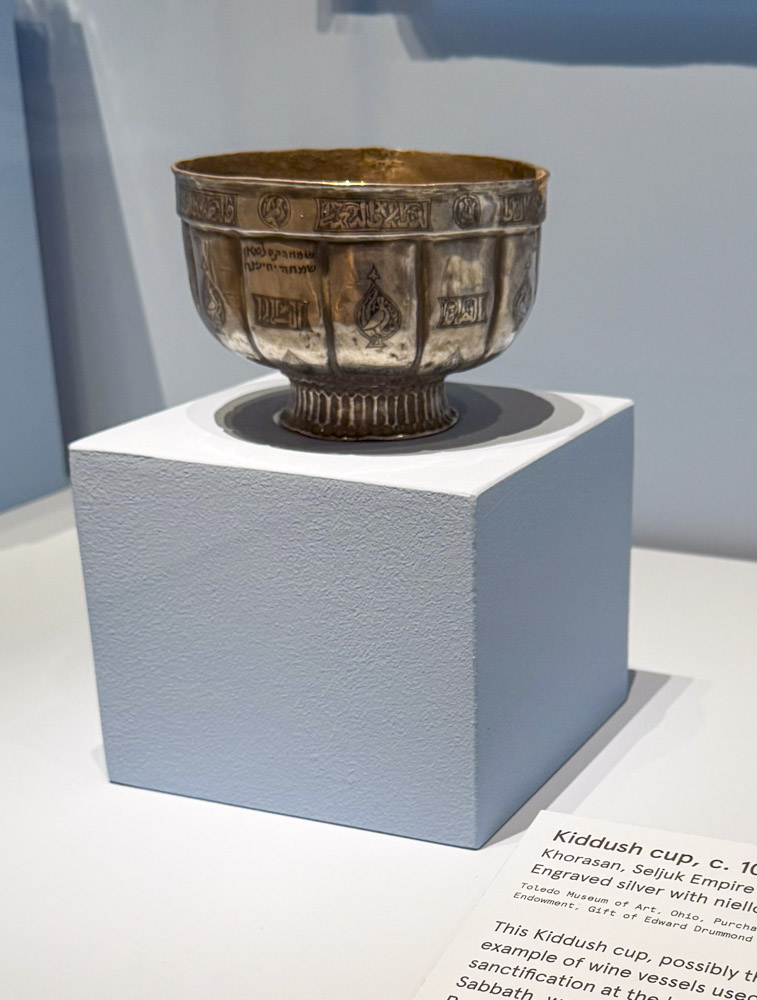
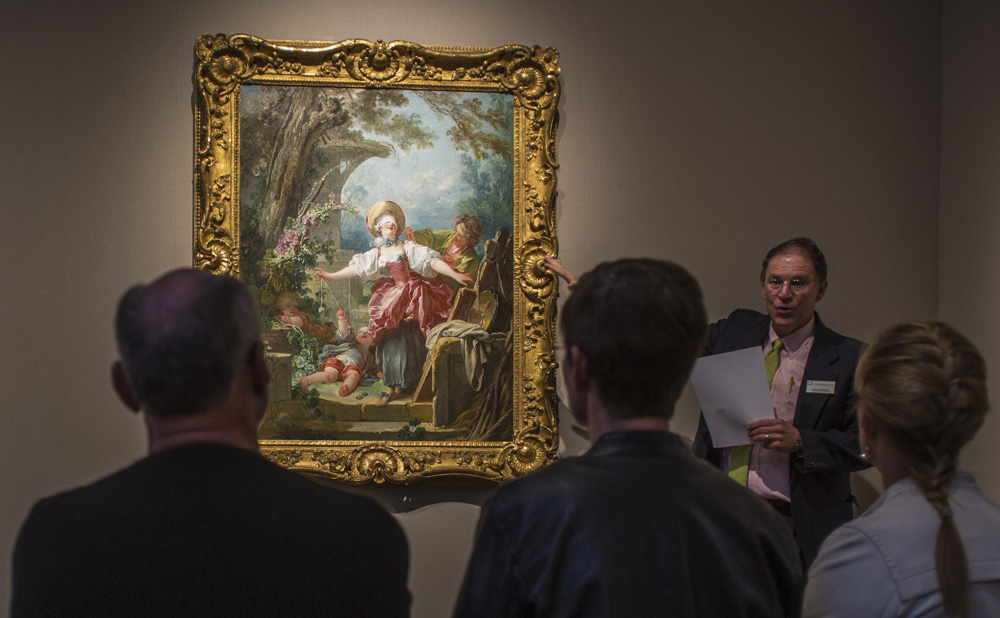
Toledo bought “The Cup of Joy;” Toledo bought the story.
$4 million hammer price shattered auction records
Toledo Museum of Art bought it and immediately lent it to the Jewish Museum in New York for long term display in their just-renovated museum.
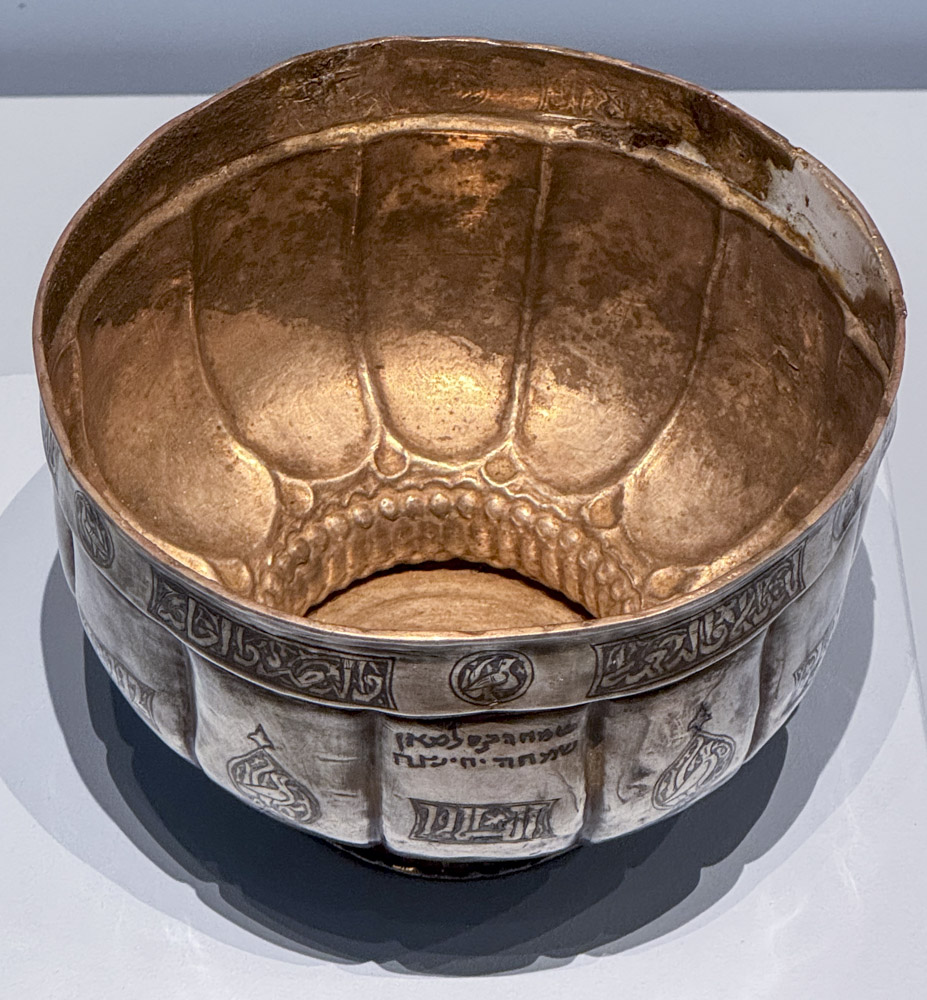
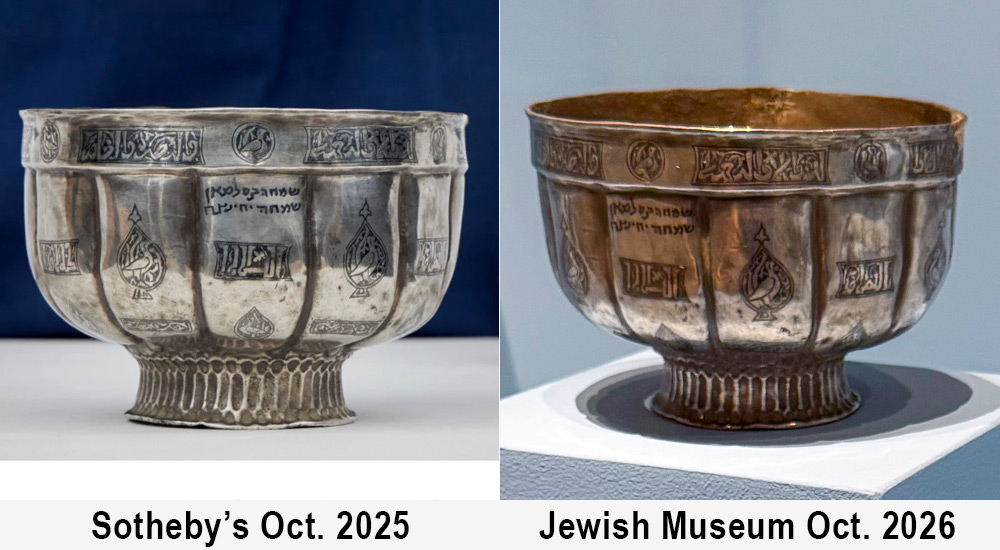
But what happened to the cup after it went on display to make it so yellow?
If it was a natural patina, it would have photographed that way in the marketing photos. Is it a thin tarnish layer, yet so evenly a brassy yellow-gold especially on the inside of the bowl? Is it the interaction of the silver with its environment, a brand new freshly painted display case in the newly renovated fourth floor of the museum? One thing is clear, it’s definitely not the lighting.
For four million dollars, the public has a right to know.
One lump, or two? the price of the kiddush cup is actually worth two of the Professional Building, apparently.
Now in the collection of the Toledo Museum of Art, Toledo is shown only one photo of the ancient kiddush cup — the Sotheby’s photo, misrepresenting the condition it is in today, one year after the purchase. For an ancient, fragile little cup having such a big price tag – $4M – more than the museum’s usual entire annual art budget – and two times as much as what it got for the Professional Building, why isn’t it on display for Toledoans in the Glass Pavilion? It doesn’t take up much room, after all, and it’s considered such a prized possession.
Adam Levine bought the story and took it on the road.
He got plenty of national press for the $4M hammer price. That helps him – but does it help the people of Toledo, for whom Edward Drummond Libbey, whose funds were used for the cup, funded this art, and intended the art to be on display in the Toledo Museum of Art?
The first paragraph of his March 26, 2023 editorial, an insight into the mindset of Adam Levine?
Who needs the cup when $4 million gets you the story?
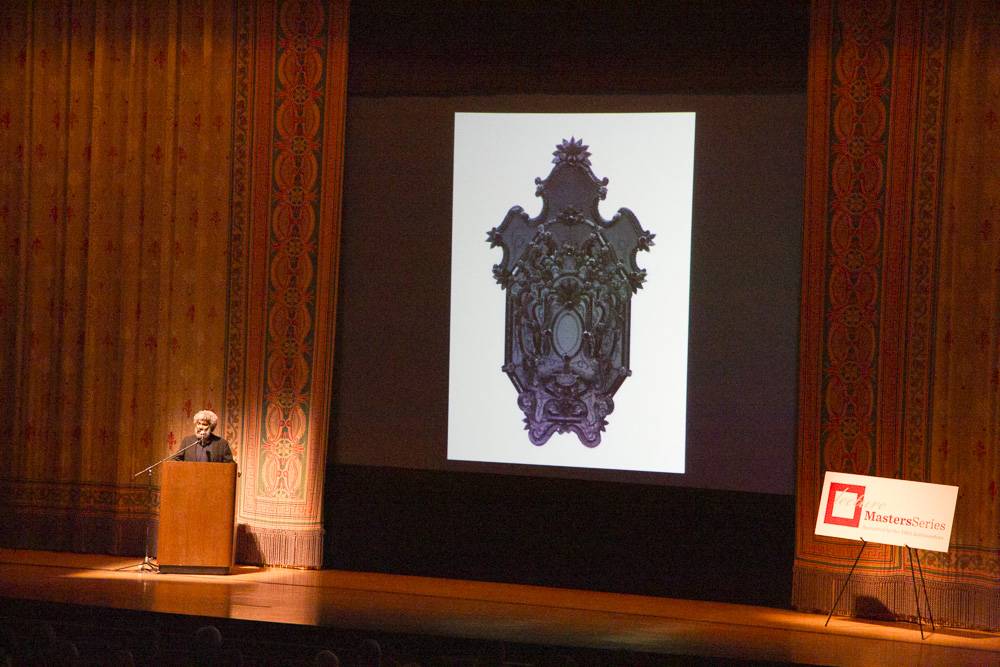
On April 19, Adam Levine didn’t show the actual cup when telling the story of the cup to Toledoans.
On October 27, one week before a contentious senatorial election, he will be telling the story of the cup at a university north of Detroit. Is he using Toledo’s new acquisition to influence an election?
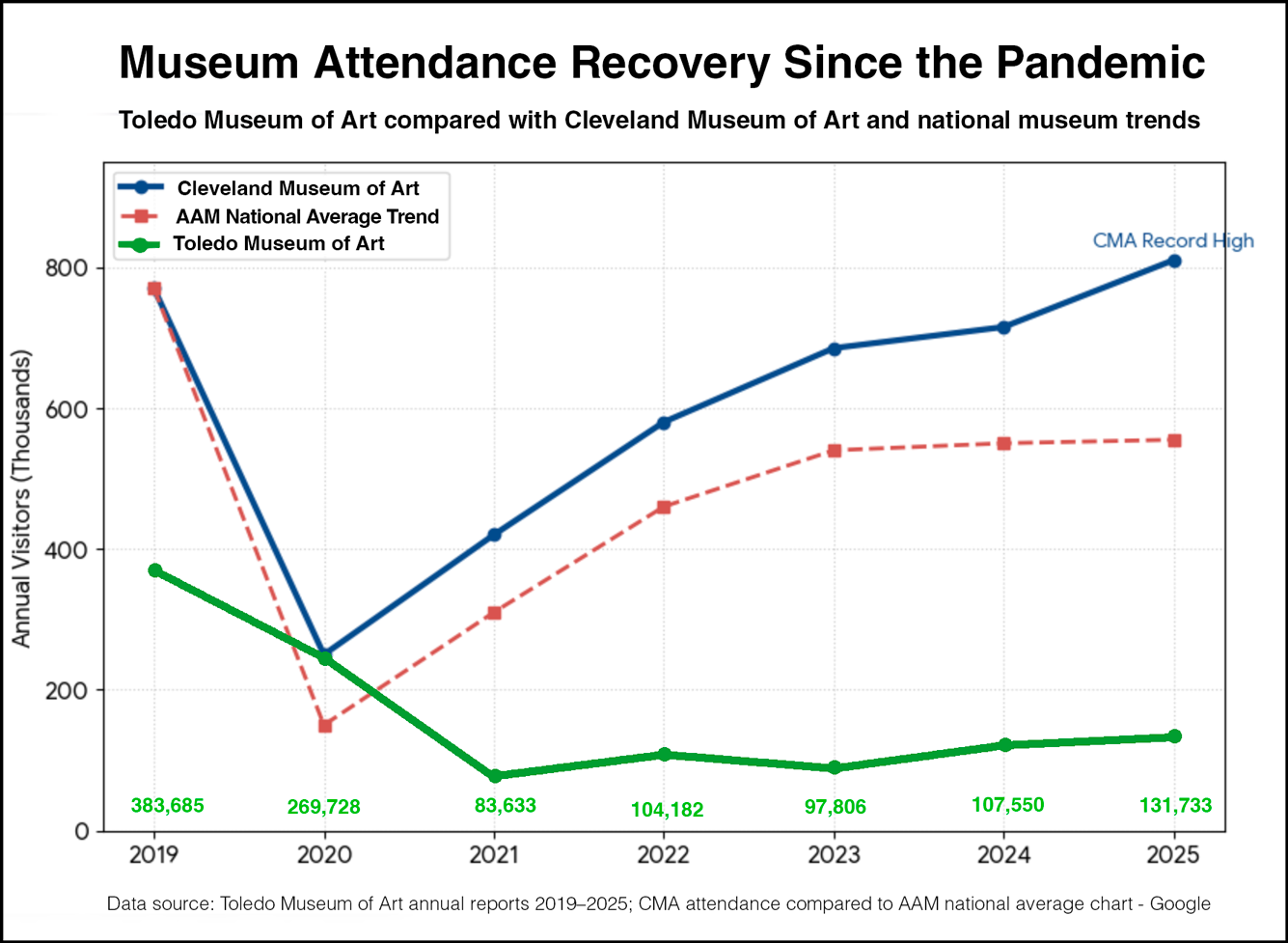
On December 7, Adam Levine will be giving a talk at the Jewish Museum with the director, James S. Snyder, tickets are $24.“Since assuming directorship in 2020, Dr. Levine has led the museum through a period of significant growth…” Oh really, when the attendance never recovered after the pandemic and now the entire main building of the museum is pretty much closed, for years, to fix the HVAC and reinstall the art? Great art has been sold, and the renovated museum will have less gallery space, with no additional storage, on a smaller campus, since the Professional Building was sold last year for $2 million.
Financial growth decoupled from public engagement and exhibition output – a disconnect between visitors and revenue — and Levine is lauded by that being called significant growth! The museum campus is made smaller, art is loaned and sent on world tours for years, and meanwhile an entire generation in Toledo is growing up without the benefit of the only art museum within 50 miles.
Compared to the Jewish Museum, the Toledo Museum is about the same size, same budget, same number of objects, but the similarities stop there. One difference is that the Jewish Museum managed to completely renovate and reinstall two floors while still remaining open to the public on the other two floors, and they did it for $15 million — they are transparent about it – unlike Toledo. Closing the museum in spite of the public trust, and Adam Levine refuses to answer the question that the public has a right to know: How much is the renovation costing?
Who benefits from the way this charitable asset is being used, and where is the Toledo public’s benefit in the arrangement?
To recap:
TMA spends $4 million acquiring a major object.
The object is not exhibited in Toledo; it is loaned to a prominent New York museum. The TMA director is invited to New York to speak about it. The program’s description prominently markets his credentials and his tenure at TMA, but not how great the museum itself is. The object becomes a vehicle for discussing Adam Levine’s leadership and his transformation of our beloved museum.
What public benefit does TMA receive from this particular disposition of a $4 million acquisition, and what was the basis for deciding that the object should be loaned immediately to an institution outside Toledo rather than first being exhibited to the Toledo community?
Levine is scheduled to discuss the “Cup of Joy” in Michigan immediately before the November 3, 2026 U.S. Senate election, in a state where the election has received national attention because Democratic nominee Abdul El-Sayed could become the first Muslim U.S. senator.
It makes you wonder whether this new acquisition advances the Museum’s public and institutional purposes, or does it primarily provide substantial professional and reputational benefit to its director? The circumstances warrant examination because the $4 million acquisition was not initially made available to the Toledo public, was instead placed on loan outside Toledo, and now is serving as the subject of a high-profile program in which the Museum’s director is the featured speaker and his personal leadership biography is prominently presented.
Is TMA is operating its charitable assets primarily in accordance with its public obligations, or according to the interests and ambitions of Adam Levine?
And what’s up with the color?
They spent $4 million of Edward Drummond Libbey’s money to acquire this object that has an actual appearance quite different than the image used to represent it to the public. That, and the museum has not put the cup on view in Toledo. Does the museum know why the silver surface looks the way it does?
What is the relationship between the acquisition, the immediate loan to the Jewish Museum, and the promotional/public relations use of the object?
The museum is promoting an image of the acquisition that does not correspond to the object as it is actually experienced by visitors. There is no apparent public explanation of this discrepancy.
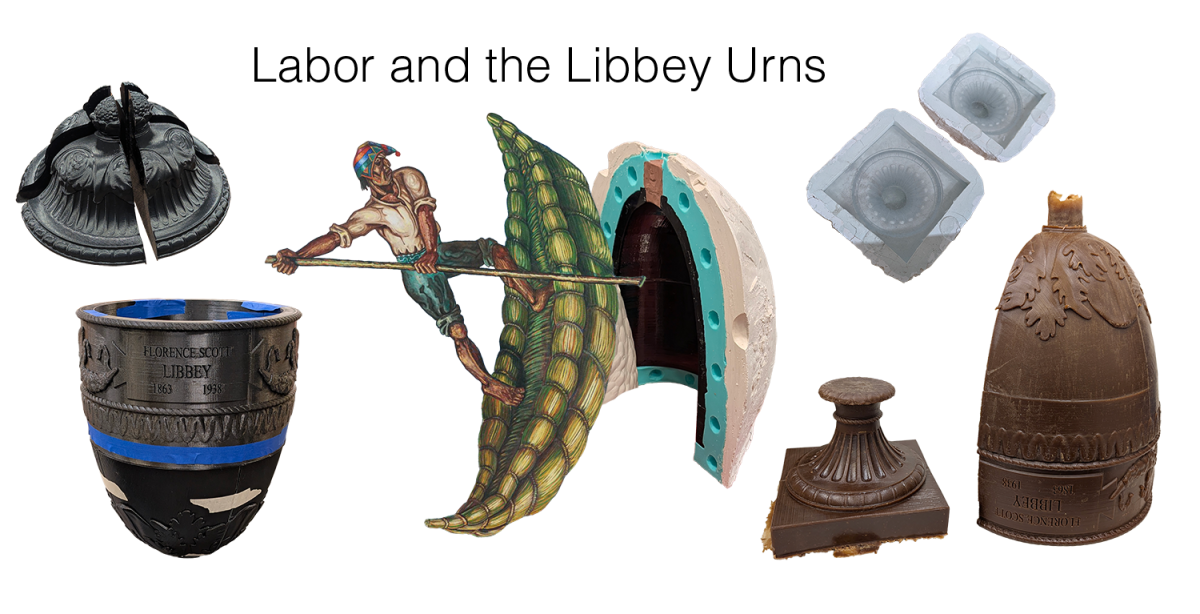
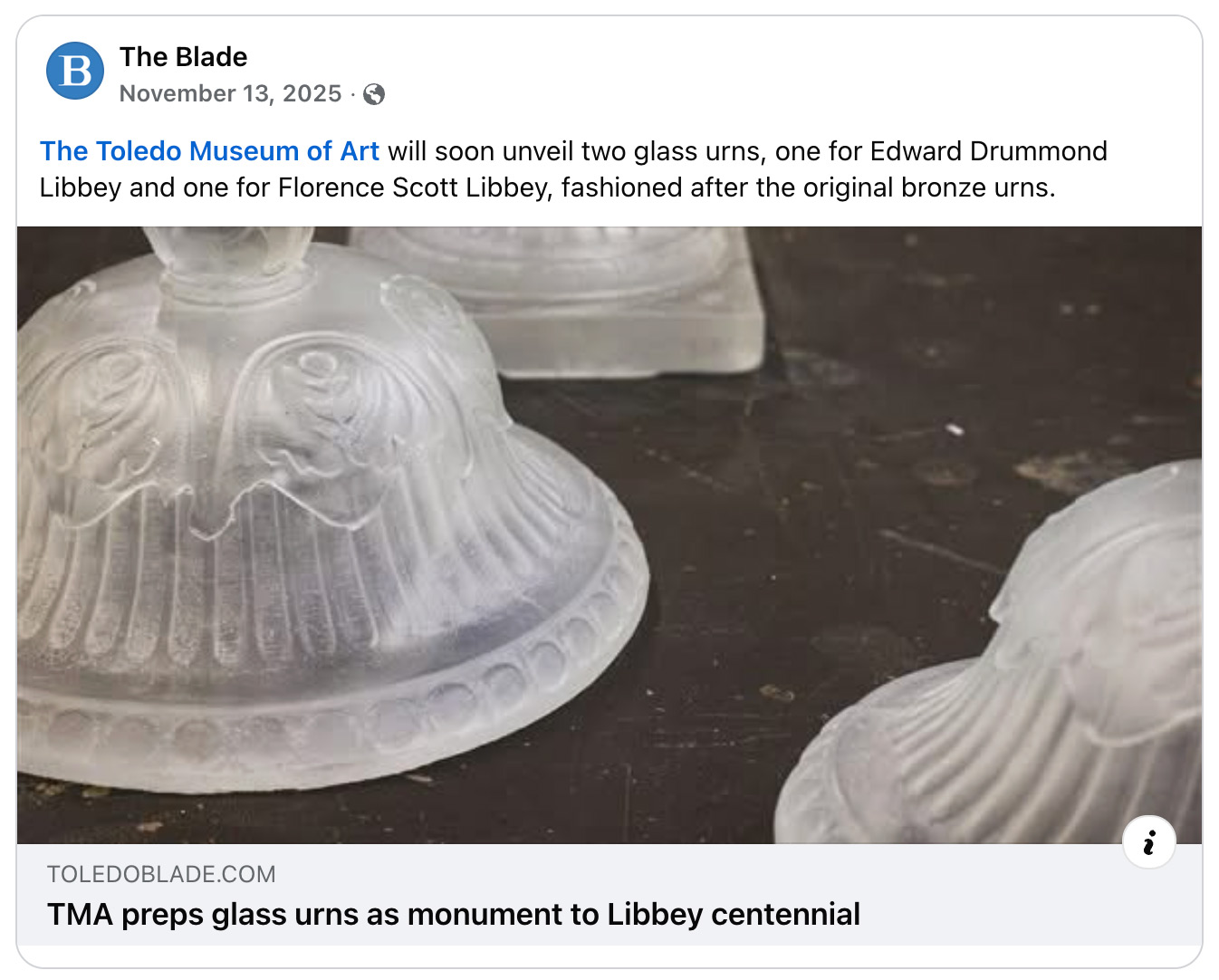
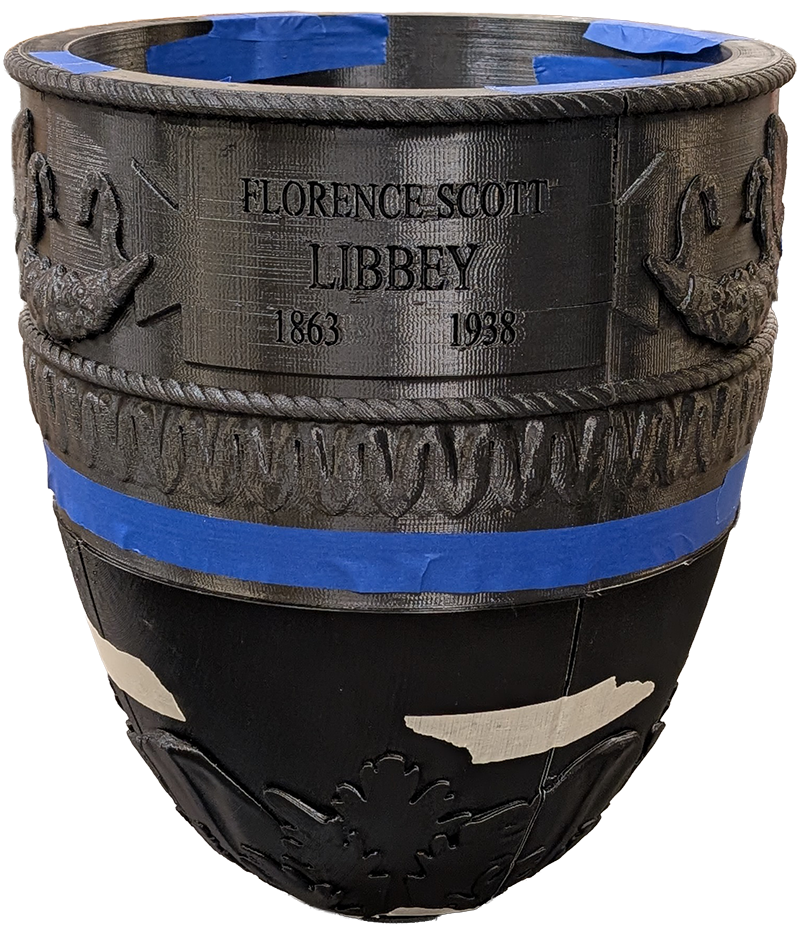
Hanging in the air are the uncompleted glass urns for the Libbey monument at Woodlawn.
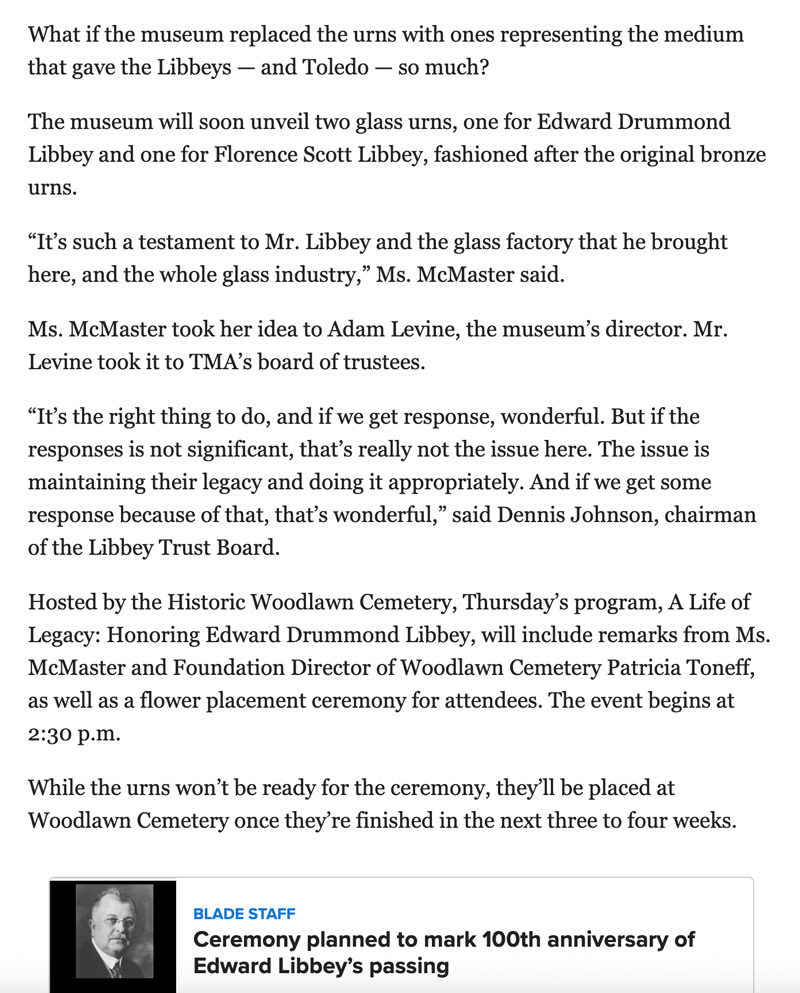
Because of labor trouble, the museum couldn’t get the honorary glass urns finished by November 13, 2025 for the centennial ceremony of Edward Drummond Libbey’s passing.
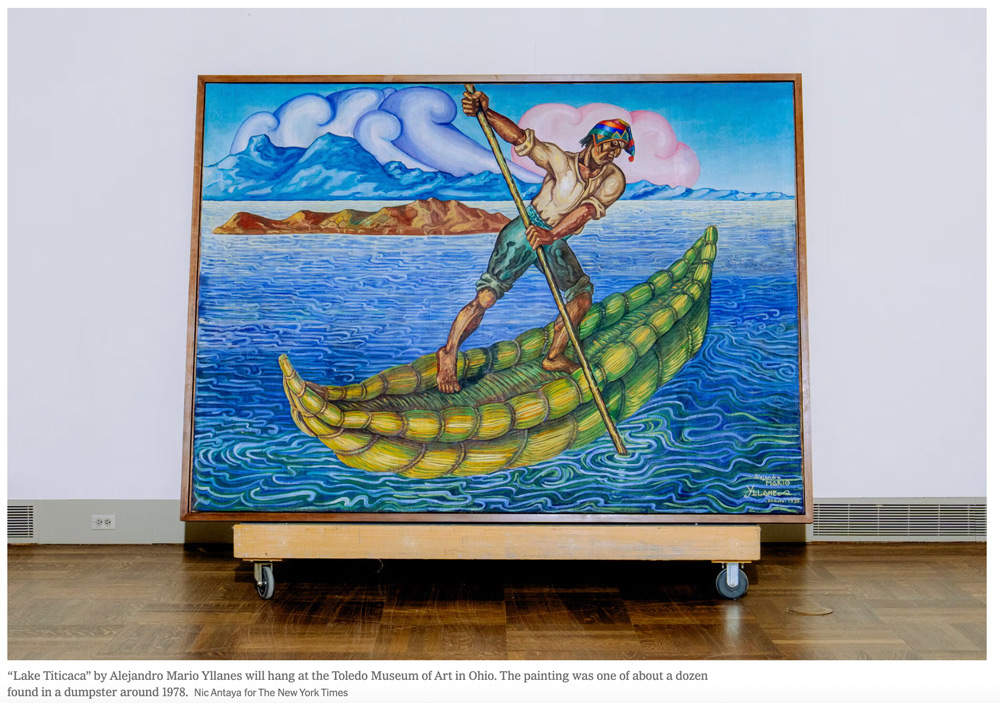
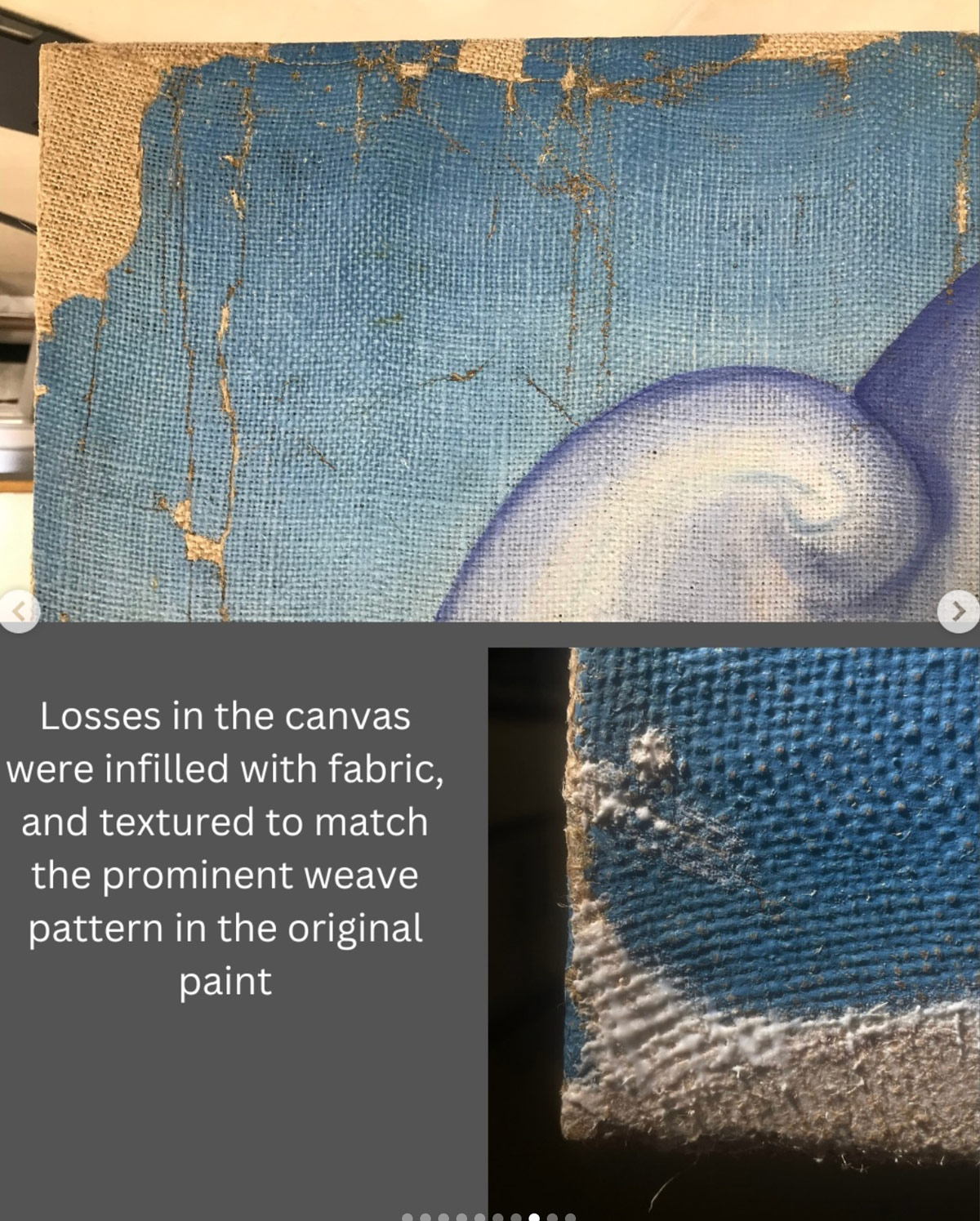
but they purchase a painting in terrible condition, because the subject is a Bolivian workers rights artist – the irony. The hypocrisy!
The irony and hypocrisy, when the museum treats their employees so badly after they joined the union. And the guards, when they tried to form a union, were fired, just to be offered the same job through a third party agency, without benefits.
“Yllanes’s works often exposed the harsh mistreatment to which Bolivia’s Indigenous communities were regularly subjected.” The Enigmatic Bolivian Artist Who Centered Indigenous Workers’ Rights, Hyperallergic, February 6, 2024
Photographed at the Toledo Museum of Art for the New York Times September 22, 2026 news story, This Forgotten Artist’s ‘Extraordinary’ Work Was Saved From a Dumpster, even though the museum closed because the HVAC system had to be replaced and walls were being taken down to the studs and all the paintings had to be sent away to be put in storage or loaned internationally or nationally.
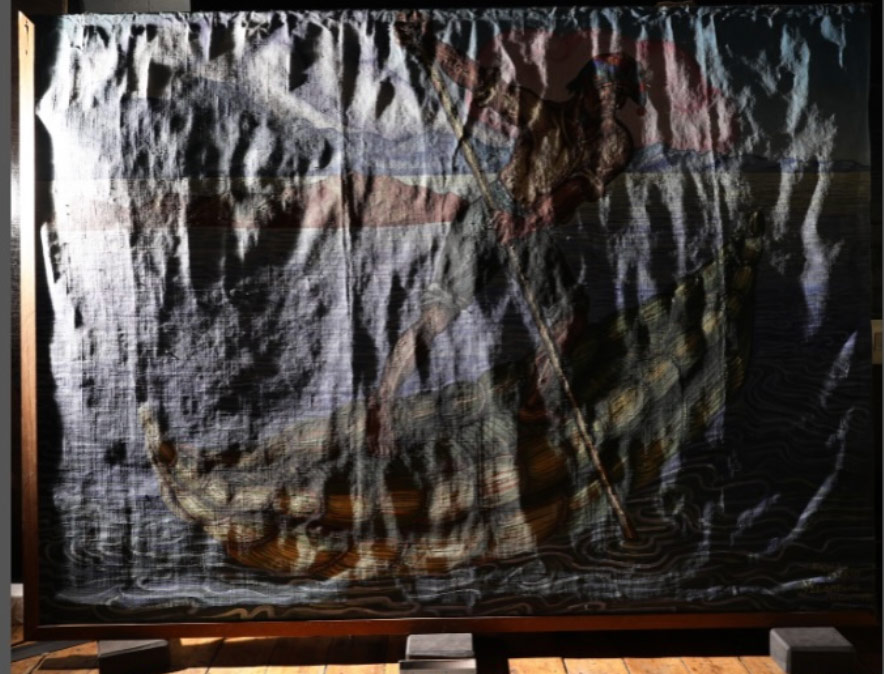
The painting the museum bought, Lake Titicaca, is reminiscent of the powerful strength of a glass blower with a long blowpipe who just gathered a glowing, molten glob of glass from a furnace, but instead of following through with the making of a creation, the hot glass was dropped into the cold water of the lake.
Which is symbolically what happened at the Glass Pavilion with the glass urns for the honoring of the 100th anniversary of the passing of the founder of the museum, Edward Drummond Libbey for the ceremony at the Libbey monument at Woodlawn Cemetery on November 13, 2025. It fell short, because of the despicable labor relations at the museum.
The Blade, as usual, covered for the museum
instead of reporting on the urns
That was on November 13, 2025. The Blade’s story reported that the urns would not be ready for the ceremony because of the annealing process, but would be ready before Christmas. It is now ten months later, and the urns have still not been installed at the gravesite monument.
I wrote to the museum twice in the past month for some clarity, but they did not reply, sending automated responses that they would get back to me within three business days.
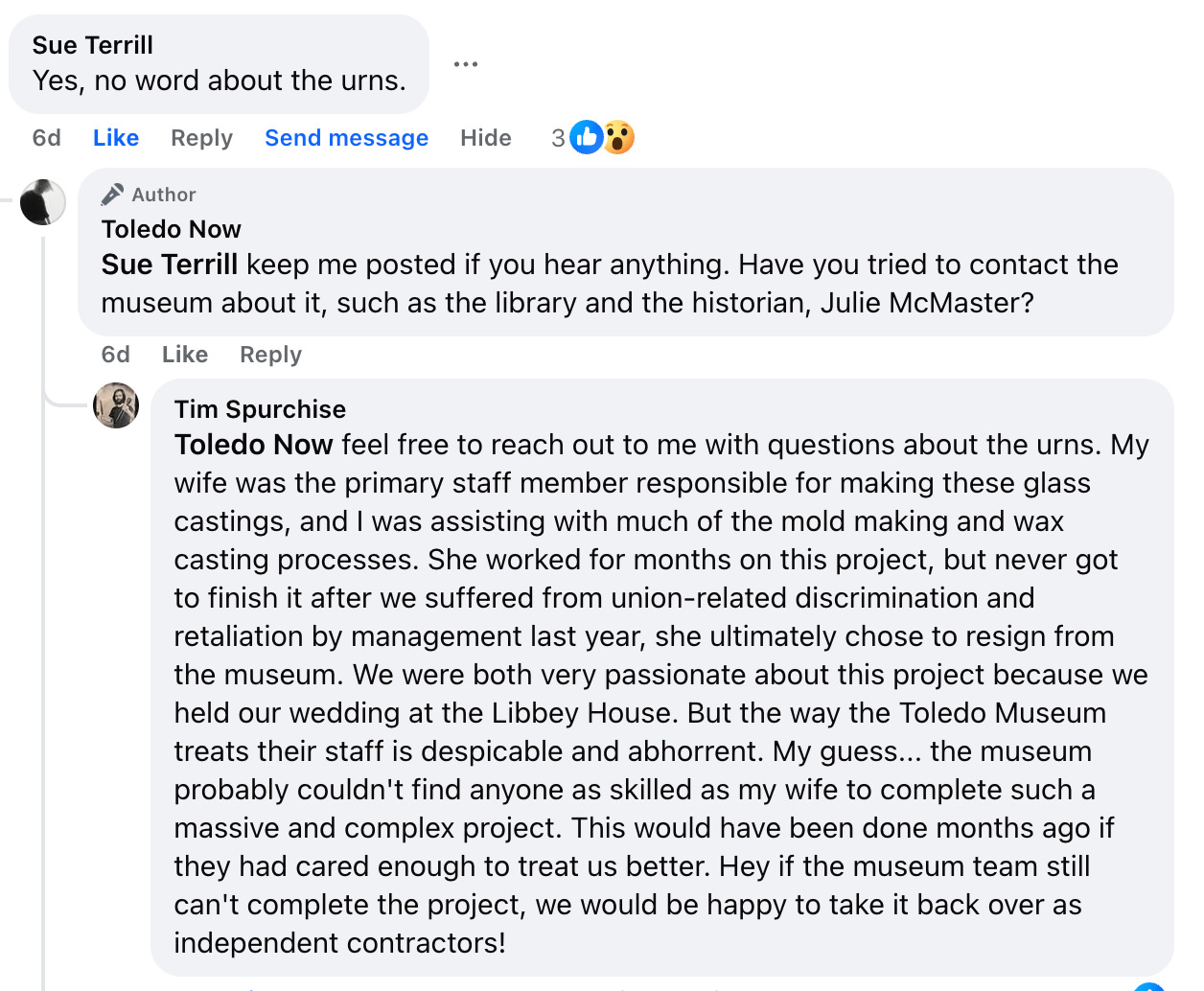
Then, last week on a Toledo Now Facebook post, a comment was made by the glass artist working on the project:
I did reach out to Tim Spurchise, and here is his story, in his own words:
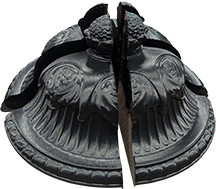
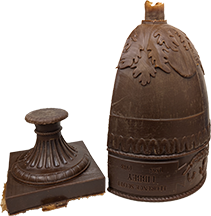
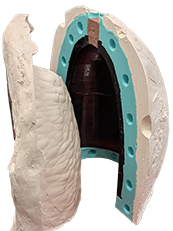
The glass pavilion team at the museum received information about the desire to cast replica Libbey urns out of glass around the beginning of 2025. My wife, Chuchen, had been the lead glass casting artist at the museum for a few years because she has highly specialized skills when it comes to mold making and glass casting, which is a very different process than glassblowing. Anytime we had a GAPP Resident Artist who was interested in kiln work or glass casting, Chuchen was always the lead on those projects. So when the Urn project came through, Alan asked her to put together a budget of materials and labor with a rough timeframe of project completion. The museum outsourced the 3D scanning and the 3D printing for the urns (I don’t know the company they used, but it wasn’t done in house). The glass studio got back the final 3D prints around the end of March 2025. Chuchen was immediately able to get to work and she made all of the plaster and rubber molds, cast all the wax, and began the kiln castings of them.
For the next few months, Chuchen spent most of her time working on the Urn project, and anytime she needed assistance, I was the one scheduled to help because I have helped her with mold making in the past. Misha and the rest of the team were focusing on other projects during this timeframe, and Misha was not involved until after Chuchen left the museum.
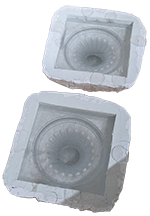
So Chuchen had to clean the 3D prints, adhere them together, seal them, then make rubber molds around the prints, then make a rigid plaster mold around the rubber, and then cast wax into the rubber molds. Once the waxes cooled, we would clean and detail the waxes, then make a more complicated plaster/silica mold around the wax. The wax then gets steamed out of the mold, the mold is dried and then glass is measured and cleaned to be added into the mold inside the kiln. The kiln gets slowly sent up to melting temperature, and then slowly cooled to prevent cracking.
Depending on the thickness and complexity of the final mold, this kiln process could take 1 to 4 weeks. Once the kiln is back to room temperature, the molds are taken out and the plaster/silica is broken away from the glass, and then the glass gets cleaned and cold worked (this is the image of Misha).
After the staff unionized in April of 2025, my wife and I received immediate and harsh retaliation from management (Alan Iwamura and Deb Ball). This included unjust write ups, false accusations, unequal treatment, etc. This happened to all staff (such as my wife and I) who were vocal about their union support.
Shortly after the unionization, my wife and I were notified that our schedules would be changing (and only ours). We would have opposite schedules, giving us less time to work on the Libbey Urns together, which we felt was continued retaliation and an attempt to slow us down on the progress we were making, trying to set us up to fail. This also meant we would not longer have any overlapping days off together at home. While obviously problematic, we had no choice but to accept the decision.
Unrelated to the unionizing, my wife and I had received horrific workplace harassment over about two years of being there. While we reported it numerous times to management and HR, nothing was done to help us. We received no support from the people we needed it from the most. Prior to the unionizing timeframe at the museum, we were finally relieved that the individuals who caused us so much pain had finally left the museum. We thought we would finally get some relief, and after having no support from management, we felt very strongly in favor of supporting the unionizing.
Throughout this timeframe, we had also reported to others in the field about the harassment we received at the museum. Well, after the union passed, Deb spent as much effort as she could in targeting anyone who was vocal about their union support.
In June of 2025, Chuchen and I were called into meetings with Deb and Alan, where we were told we shouldn’t have reported on the harassment we received because it looked bad on the museum. Deb’s exact words were that it put the museum at “reputational risk.” How ironic. With my union representative present, I said to Deb Ball how can you not only violate my first amendment rights, but also stand by the harassment we received in an attempt to cover up your retaliation against the union. Her response was “I don’t need to hear any more from you, my decision is made.” To which I replied “Well, I need to hear more from you because this doesn’t make any sense to me.” And I was met with nothing but silence. That same day I was terminated and my wife was disciplined (probably not terminated because they knew they needed her for the urn project). Well she immediately took protected Family and Medical Leave of Absence, and then resigned from the museum afterwards.
By this time, we had completed the castings for some of the lids and bases, and began making the final molds for the rest of them. We had also mostly finished detailing the main waxes for the urn bodies and we had everything prepared to move forward with the next mold-making process. It was devastating and heartbreaking for us not to be able to finish such an amazing work of art, but the museum’s management shot themselves in the foot when they chose to target us because they’re too childish to learn how to work with a union instead of against them. So to my knowledge, the only finished portions of the urn project are the lids and bases that we cast before leaving the museum (this would be what Misha would have been photographed cold working).
As far as we know, the project has basically been at a standstill since then. We heard that Alan tried to contract another artist to come in and make a mold, but it sounds like it was possibly an unsuccessful casting, and not enough got made within the timeframe anyway.
We love the Libbey Foundation and we were honored to have our wedding at the Libbey House. I don’t know who funded this Urn project, if it was the museum directly or the Libbey Foundation. But if the Libbey Foundation wants this project completed, we welcome the opportunity to work directly with them. We would be happy to be contracted as independent artists to finish this project properly and the way it was intended.
Photos by Tim Spurchise:
the process:
clean the 3D prints,
adhere them together,
seal them,
then make rubber molds around the prints,
then make a rigid plaster mold around the rubber,
and then cast wax into the rubber molds.
Once the waxes cooled, we would clean and detail the waxes,
then make a more complicated plaster/silica mold around the wax.
The wax then gets steamed out of the mold,
the mold is dried and then glass is measured and cleaned to be added into the mold inside the kiln.
The kiln gets slowly sent up to melting temperature, and then slowly cooled to prevent cracking.
Depending on the thickness and complexity of the final mold, this kiln process could take 1 to 4 weeks.
Once the kiln is back to room temperature, the molds are taken out and the plaster/silica is broken away from the glass,
then the glass gets cleaned and cold worked (this is the image of Misha).
Thank you, Tim, for providing some clarity on the new unfinished urns that the museum’s historian, Julie McMaster, with all of her best intentions, tried to have made for the Libbey ceremony, and for giving us a window into the hypocritical labor relations of the museum.
As a native Toledoan I am ashamed of my city and of my museum and I am especially sorry for the pain you and Chuchen, talented artists choosing to come to our glass city, Toledo, a union town, to practice and teach your craft at our supposedly esteemed and progressive museum, have had to endure navigating the dysfunctional mismanagement and toxic environment that never should have been.
You came to make art, to lay down roots and start your life together here – you held your wedding at the Libbey House and you worked on the Libbey Urns – what a profound and beautiful connection, and how heartbreaking for it to be cut short. Your relocation here as skilled and talented glass artists was a gift to Toledo, and for Toledo to lose you is tragic. Toledo disrespected your contributions and your rights, victimizing you for having the courage to unionize, while telling the world that they are all for workers rights.
The Libbeys did not intend to support a future like this. The museum is for, first and foremost, the people who live in Toledo.
The museum had five full months after repelling this talented young couple in June 2025, in order to complete the project in time for the Libbey Centennial ceremony on November 13, 2025, but they failed to do so.
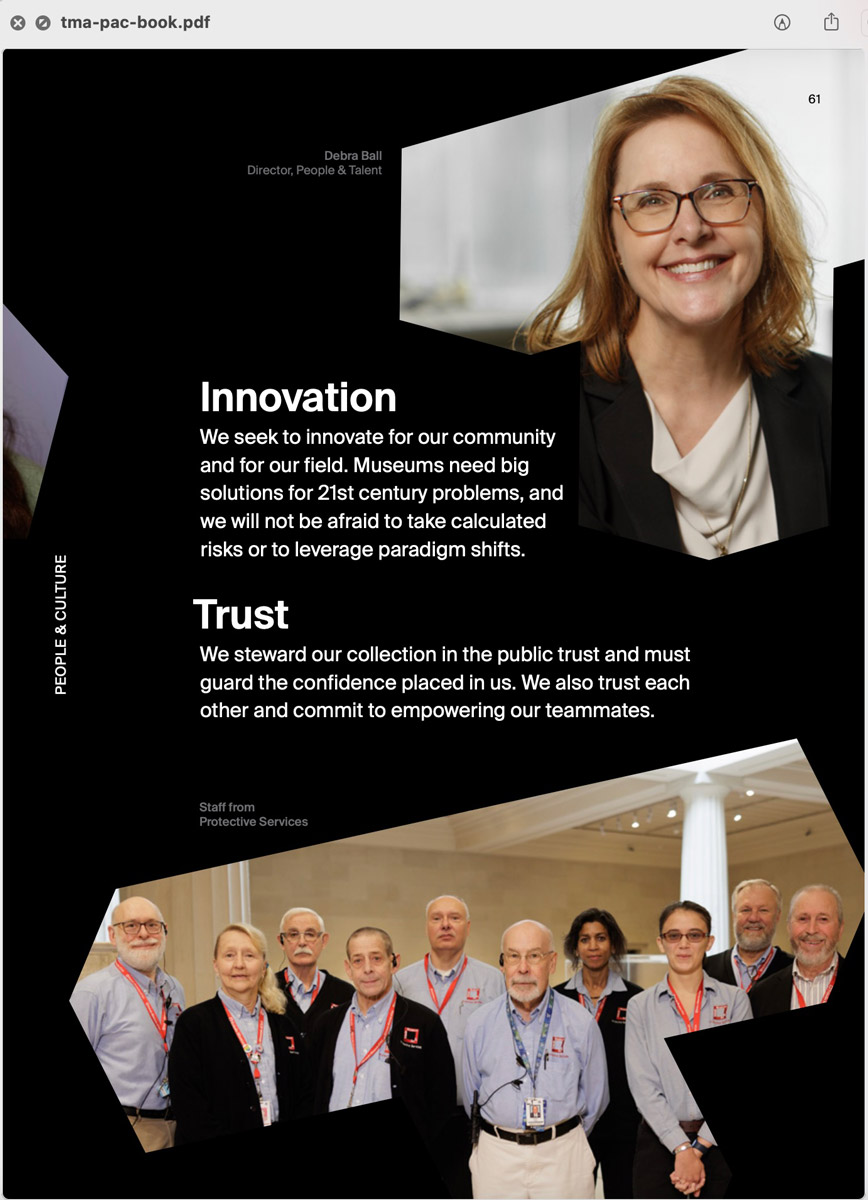
The museum disrespected their own skilled workers and mismanaged employees, ironically after hiring two new managers for two new oversight departments — Jennifer McCary, Chief People, Culture and Brand Experience Officer, and Debra Ball, Director of People and Talent, to oversee these matters. The museum had recently doubled its administration, but to what end?
The consequence of poor management and the toxic environment in this instance was the failure to be able to produce (on time or at all) the very important and symbolic Libbey Urns in honor of the museum’s founder and the father of Toledo’s glass industry. That is but one example of what Toledo has lost due to what they are doing to the museum.
The bloated new management allowed skill and talent to slip through their fingers in their attempts to bust the union instead of trying to work with it. Then, by purchasing a sub-par painting mainly for the workers rights story, they mock their own employees’ efforts to form a union.
“Yllanes’s career was repeatedly disrupted by political exile due to the radical nature of his work in its critique of Indigenous labor conditions.” Toledo Museum of Art press release September 25, 2026
The Toledo Museum of Art has degenerated from being a free, creative, educational space that fostered the birth of the 1962 Studio Glass Movement to being a repressive and hypocritical institution where, in 2025, not even the special Libbey Urns could be completed in the Glass Pavilion that grew out of Toledo’s great glass legacy.
TOLEDO IS A UNION TOWN
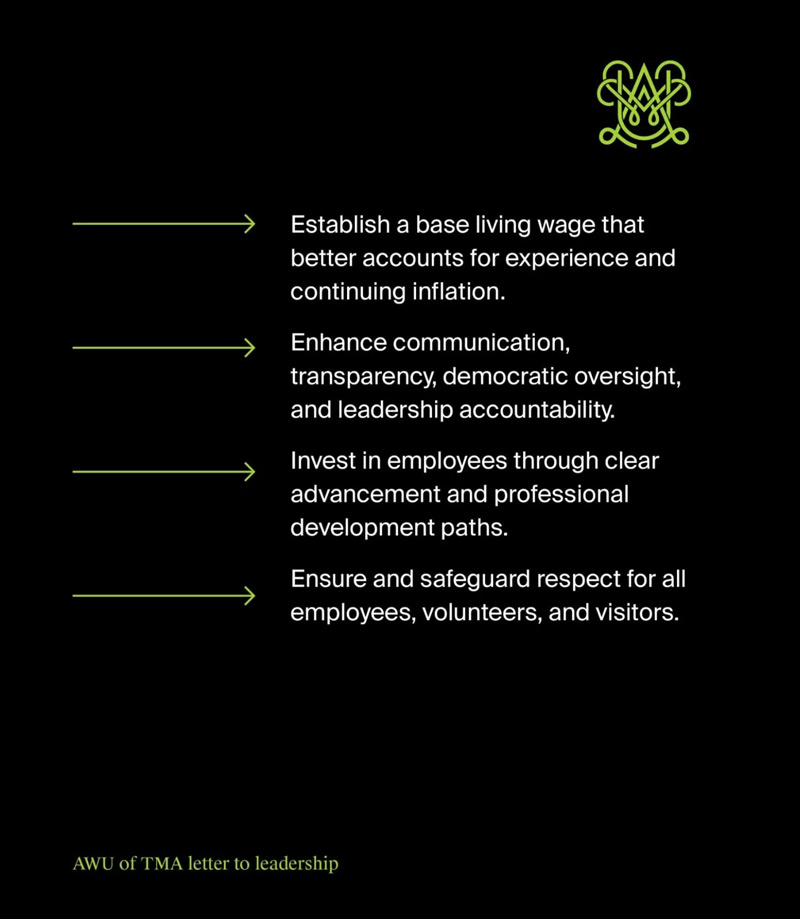
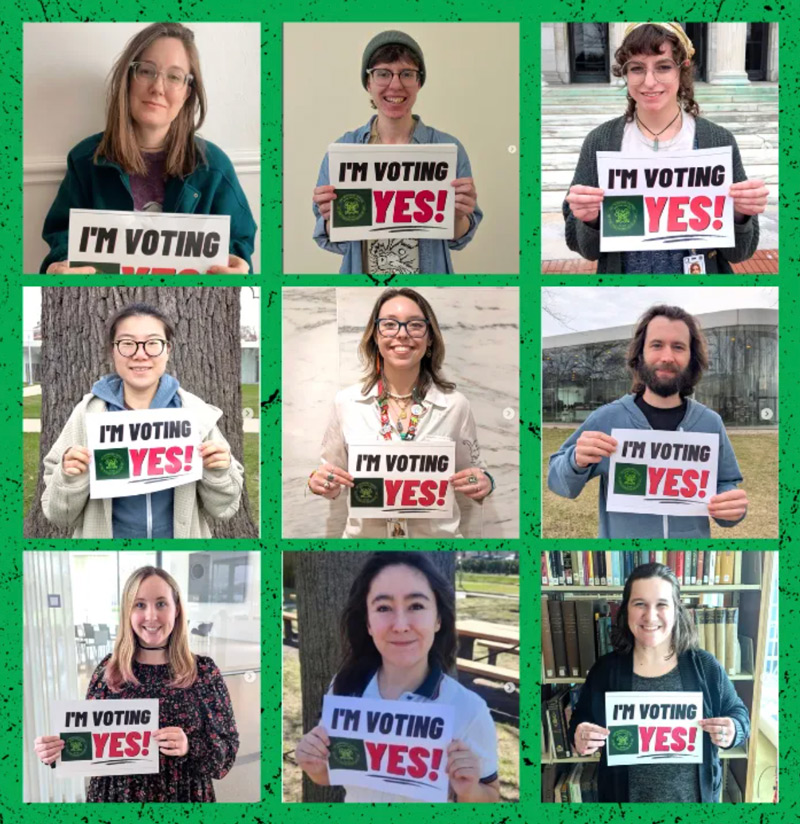
AWU of TMA letter to leadershipA question for the museum: why are several of these workers voting yes for the union no longer employed at the museum?
In 2024, while the management was doubling in size and planning massive changes to the museum, the employees started talking about forming a union.
A union of about 100 workers in visitor services, glass studio, research, education, family center, outreach, curators, librarians and more was formed under the American Federation of State, County and Municipal Employees (AFSCME), and was officially recognized in the spring of 2025.
For Chuchen Song, a glass studio specialist, the union is also about strengthening connections and building solidarity among museum staff.
“TMA talks about how the administration can be more supportive to employees and community,” said Song. “As an employee, l believe our union not only provides protection but also brings a positive impact to our community because workers always look out for each other.” – Art Workers United – TMA Win Their Union Election
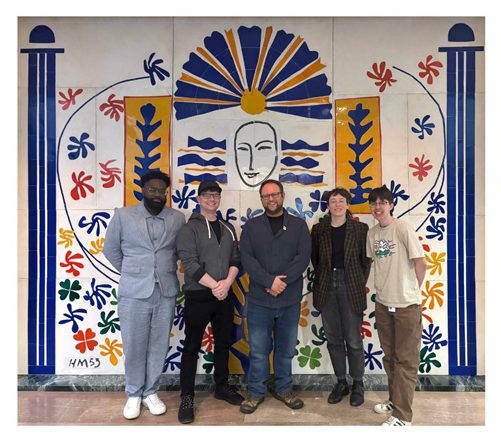
“The time to raise our voices is now,” said Skye Sloane, a Visitor Services Team Lead, “The Toledo Museum of Art is building and remodeling key sections of the Museum in a multimillion-dollar capital project. As employees, we want to make sure there is transparency and an opportunity for employees to have a formal way to make their voices heard. As dedicated cultural workers, we have invested in the Museum’s success and want equal footing.” Art Workers United – TMA Win Their Union Election
photo of employees that appeared in the Hyperallergic article
The reinstallation project is “a significant change to the institution that we all love, and we wanted to band together and feel sure and secure in our new jobs, benefits, and wages, before the project is completed.” Skye Sloane, a team leader for visitor services, told Hyperallergic.
Jennifer McCary, the museum’s Chief People Officer, told Hyperallergic that the Museum “respects the democratic process and remains committed to fostering a supportive and collaborative work environment for all employees.”
For a museum that says it wants to be an employer of choice, the management has really shown its true colors.
Of the six employees who were interviewed or were photographed for the Hyperallergic article, including Chuchen Song, who was interviewed but not photographed, only half remained employed at the museum one year later, after the formation of the union. These employees were proud of forming the new union, and hopeful for their solidarity at the Toledo Museum of Art, but they were hassled so much by management that they either left on their own or were terminated, according to inside reports.
“It seems the museum is more willing to punish & dispose of loyal staff than address deep-rooted issues in organizational culture & toxic individuals in leadership positions.”Toledo Free Press facebook post, August 18, 2026, with several comments by former museum employees and a glass pavilion student who was mistreated, discussing the toxic environment and mismanagement of the employees.
On May 6, a complaint was filed with the (National Labor Relations Board (NLRB) on behalf of all guards, claiming retaliation and unlawful interference. The filings allege that the museum interrogated security staff about their collective bargaining interests and discriminated against workers who “joined or supported a labor organization”. Furthermore, guards were allegedly terminated for engaging in legally protected activities, which included protesting working conditions and openly discussing wages.
The friction escalated after the museum announced plans to outsource most of the Protective Services department—the largest wing of its workforce with over 60 employees—to a third-party contractor, Safeguard Security Services. This operational shift effectively forced the original museum guards to reapply for their own positions. Legal counsel has filed formal notices on behalf of the museum, and the NLRB case remains an active investigation.
Allegations:
8(a)(3) Discharge (Including Layoff and Refusal to Hire (not salting))
It’s a frightening time for those who love the Toledo Museum of Art, whether they be employees, ex-employees, or the public at large, to see the museum imploding like this – not only the physical closure of the galleries but the utter dysfunction of leadership and staff.
The galleries are closed. The art has been sent away. Hanging precariously out on a limb is Toledo’s glass legacy and about 20 billion dollars worth of public art. The museum belongs to the people of Toledo. Do people understand that? Why are they letting this happen?
Toledo – reclaim your legacy.If you would like to sign the petition, sign here.
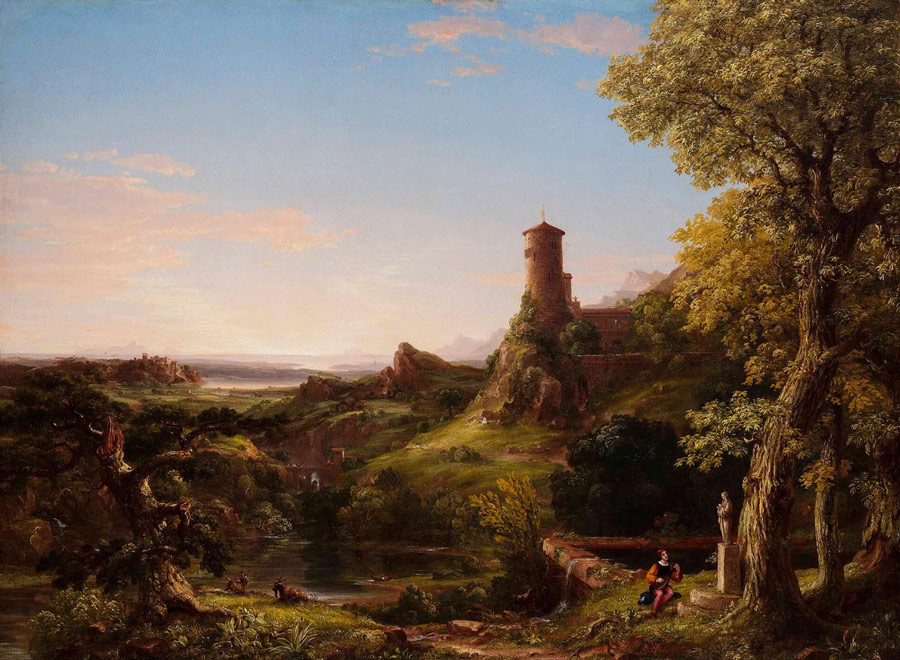
Thomas Cole, "Landscape, The Vesper Hymn: An Italian Twilight." Thomas Cole, hailed as one of America's first noteworthy landscape painters. Culled from the museum's collection sometime after April 2025.
Stewardship is the promise that what one generation builds, the next will care for and carry forward.
Should the Museum be getting rid of classic American paintings from their historic collection of American art? Does the new director have to get rid of the Museum’s collection of American paintings, so well-curated and scholarly researched that a major book was published in 1979 serving as its catalog of 277 paintings? Is the shrinking of the collection really necessary to make way for “global endeavors” (whatever that is supposed to be)?
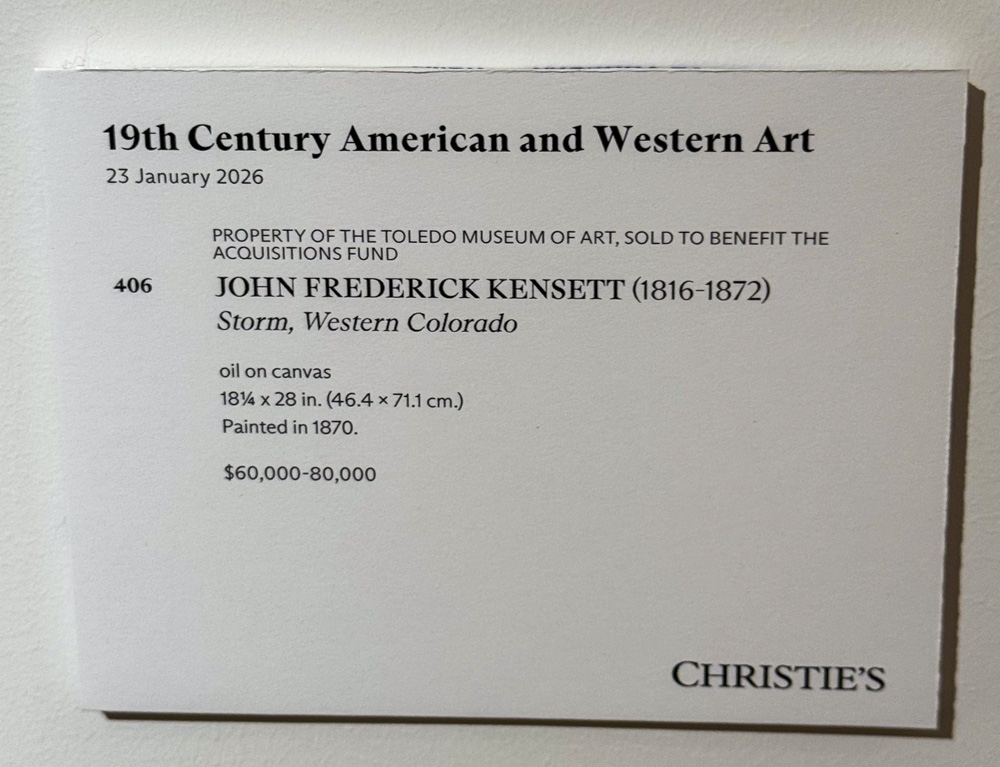
John Frederick Kensett’s Storm, Western Colorado displayed for the 19th Century American and Western Art auction at Christie’s, Rockefeller Center, New York City, January 19, 2026. Photo by Penny Gentieu
What a fine howdy-do to mark the nation’s 250th anniversary celebration – a massive sale of 18 paintings in an auction titled 19th Century American and Western Art on January 23, 2026 at Christie’s. It was quite opportunistic for the Museum to sell, rather than show, American paintings, and right in sync with the auctioneer’s schedule, who also happens to be a major Museum donor — (an auction house! And so is Sotheby’s, a major Museum donor! Is this ethical?…)
The Museum could have put up an American painting exhibition for show, not for sale, but they chose to put 18 paintings up for sale at Christie’s 19th Century American and Western Art auction instead.
They could have had a show to celebrate the 250th anniversary of America. But instead they sold 19 American paintings.
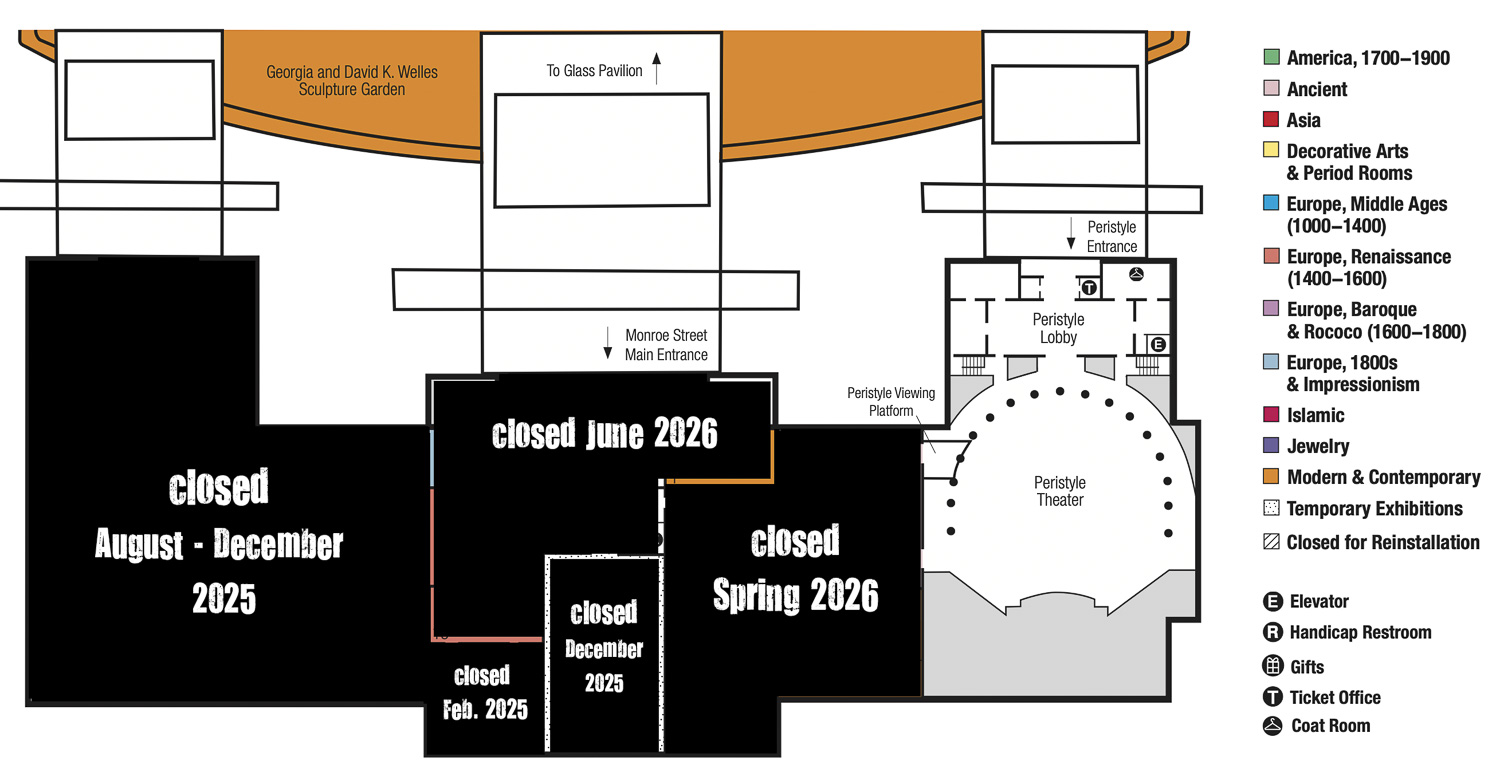
The Museum closed, and the repair of the HVAC system was the excuse. Along with it, a renovation and reinstallation of the art in chronological order. The project disrupted years of access to art that is held in trust for the community and the educational opportunities that the Museum used to offer the community.
Wikipedia describes what is going on as a “massive multi-year expansion plan to its 40-acre campus,” but in actuality, there will be no increased gallery space or additions. In fact, gallery space will be reduced to make lounges and bathrooms. Not even storage space will be added. But 1,300 new artworks have been added to the Museum’s collection during the past few years. They are spending many millions on the renovation and the new acquisitions, but will have no space to store additional art, so do they sell off everything they don’t happen to like?
Should haters be selling Toledo’s precious collections?
The public perception is that the new director and curators don’t care about the paintings or the fiduciary duty that comes along with being temporary stewards of the art in the public’s trust, or the Libbeys’ Trust and gift of the art museum being for the people of Toledo.
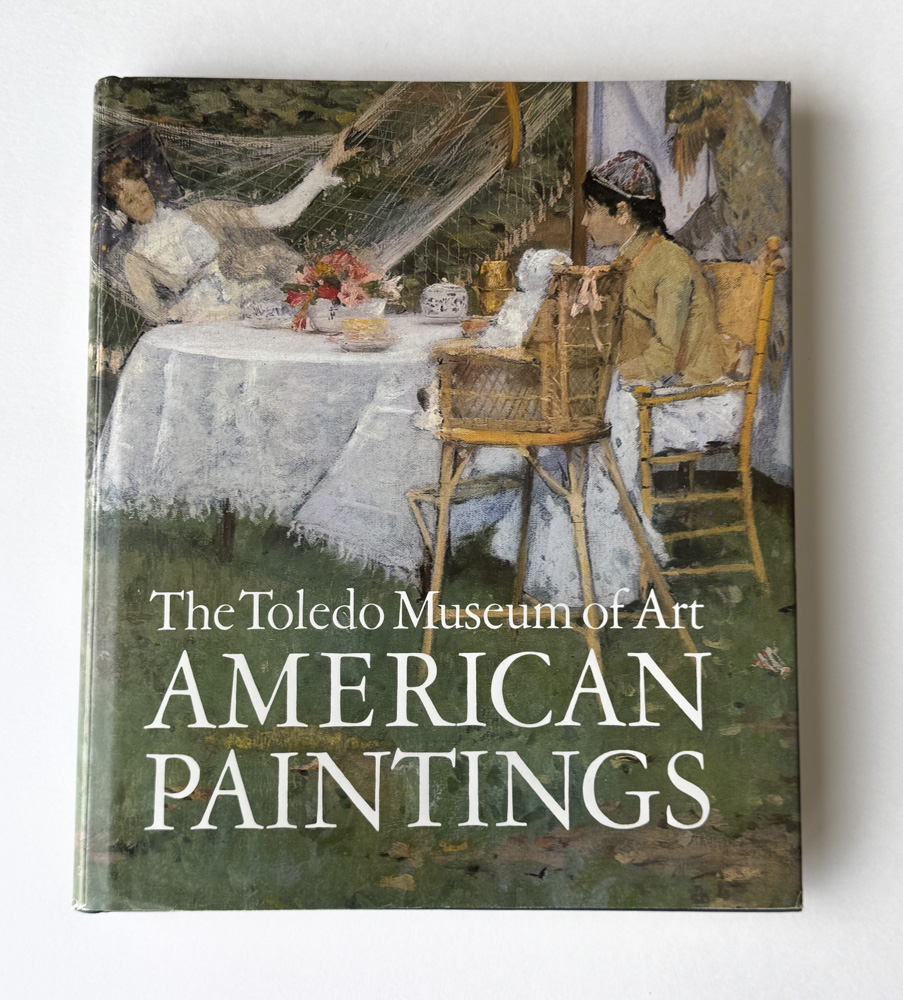
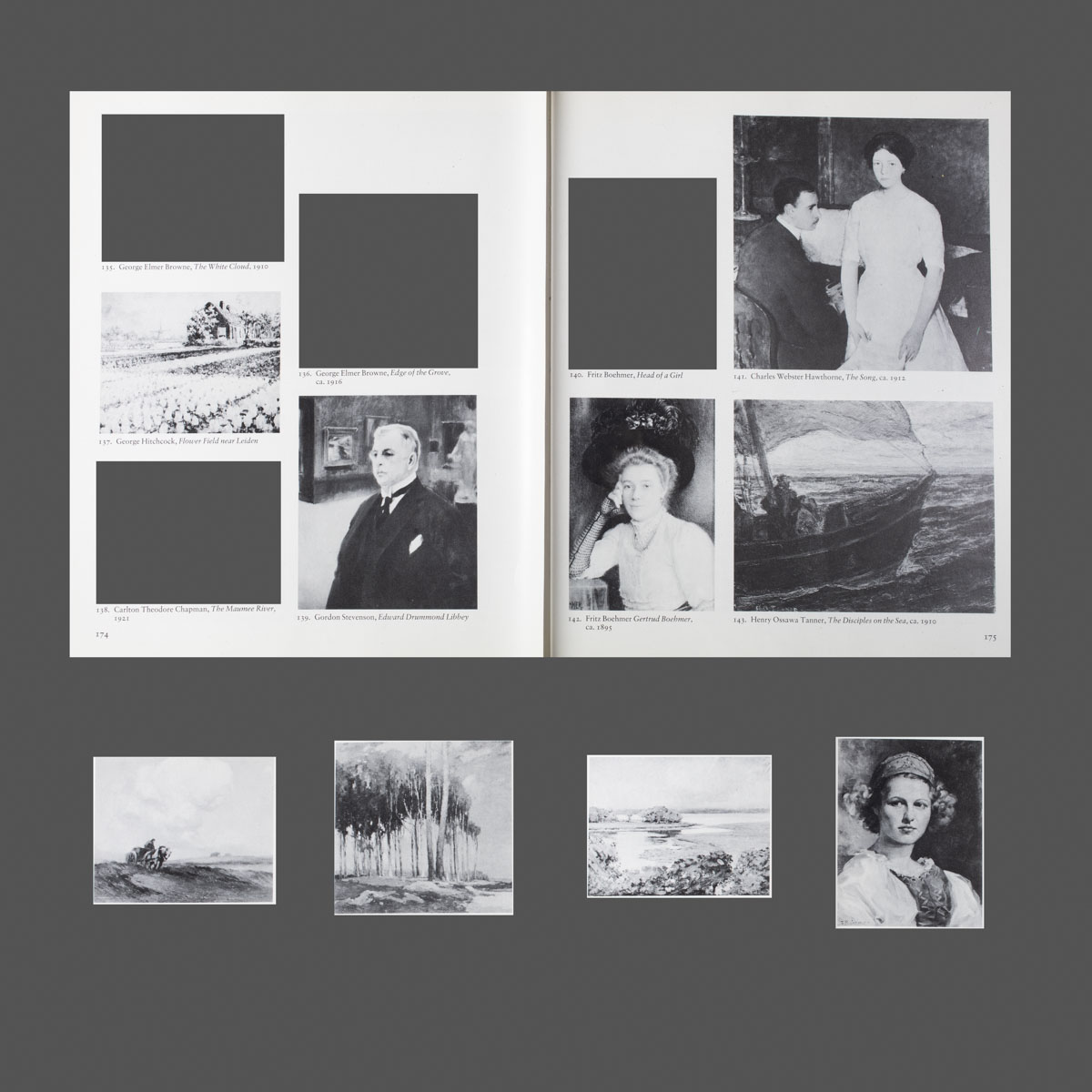
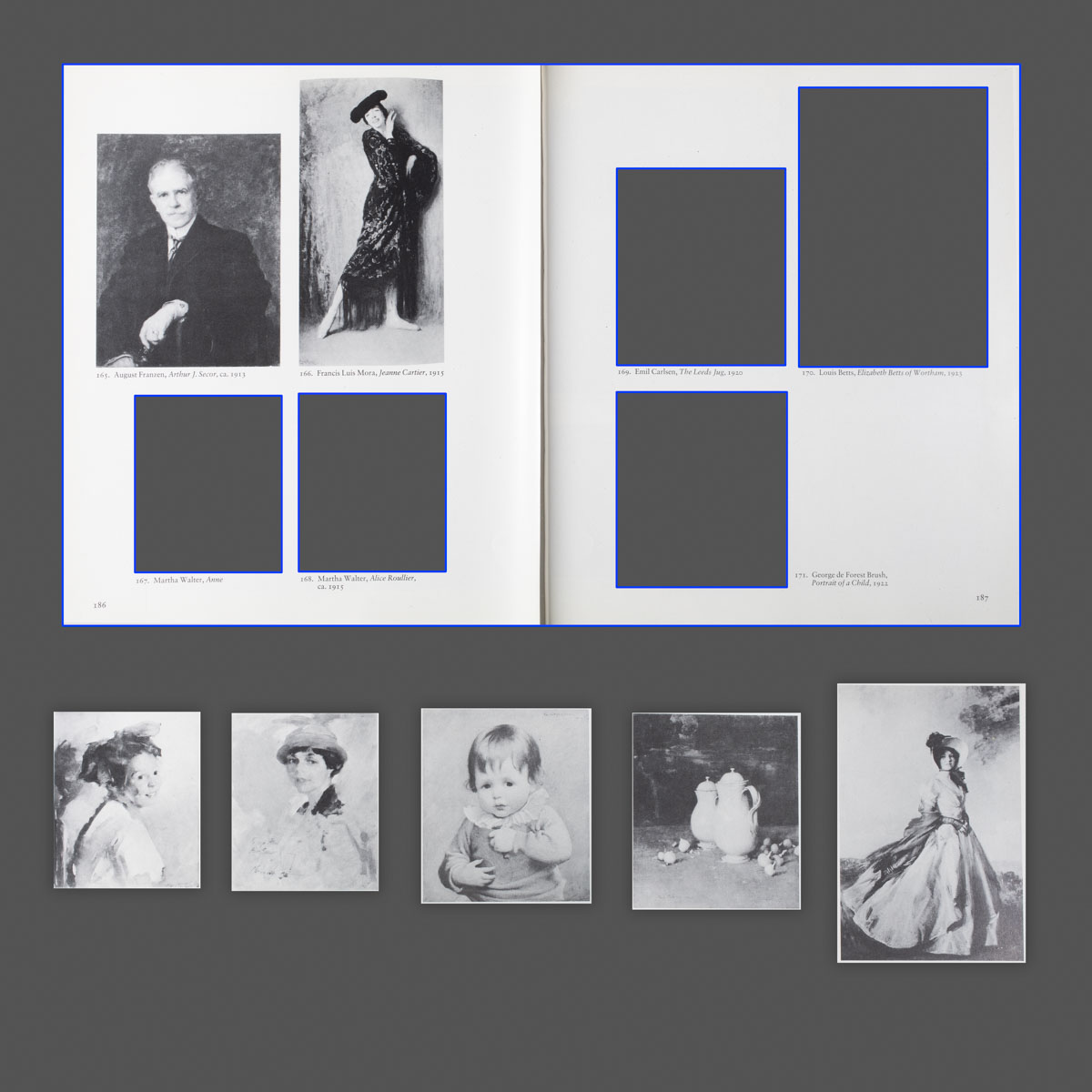
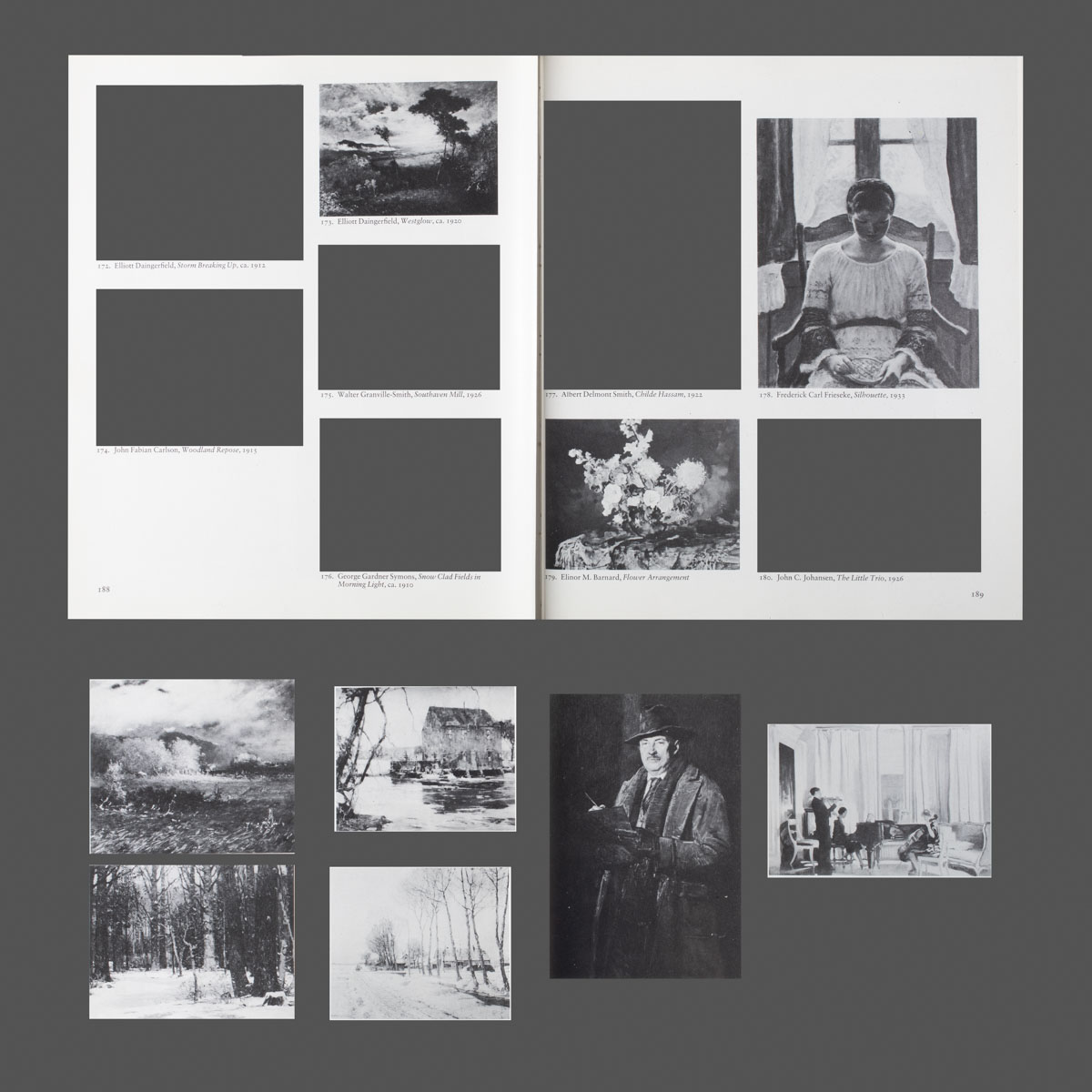
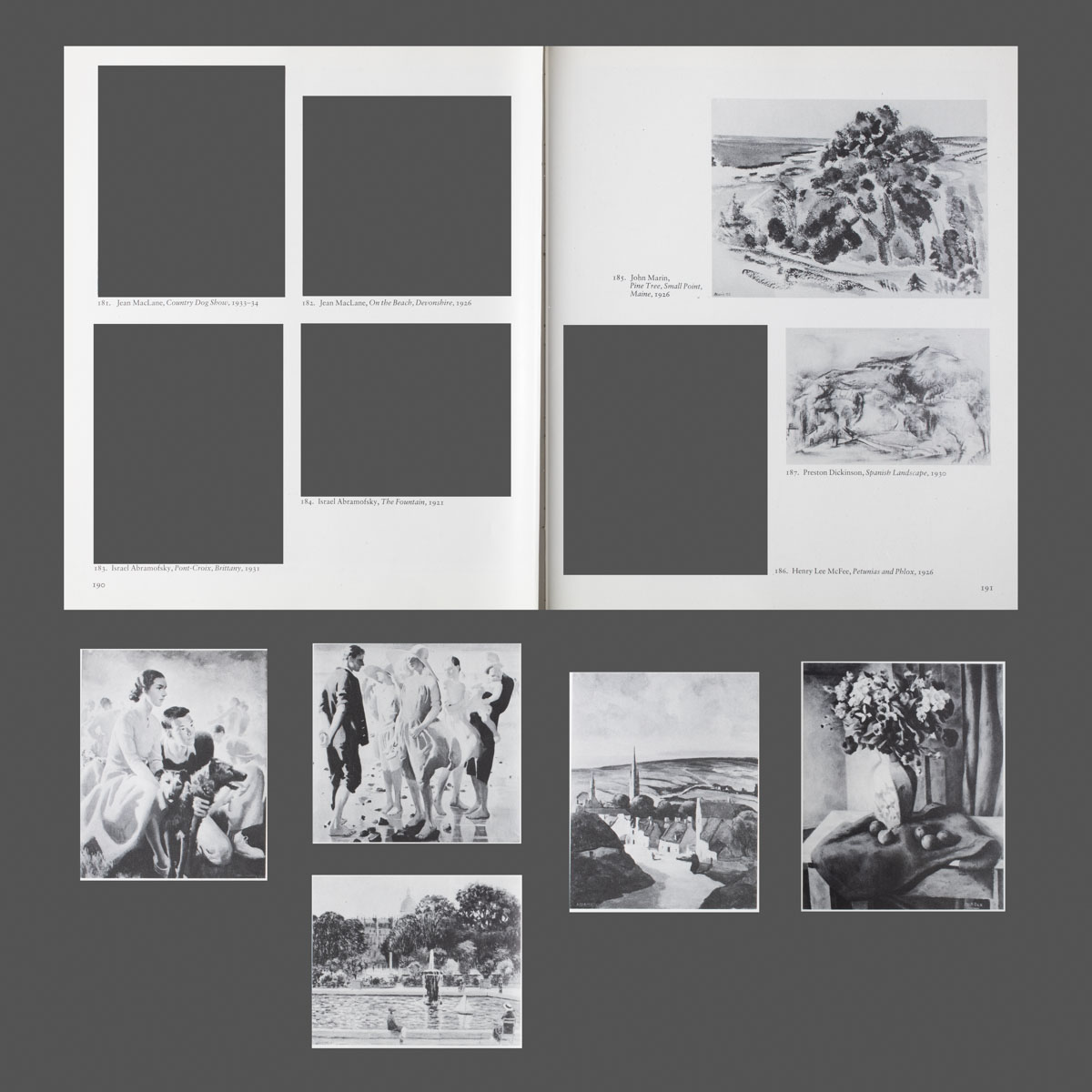
Toledo Museum of Art American Paintings, the book
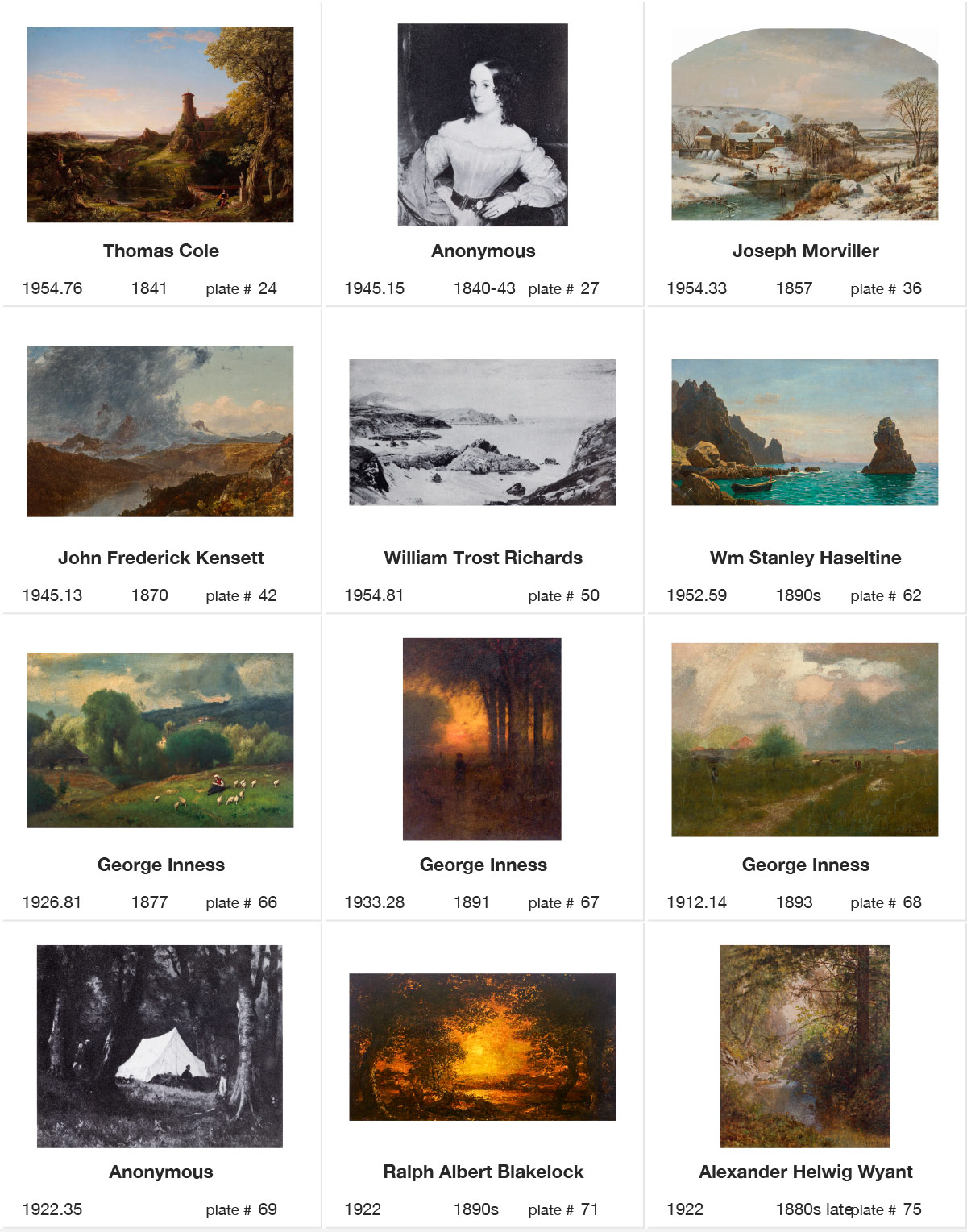
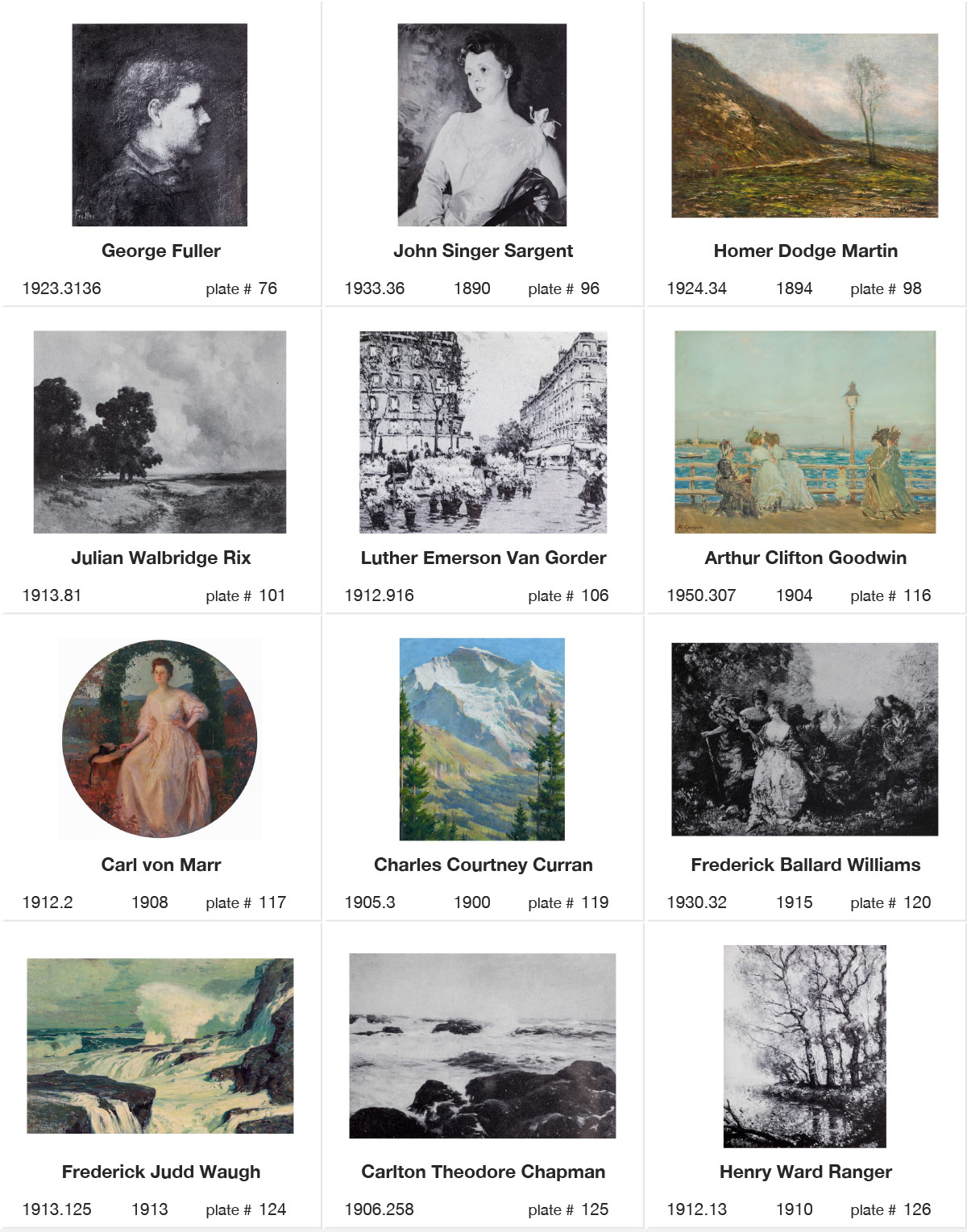
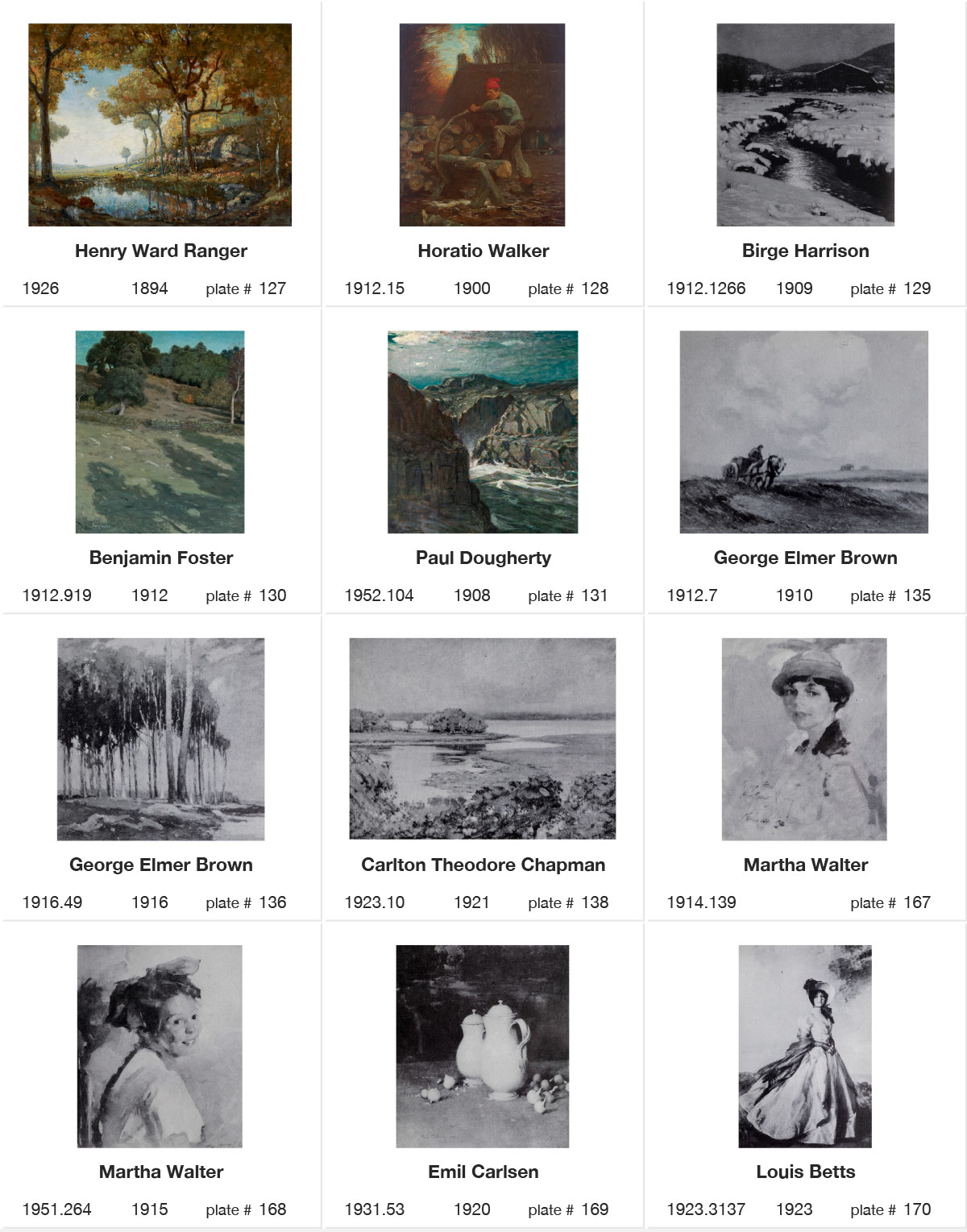
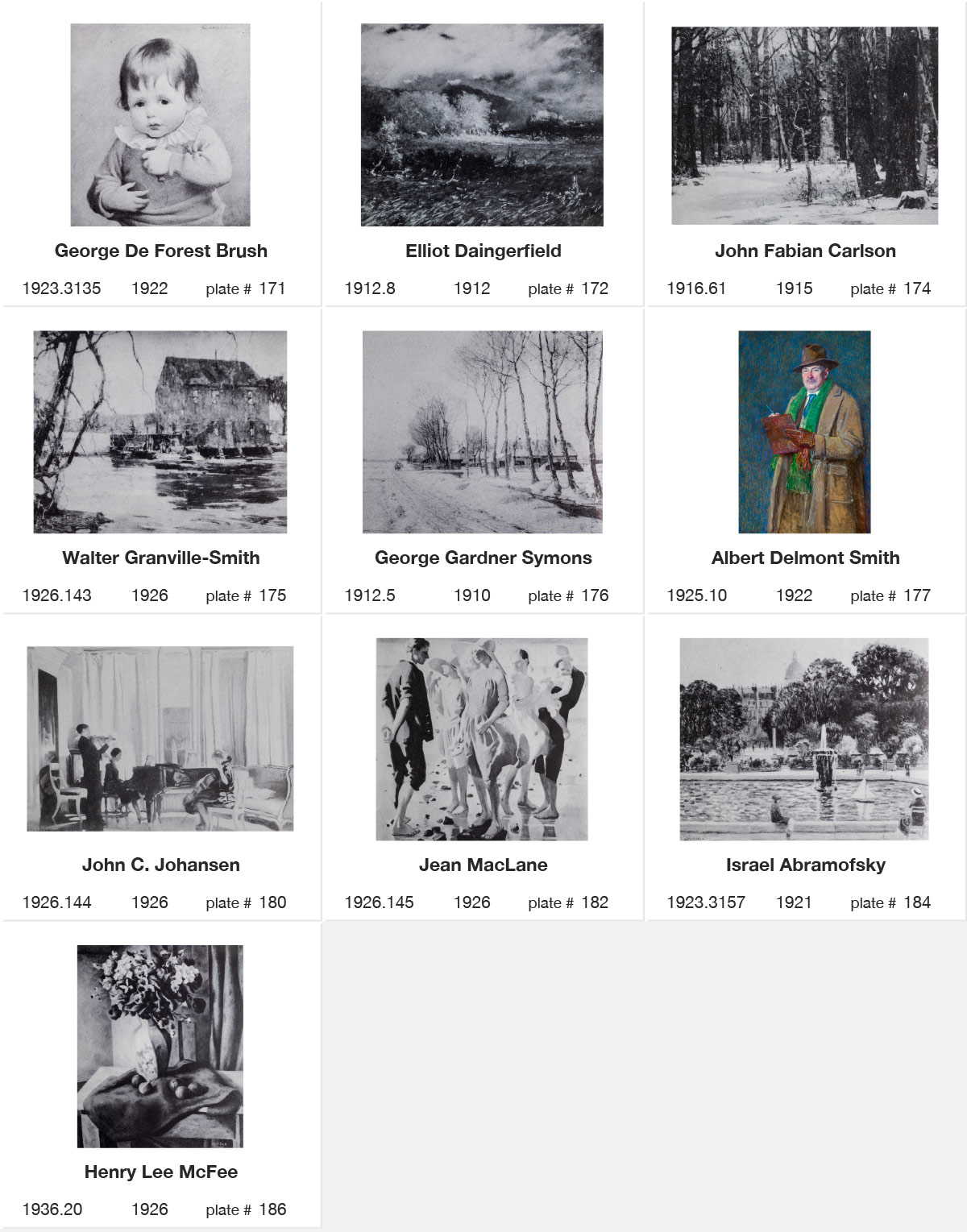
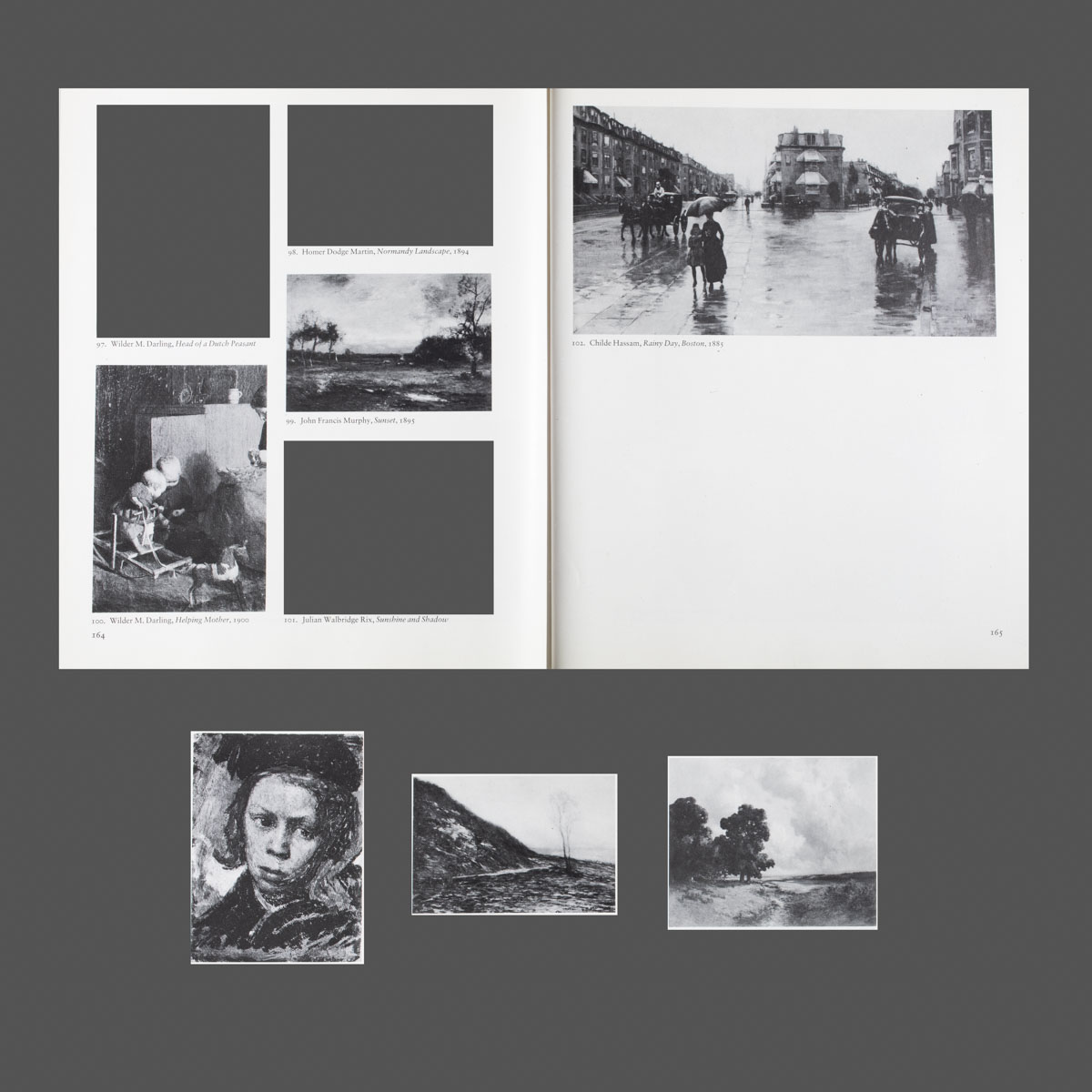
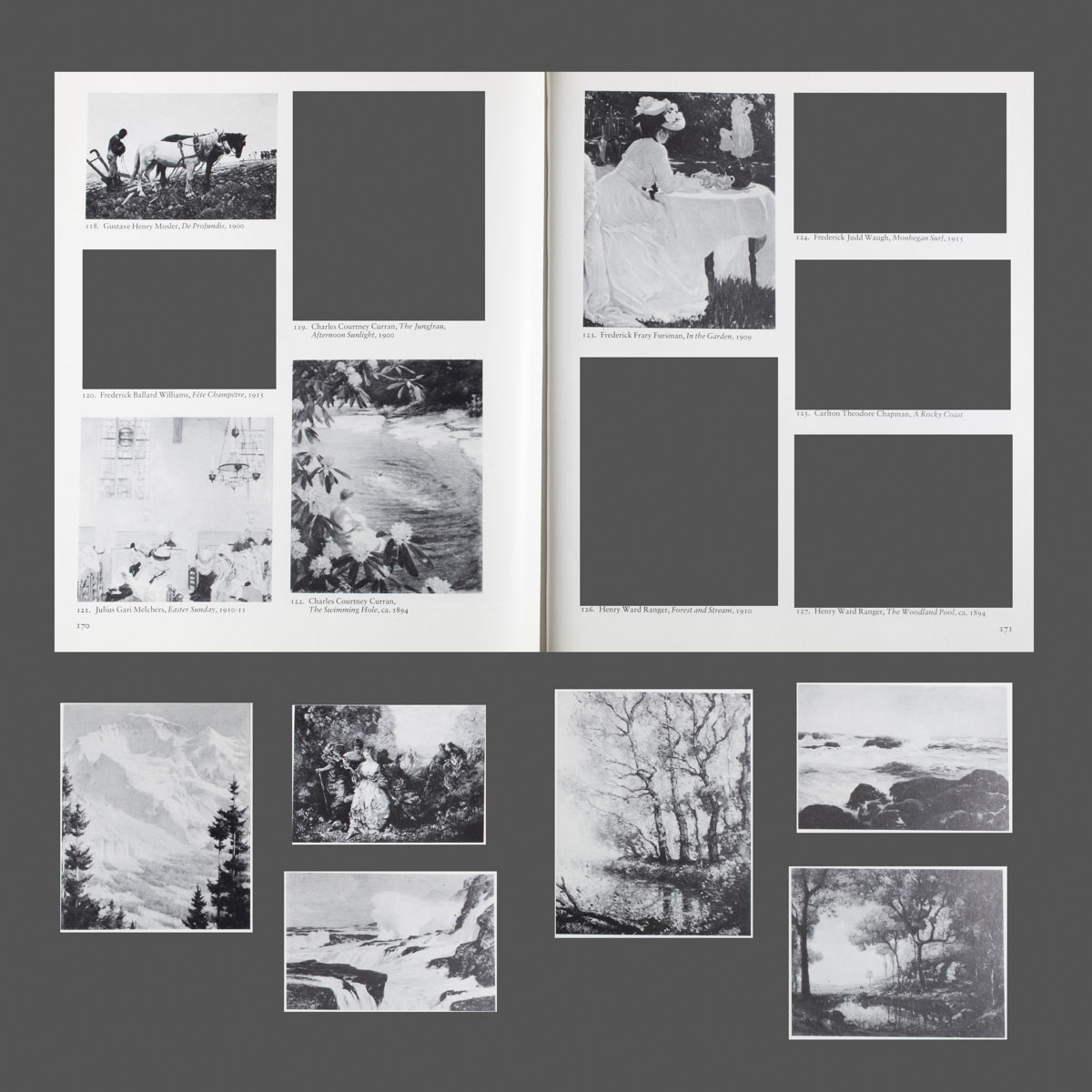
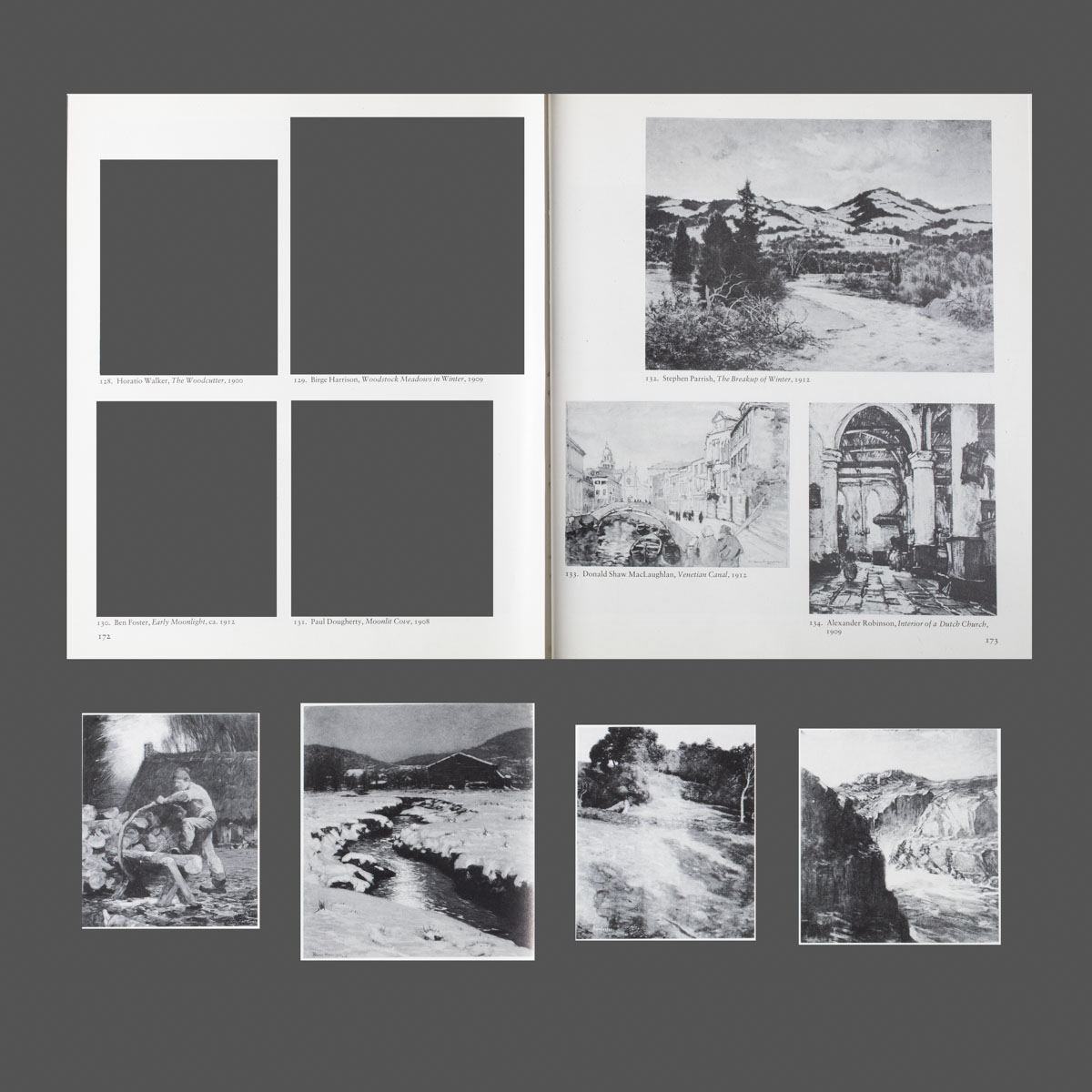
Documenting the painting, its accession number, the year it was painted, and the plate number in the catalog, I compiled a list of 46 deaccessioned American paintings, spanning from 1840 to 1926 (which were the years encompassing the recently sold paintings). These paintings were documented in the complete catalog of the Toledo Museum of Art American Paintings, published in 1979. Remarkably, over one-third of the oil paintings in this category of the collection have been deaccessioned.
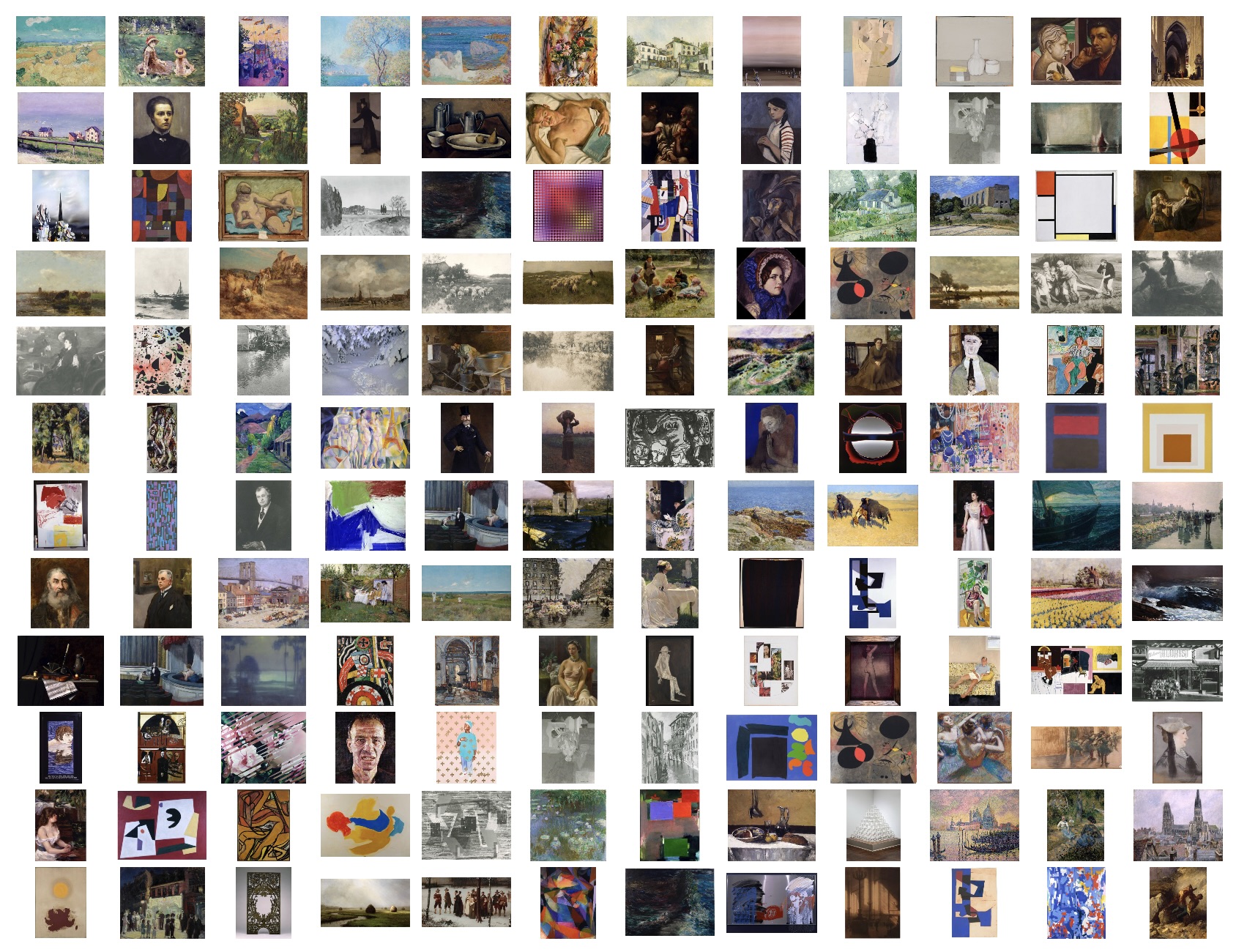
The 18 oil paintings, shown above in color and sold in January at Christie’s brought a measly $289,179. Why sell such a strong early collection? Collecting is about collecting.
46 out of 133 oil paintings dated 1840 to 1926 from the American Painting collection, documented in the 1979 book, Toledo Museum of Art American Paintings, have been deaccessioned.
That’s 46 paintings sold to the 87 that remain.
30 American artists culled from history. 77 remain.
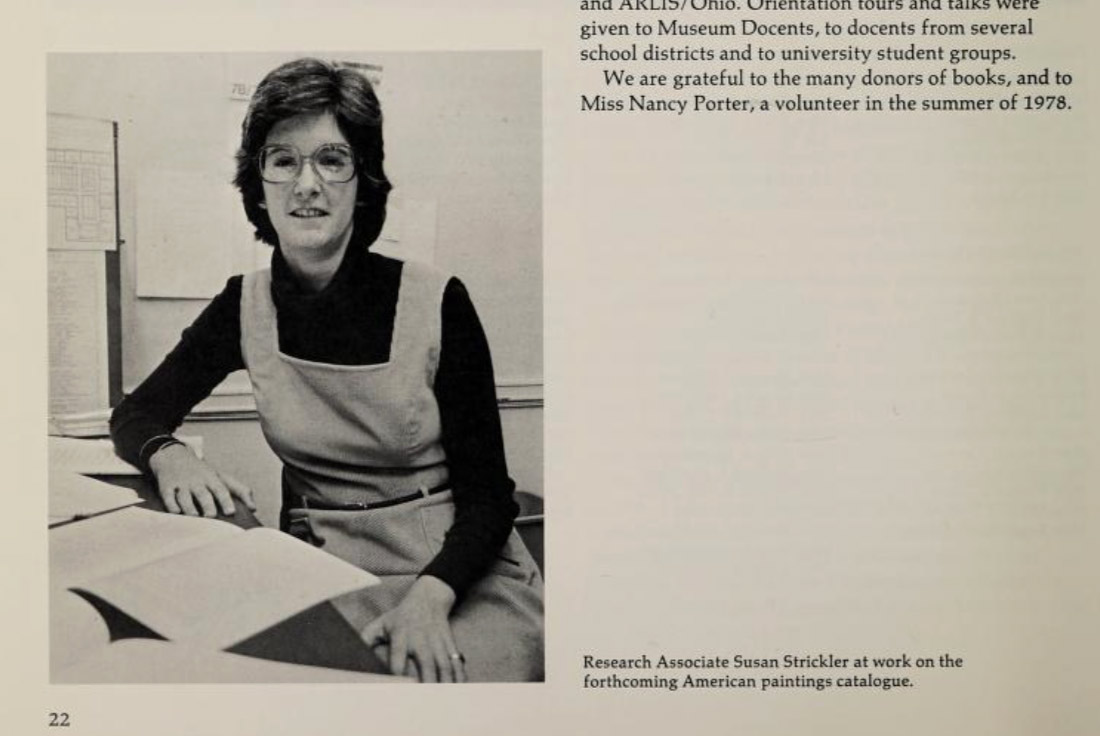
Susan Strickler, Research Associate working on the American Paintings catalogue in 1978. Ms. Strickler went on to be a distinguished museum professional and director of the Currier Museum of Art, now retired.
Curating a collection is about caring for the art. Museums usually increase the number of artworks in their collection over time, but TMA has reduced the size of collections. WHY?
They certainly have large endowments from which to draw funds for new acquisitions, so much more than most museums that it makes the other museums envious. They have over $5,000,000 a year from these funds. What is the point of weakening a collection to increase this amount by 5 percent?
But when the Museum buys a painting for $5,000,000 to support a failing Southern college, and they buy an early Kiddush cup for a record-setting $4,000,000 at Sotheby’s the same year, they are not honoring the way the Museum has successfully built its collection for over a century. The formula was to hunt for periods, styles, and geographical movements that were temporarily neglected by the mainstream art world, and not to buy art at the height of the market, which they have done in both of these examples.
Here’s what the former director, Don Bacigalupi said in 2010 about the Museum’s collections policy:
Because the TMA collection is encyclopedic in nature, spanning cultures from ancient to modern times in a vast range of media, the institution can avoid overheated sectors of the art market and focus instead on spectacular treasures that are receiving less attention. – Don Bacigalupi on the Vibrant Collections Legacy, Annual report 2010.
1,300 new acquisitions but no additional storage?
Why isn’t increased storage a part of the big renovation taking place that’s closing almost all museum galleries not just for months, but for years?
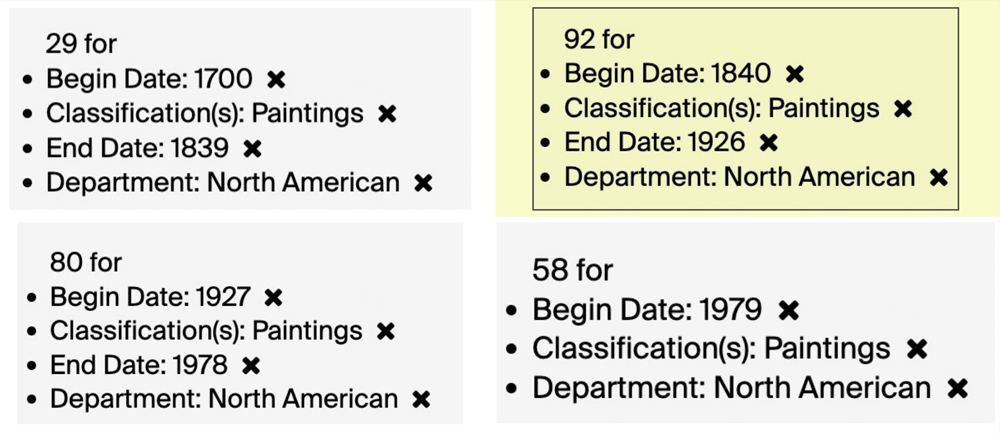
TMA emuseum stats on North American paintings retrieved August 2026:
Search results for North American Paintings in the TMA emuseum database, showing 92 for paintings dated 1840 – 1926. Five are works on paper, so that leaves 87.
Thomas Cole’s painting was deaccessioned since last appearing on TMA’s emuseum in April 2025. Perhaps it was sold privately?
several pages of the book, Toledo Museum of Art American Paintings, with sold paintings cut out:
It’s our American legacy, our history, how our great great+ grandparents saw the world, authentically given to us by the founders of our museum, and several of the artists were local.
Ironically, with the new vision of the museum identifying strongly with telling a historical story, our local history has been erased. Our cultural tradition of the Toledo Area Artists Exhibition, which was almost 100 years old, and brought together the Toledo area art community every year with a competitive, high-quality juried show, was stopped in 2014. That marked the beginning of the ending of the once flourishing community centered museum.
An entire collection of distinguished local art, dated from 1948 to 2013, comprised of the purchase awards of the Toledo Area Artists Exhibition annual shows, was removed from storage at the Museum about 18 years ago, and relegated to the care of the Toledo School for the Arts. At the high school, the collection was stored in a utility closet until 2024, when the Toledo Federation of Art Societies, the historic group formed to put on the annual juried exhibition, disbanded. They gave it to the Schedel Arboretum & Gardens in Elmore, Ohio. The historic and distinguished collection of the TFAS Purchase Awards is not even in Toledo anymore.
it’s anti-local and unamerican
The museum’s so-called “stewards” took our traditions away, they took our education away, they took our art away, and they took our history away!
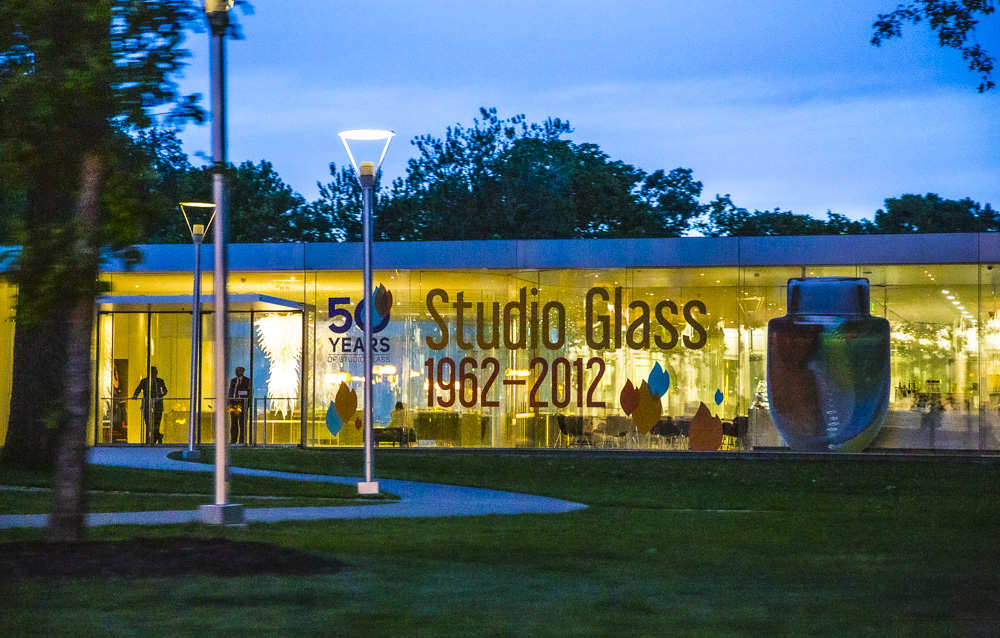
As for the Glass Pavilion, built to house Toledo’s glass collection and encompass Toledo’s unique glass history; this richly dedicated, all-glass building conceptually designed by the famed Japanese architects, SANAA with this in mind, is being dishonored. I wrote about it here, along with the problem that Toledoans are not getting the news –
The Toledo Museum of Art belongs to the people of Toledo. It is a gift from the Libbeys, but it’s getting broken, torn, separated, divvied out, exploited, used, leveraged and sold out. Voices speaking up are muted and ignored.
Transformation 2027???
Transformation 2027: it’s a cover story for the shell games of the new Toledo Museum of Art, keeping you busy looking in one direction while they are busy doing very questionable things undercover.
We should be proud of our heritage. Hold on to it, don’t let it go.
What it feels like the museum is doing to the public, ever since the pandemic.
I love this story about the Toledo Museum of Art. The author, James Moore, kindly granted me permission to share it here.
They are the words of a highly distinguished curator who got his professional start at the museum. James Moore left Toledo to become the first director of the Albuquerque Museum of Art and History, directing it for 26 years.
In the 1970s, James Moore served as a coordinator for the Art History department at the Toledo Museum of Art.
It was the most unique workplace I have ever experienced. The professional staff (curators/educators) all met in the restaurant for coffee at 10 and again at 2. It wasn’t required, but it was traditional enough that if you missed one, you apologized and explained at the next one. That was where our informal interaction took place, an activity highly important in any healthy corporate organization but all too often ignored.
At Toledo nobody would have ever thought of dropping into someone’s office just to chat. Once in the saddle and off to work, we were all business.
One day at coffee we were celebrating Bob Phillips’ birthday. While passing out the cake, Roberta Waddell, Curator of Prints humorously prodded everyone to reveal their age. To our surprise, with the exception of Bill Hutton (Senior Curator), who was 50, we were all between the ages of 38 and 41, including Roger Mandle, who was the director then.
Surprised, we sat there looking at each other in silence.
Then Roberta grinned and said: “You know what’s happened, kids? They’ve turned it over to us!”
We laughed but had to fight back the tears. “It,” of course, was the collection.
“They” cast a long shadow indeed, and we could see their work on the walls and feel them following us around every day.
Given “their” example, how could one not do one’s absolute best? How could one possibly let “them” down?
I know of no other story that better explains what it felt like to work at Toledo.
To be a curator is not a matter of selecting things. Curation is, first and foremost, knowledge of and care for, a collection.
2014
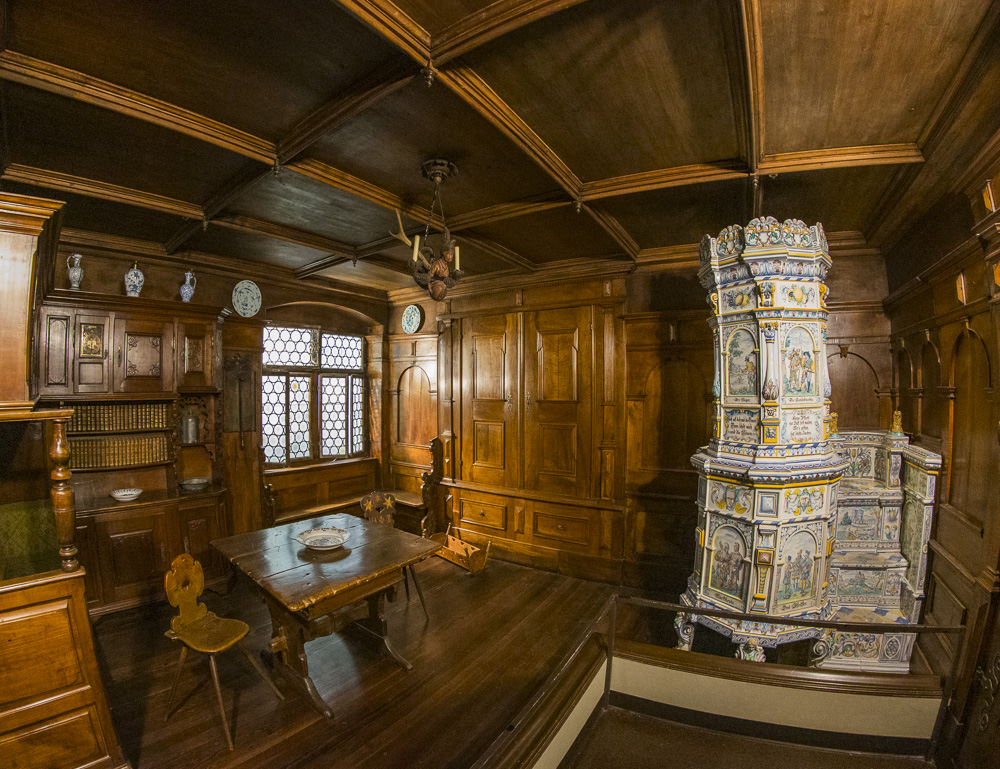
Native Toledoan Nettie Poe Ketchum, born 1865, was a cousin of Edgar Allen Poe. She donated the Swiss Room to the Toledo Museum of Art in 1926. She died in Switzerland in 1950, bequeathing her estate to the TMA School of Art and the Toledo YWCA in equal parts. She had been impressed to learn on a visit to the art school in 1933, that that working women took art classes at the museum on certain nights and on other nights had activites at the YWCA.
The changing of the guards
The culture of the museum carries on. Generations later, there is still a sense of awe and camaraderie amongst the employees. They love the museum. The museum, with its collection, has always been and will always be (unless they sell it) the epitome of excellence.
The collection is the result of a $10 million endowment to the museum from the Libbeys in 1925. The fund would be worth maybe $3.66 billion today if it had only grown 6% annual interest and never had been touched for 101 years. But since it’s been used quite effectively all these years; while being conservatively invested, it is worth today about $34 million.
Edward Drummond Libbey and his wife, Florence Scott Libbey wanted to give the people of Toledo a gift. After all, Libbey made his fortune in industrial glass here, and he wanted to give back to his workers, their families, and all the people of the city. He did so in the most democratic way. He endowed a museum with art and art education, and made it forever free for all people to attend.
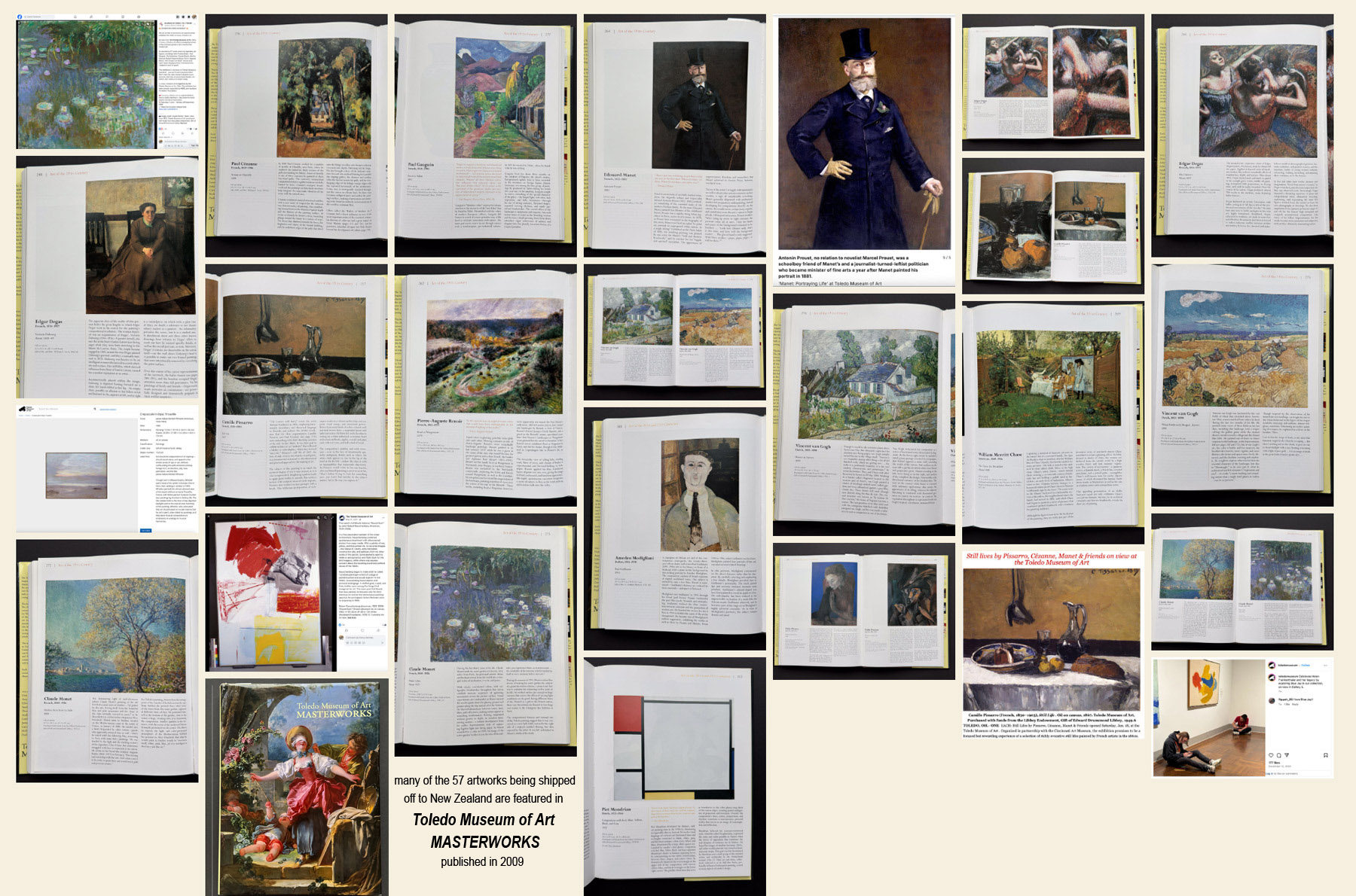
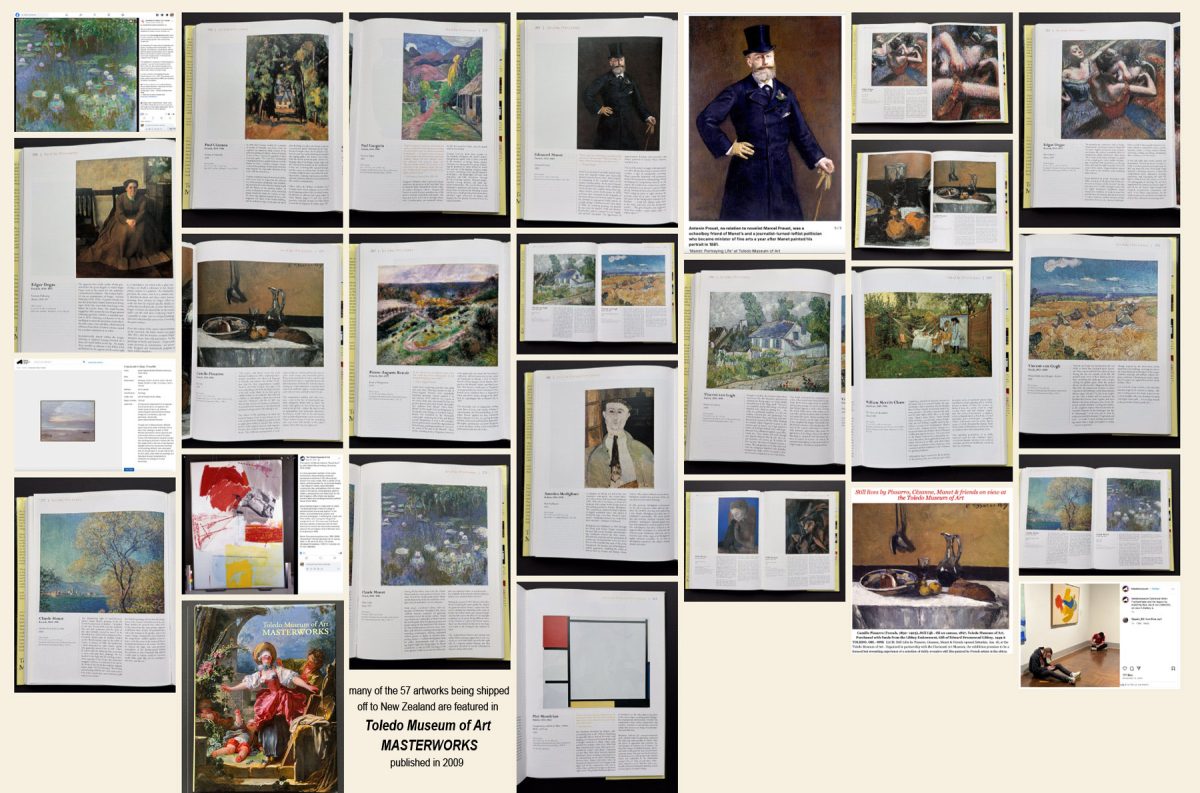
To make his gift last, Edward Drummond Libbey had an ingenious condition regarding the use of the funds. The condition was that for any money withdrawn, 50% would have to be spent on art. Working in perfect harmony with this plan, curators over time have purchased the very best art for the collection. Today this collection well-exceeds the $3.56 billion of our 6% estimated return on the original investment if it was never touched. It’s worth well into the double digit billions. The 57 masterworks that are currently on tour in New Zealand and Australia as a group are worth $1 billion or more.
The endowment’s 50% rule has transformed itself into a continual stream of new art for the cultural benefit of the people of Toledo, as it was a gift to the people, under the historic charitable trust of Edward Drummond Libbey.
The Museum in the Seventies
In the 1970s, when James Moore was there, the museum was highly culturally productive. The community drew its vitality from its existence in the heart of the art world, which was the museum.
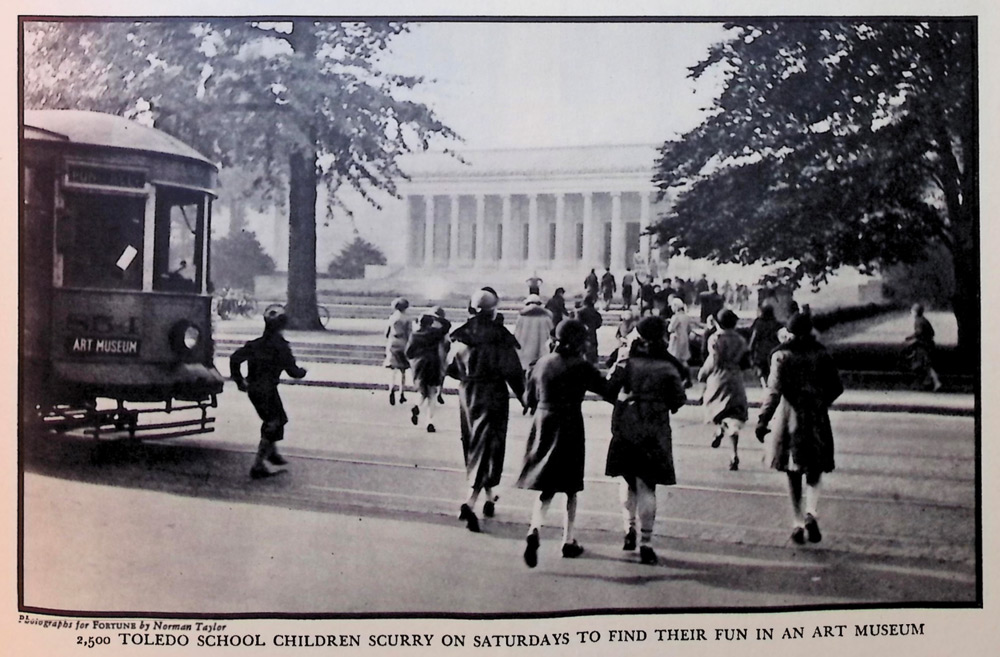
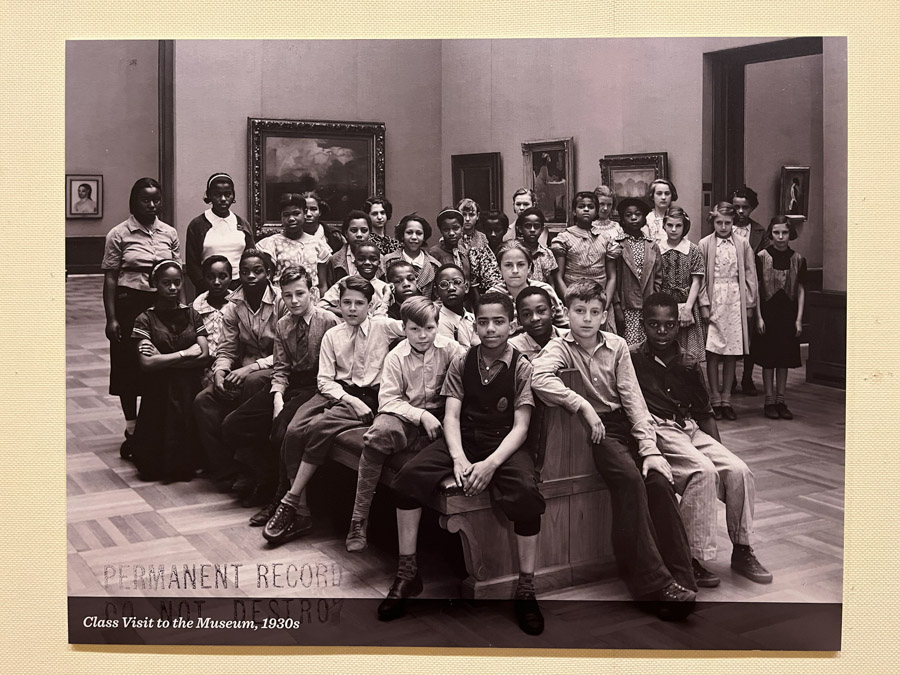
Local artists were supported within the museum system, which showcased their work in a prestigious annual juried exhibition that grew into a nearly century-long tradition. The museum also provided the public with an exceptional art education, particularly through its year-round city-wide children’s classes held every Saturday.
Toledo believed that curators should be educators first. Each year, a competitive fellowship program brought together six or more talented young art history scholars from the best colleges across the country to work at the museum. In addition to gaining firsthand experience with the museum’s collection, fellows were required to teach children’s classes. The children’s education program was a tremendous gift to Toledoans, myself included.
Perhaps 50 fellows came through this program during this decade, many going on to prestigious positions in the art world. For example, the Pulitzer Prize winning art critic of the Los Angeles Times, Christopher Knight, and the Director Emeritus of the Whitney Museum of American Art, Adam Weinberg.
Adding organically to the texture of the world’s arts culture, the museum gave to the city all of this, and did so, so leanly. The annual budget of the museum was about $1.34 million, or $10.59 million in today’s dollars. (Today’s budget is close to three times that, with none of that anymore.)
All this as the art collection grew.
The 21st century Battle of Toledo
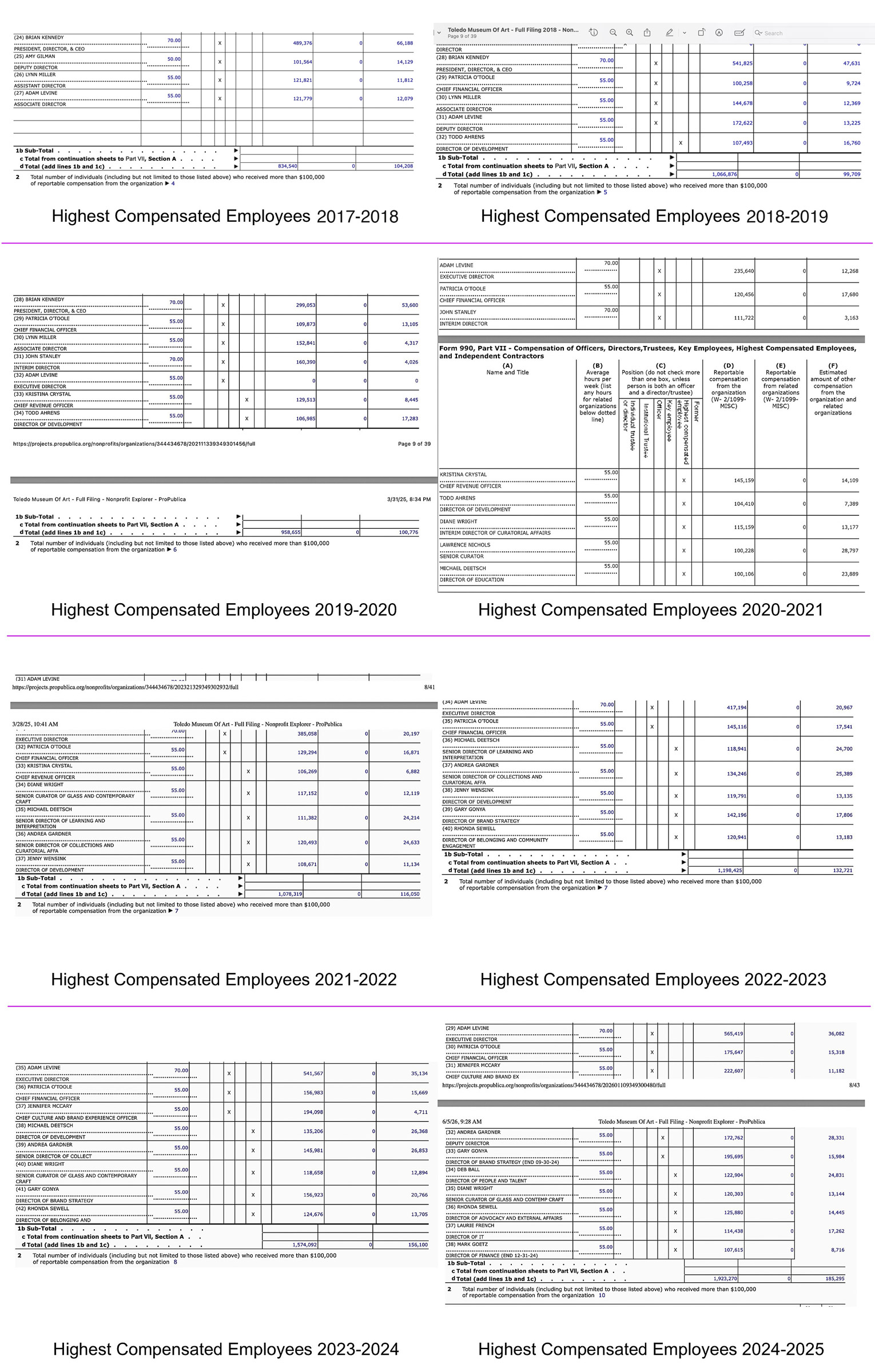
After the untimely resignation of Director Brian Kennedy in March of 2019, and the year-long search for a new director, during which John Stanley was hired in the interim, Adam Levine, the youngest director ever, began his tenure. He started exactly when covid hit – in April 2020.
Adam Levine “leverages” the Libbey collection. He speaks openly about it. He is using the collection to transform the museum right down to the “physical studs.” He is not as much a curator as he is an excavator-turned contractor.
He calls it, “Transformation 2027,” a strategy slowly revealed to the public with what began as a plan to update the HVAC system, funded by a bond issued by three different Ohio port authorities for $25 million.
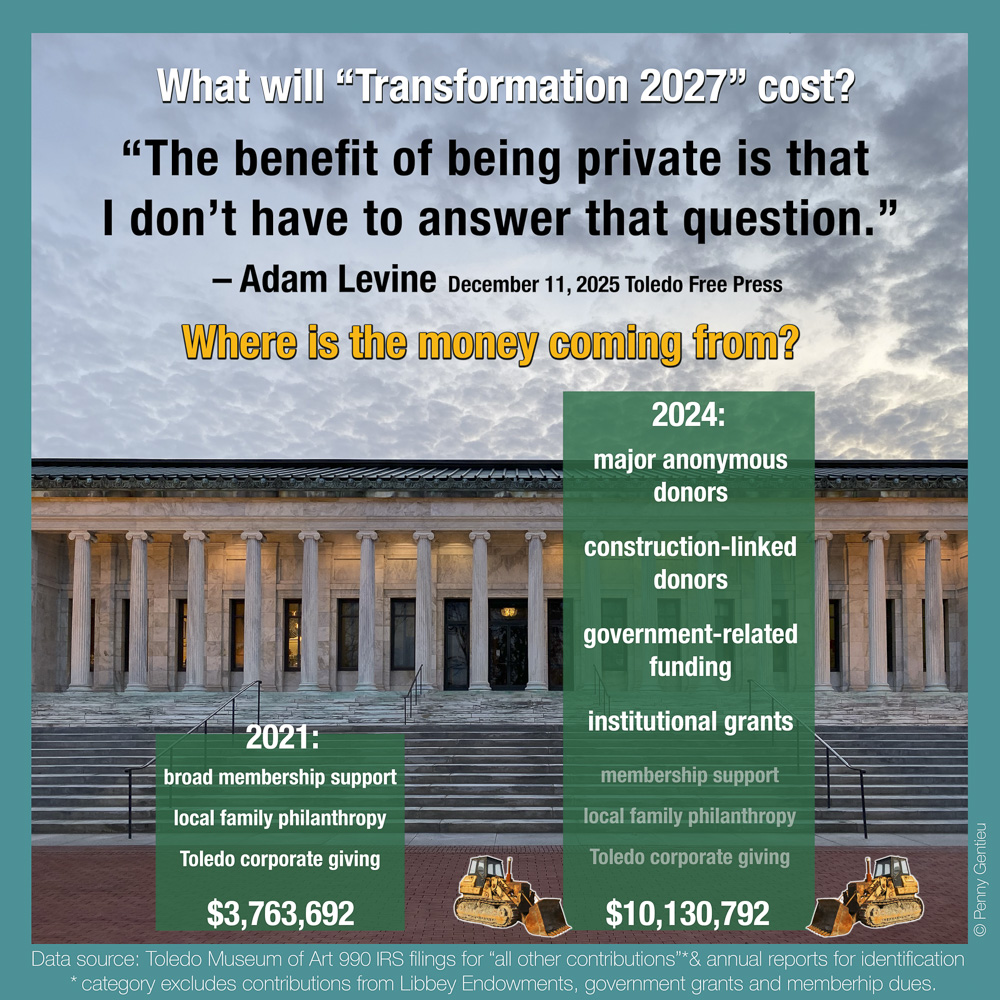
Adam Levine will not reveal the financial details of “Transformation 2027.”
Whereas the museum had always been supported locally, it went out of its way collecting donations from any and everywhere possible, strings or no strings. The new sources include anonymous donors, institutional grants, government-related funders of all kinds, and construction-linked donors. These new donors overshadow the long-time local family philanthropy, Toledo corporate giving, and broad membership support that for 125 years has kept the museum going quite successfully, and locally, carrying out Libbeys’ intentions and visions for the people of Toledo.
Adam Levine collected federal public funds during the pandemic meant to help support hurting institutions. He obtained a two-year variance on Libbey Endowment”s 50% rule, so that the money earmarked to buy art could be used for the “care of art” instead. Was it to the best advantage of the trust and for the people of Toledo? There was no financial hardship, as would be shown in the IRS 990 filings after the fact. Considering that Levine used the money to prepare paintings for shipment outside of the country so that he could leverage the art and finance his makeover of the museum, I would argue that the variance obviously was not in the best interests of the trust, which was to provide culture to the people of Toledo. In fact, it might have been obtained under false pretenses, if in fact the museum claimed hardship.
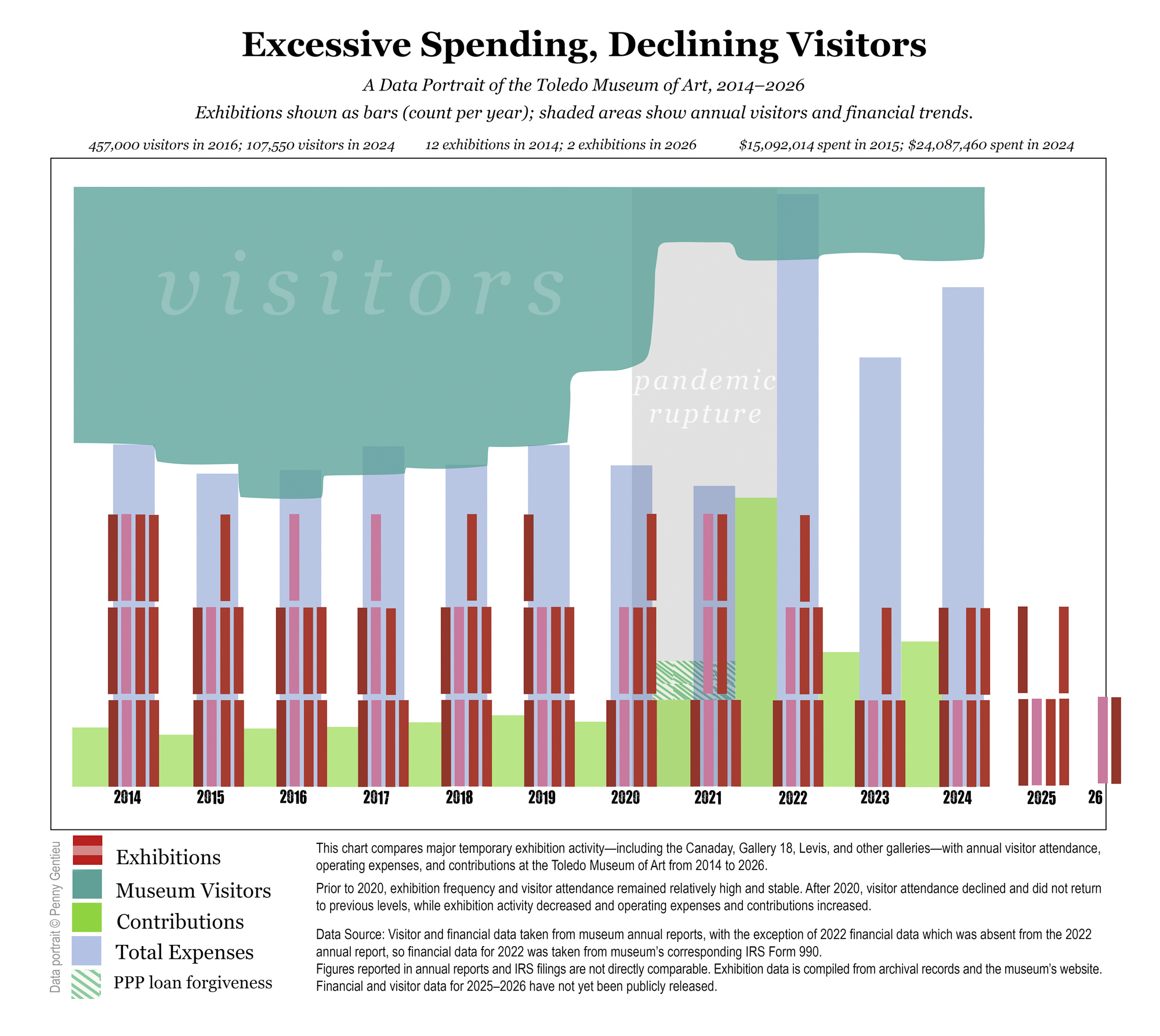
Exhibition Activity, Attendance, and Financial Trends at the Toledo Museum of Art 2014–2026. Note the increase in contributions and expenses after the pandemic which became decoupled from public engagement and exhibition output. A disconnect between visitors and revenue.
Adam Levine took a $6M federal loan forgiveness in 2021. Who would blame him for taking the free money. But with it, he raised the operating budget fast and high, and there was no looking back.
His funding sources even cut into the precious Libbey art collection — in 2022 he sold three exquisite paintings by Cezanne, Matisse and Renoir for $59.7 million dollars. He did not buy art with it as it is stated in the will. He did not put it back into the Libbey Fund earmarked for art purchases. He created a brand-new fund the size of the “Libbey corpus” with the Cezanne and Matisse proceeds, out of sight from public scrutiny of the Libbey Fund.
Attendance never recovered after the pandemic
The museum staff grew by perhaps 50% or more since Adam Levine started. Whereas in 2017 the museum reports 150 employees, in 2025 we heard reports of 350 employees.
One might wonder, what was the point of the increase in staff, because the museum never recovered from the “pandemic rupture.” The attendance reported in the annual reports had been flat from 2021 through the last annual report published, 2024.
Toledo is a union town
One day in 2024, the employees of the visitor services, glass studio, research, education, curatorial and library departments started talking about forming a union. They loved the museum and were passionate about their jobs; they wanted job security. They could foresee the future and wanted to protect themselves. They were as unified a group of museum workers today as they had been throughout the museum’s history.
They formed a union, under the American Federation of State, County and Municipal Employees (AFSCME), of about 100 workers, which was officially recognized in the spring of 2025.
Skye Sloane, a team leader for visitor services, told Hyperallergic, the reinstallation project is “a significant change to the institution that we all love, and we wanted to band together and feel sure and secure in our new jobs, benefits, and wages, before the project is completed.”
TMA chief people officer Jennifer McCary told Hyperallergic that TMA “respects the democratic process and remain committed to fostering a supportive and collaborative work environment for all employees.”
For a museum that supposedly prided themselves as having great employee relations, it seems that they suddenly became union busters. A few of the employees who were interviewed or who posed for the photo in the Hyperallergic article, among other vocal employees of the union, are no longer working at the museum today – one year later.
The museum talks the talk but it won’t walk it.
This is Objective 3 of Adam Levine’s 2021 five-year strategic plan:
Become an Employer of Choice — Visitors will be “shocked and delighted to be welcomed by a diverse and empowered staff so clearly loving what they do and the institution they serve,” and visitors will also be “eyeing the posted job opportunities, hoping for a chance to work for an institution known widely for treating its staff so well.
An employer of choice would allow their staff to have direct collective bargaining power, to ensure fairness and security for themselves and for their coworkers.
Especially in Toledo, a union town.
Letting their guards down
Now, in 2026, as the guards tried to unionize, the museum terminated the guards only to rehire them through an outside company, stripping them of health insurance, retirement benefits, reduced hours and more.
The guards wanted to form a union. They filed a petition with the NLRB to do so. But they were immediately cut off at their knees – given notice that they were being terminated but that they could be rehired by the company called (ironically) “Safeguard.” Safeguard is the outside company that the museum had been using for patrolling outside the building and the parking lot. And now this outside company is in charge of the inside, and the workers who once worked for the museum have been taken down.
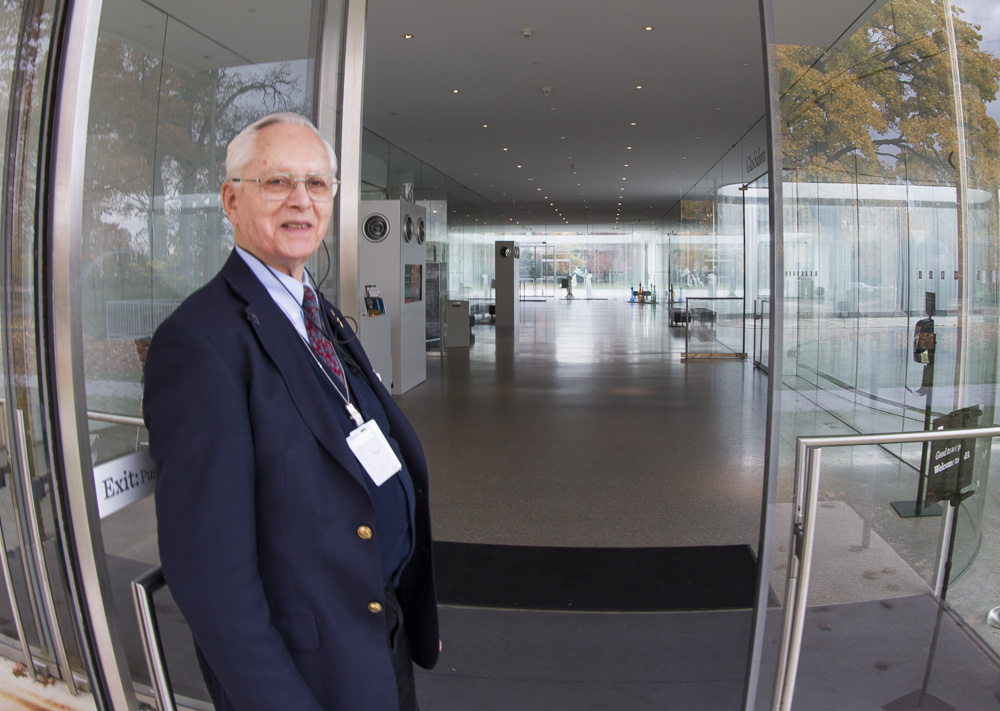
Frank, museum guard, at the entrance of the Glass Pavilion, 2014
The guards were probably the largest category of employees at the museum — I counted 75 names listed one year on an annual report. They are the frontline, the security, the ambassadors, the people that safeguard the art and connect visitors with the art. They are the most beloved employees at the museum, and they have been downgraded and degraded by an ever-ballooning administration that even hired a special chief people officer a few years ago to keep up with the growing staff and instill a culture of belonging (what a joke) — and look what they are doing now.
Adam Levine’s “Transformation 2027”
In March of 2026, along with out-sourcing the staff, we heard news that our priceless artwork was being shipped out of town en masse.
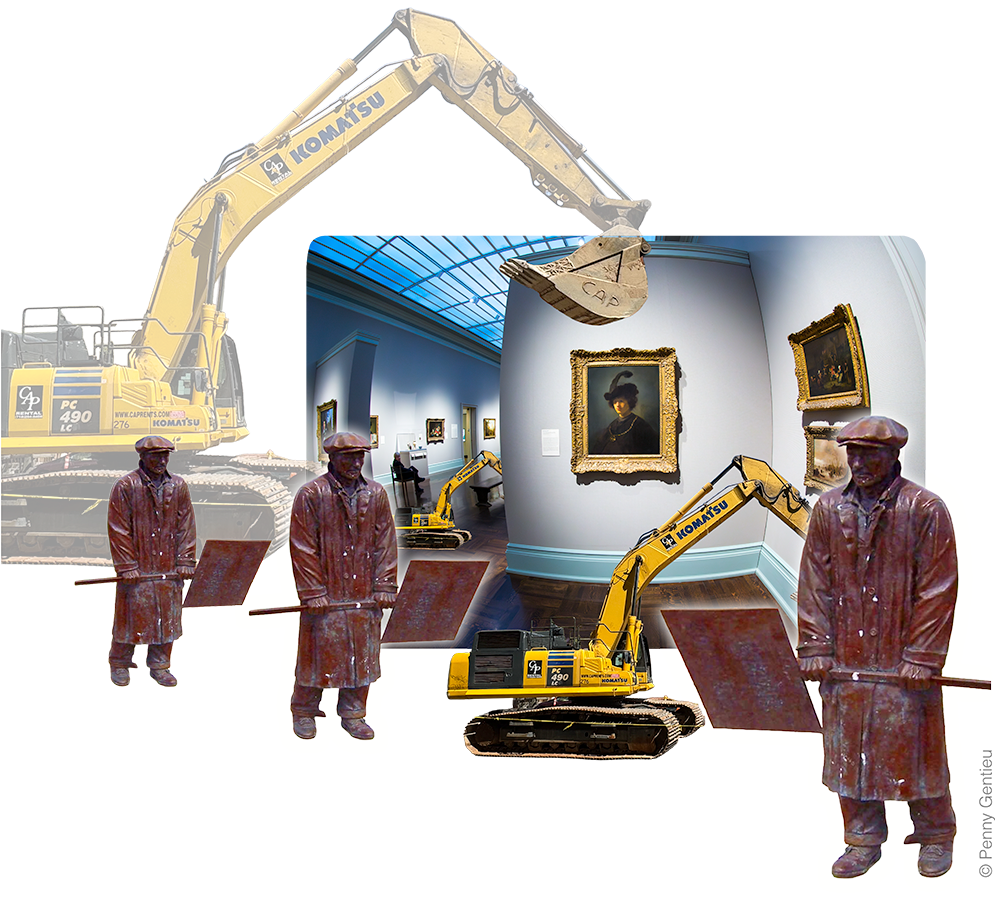
As Adam Levine tears the museum down to the studs, removing our art and shipping it all over the world for exhibitions and storing the rest in art storage facilities in various cities in the U.S., he is also destroying the museum’s own corporate foundational ecosphere built to care for the art.
It makes you wonder, is this going to land well, or are we presently witnessing the total implosion of our museum?
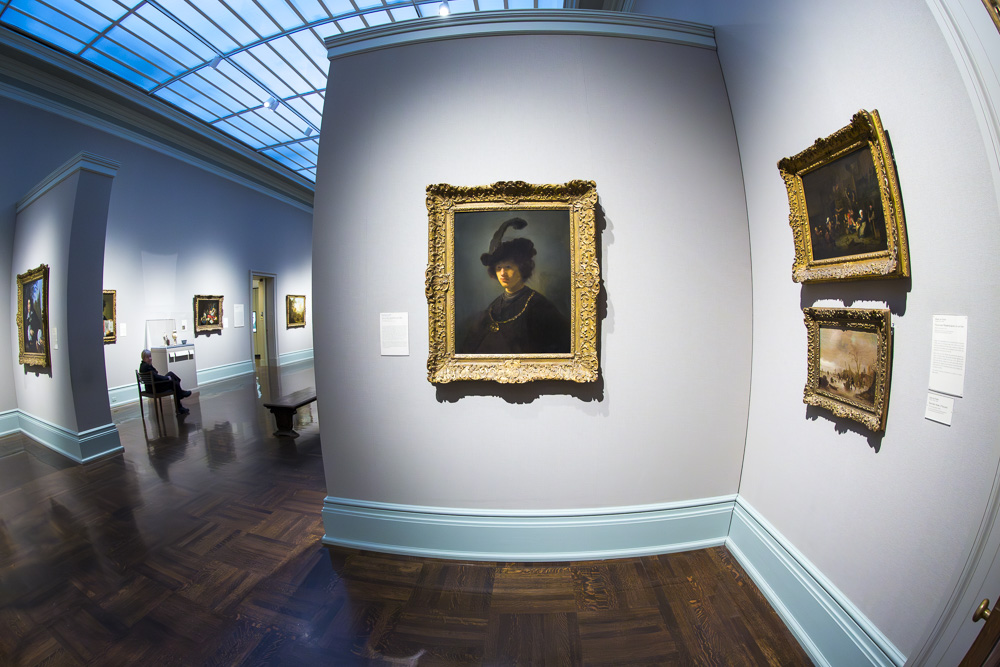
Hey Adam — that’s our Rembrandt! Can you please tell us where it is at this exact moment? And where is everything else?
The 1934 Battle of Toledo: A bronze statue created by Hai Ying Wu paid tribute to Toledo’s role in America’s labor history during the two-month long strike at the Autolite factory. Forged at the university’s sculpture studio behind the museum, it was installed at Union Memorial Park at Elm and Champlain streets in 2000. Removed in 2019, it was put in storage, but the ghosts remain. Ironically, the Autolite company’s president’s trust is one of TMA’s largest donors.Click on this comment to read an ongoing discussion on Toledo Now Facebook page
after all that they have shown us,
How can the directors be deserving of our trust?
It’s OUR museum.
The Libbey Trust, over 101 years, has transformed itself into many billions of dollars worth of public art. The Libbeys intended it for the people, not for leveraging power of a director.
It belongs to the people. For our art to be scattered all over the world — in international exhibitions and in storage facilities across America – while our museum undergoes “transformation” and workers lose jobs is outrageous!
James Moore, the former TMA employee who inspired this essay, has had a distinguished career in the art world. His early life was shaped by the unique culture of Toledo, and the principles learned at TMA have guided him throughout his career. He has been a trustee of the Wichita Art Museum, a lecturer at University of Mexico, a member of the Collections Committee of the National Hispanic Cultural Center, and is the Director Emeritus of The Albuquerque Museum of Art and History.
He wrote an opinion piece published in the Berkshire Eagle in 2018 regarding museum stewardship. The context concerned the unethical deaccessions taking place at the time at the Berkshire Museum. It rings true today. James Moore: Museum’s violation of trust will have far-reaching impact.
We speak of “trustees,” and the “public trust,” but these are abstractions. In reality, it comes down to assessing whether a museum is trustworthy by evaluating whether the people managing and governing it are themselves trustworthy. This is the basis for ethical behavior among people, both internally with employees and externally with the public.
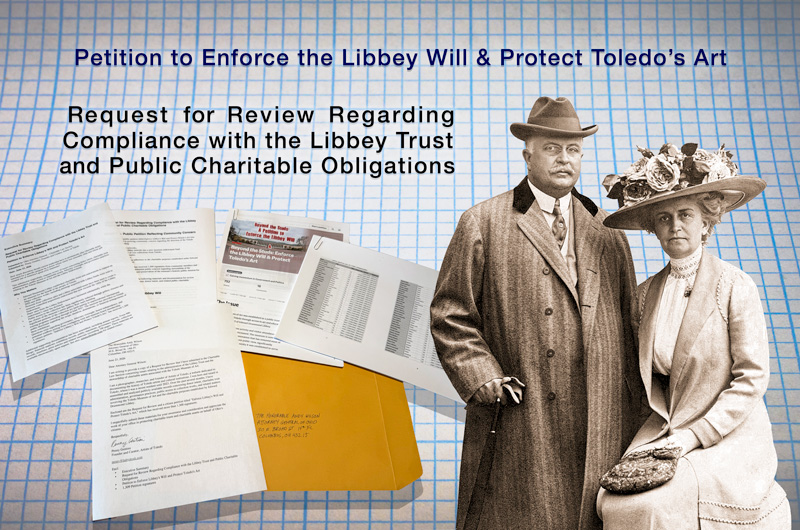
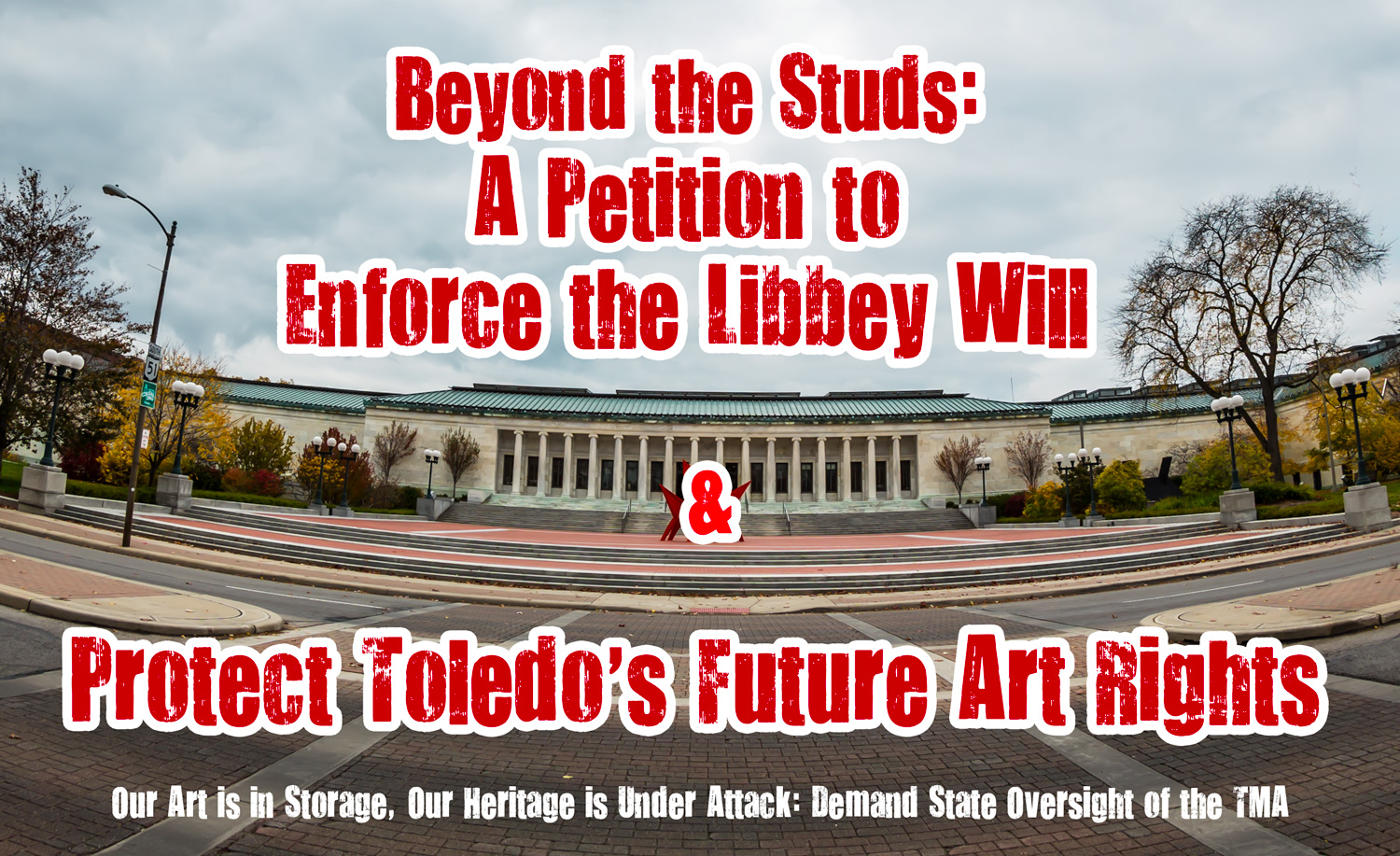
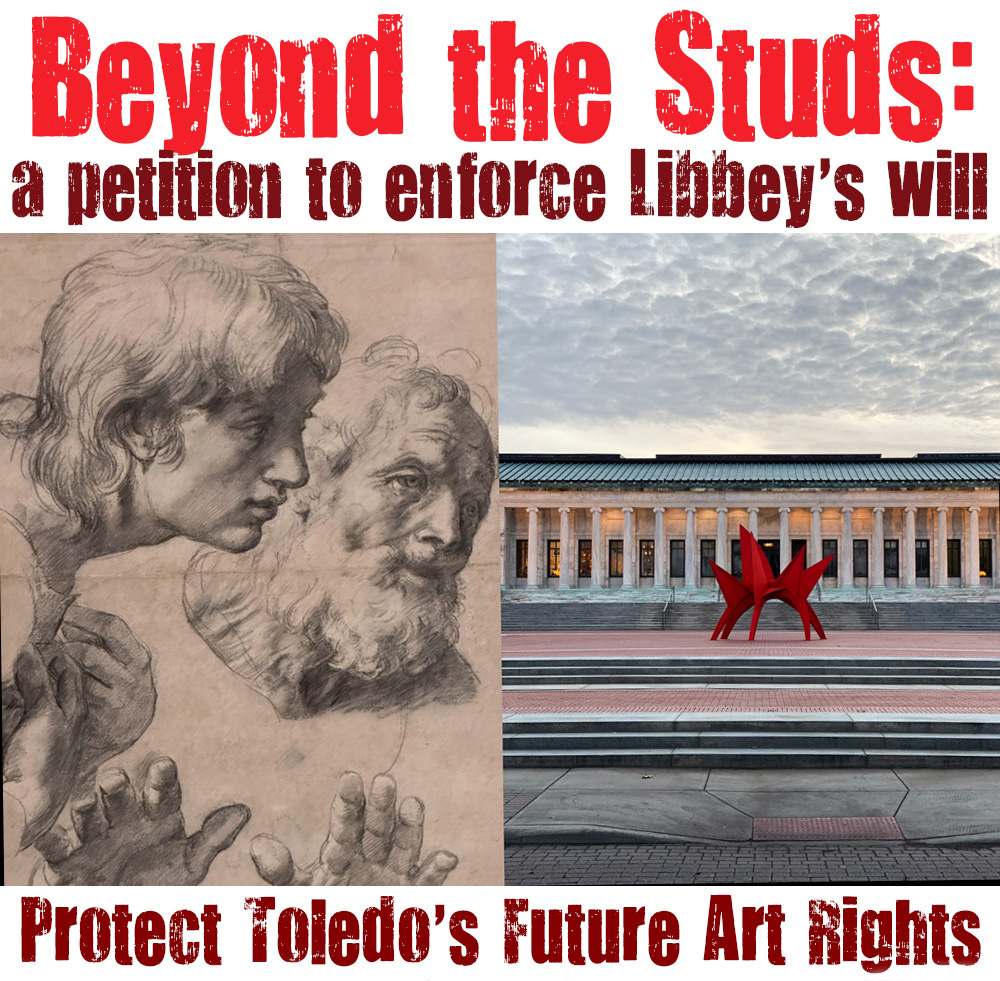
I would end this essay here but there is no end in sight…. So many problems … hence, a petition is underway addressed to the Ohio Attorney General to enforce Libbey’s Will and protect Toledo’s art.
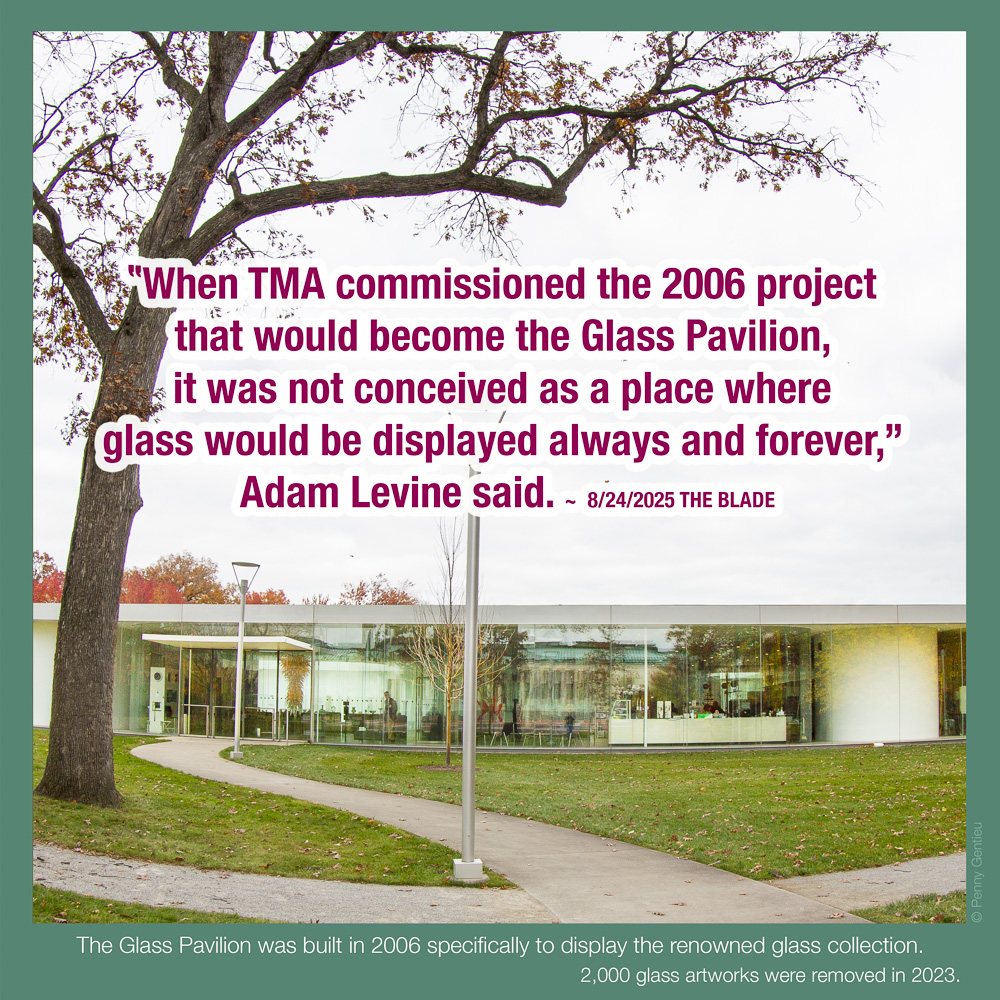
Years of planning, intention, effort and money went into to the building of the Glass Pavilion for the museum’s collection of glass. Then along comes Adam Levine telling us that “it was not conceived as a place where glass would be displayed always and forever.” Umm…really?
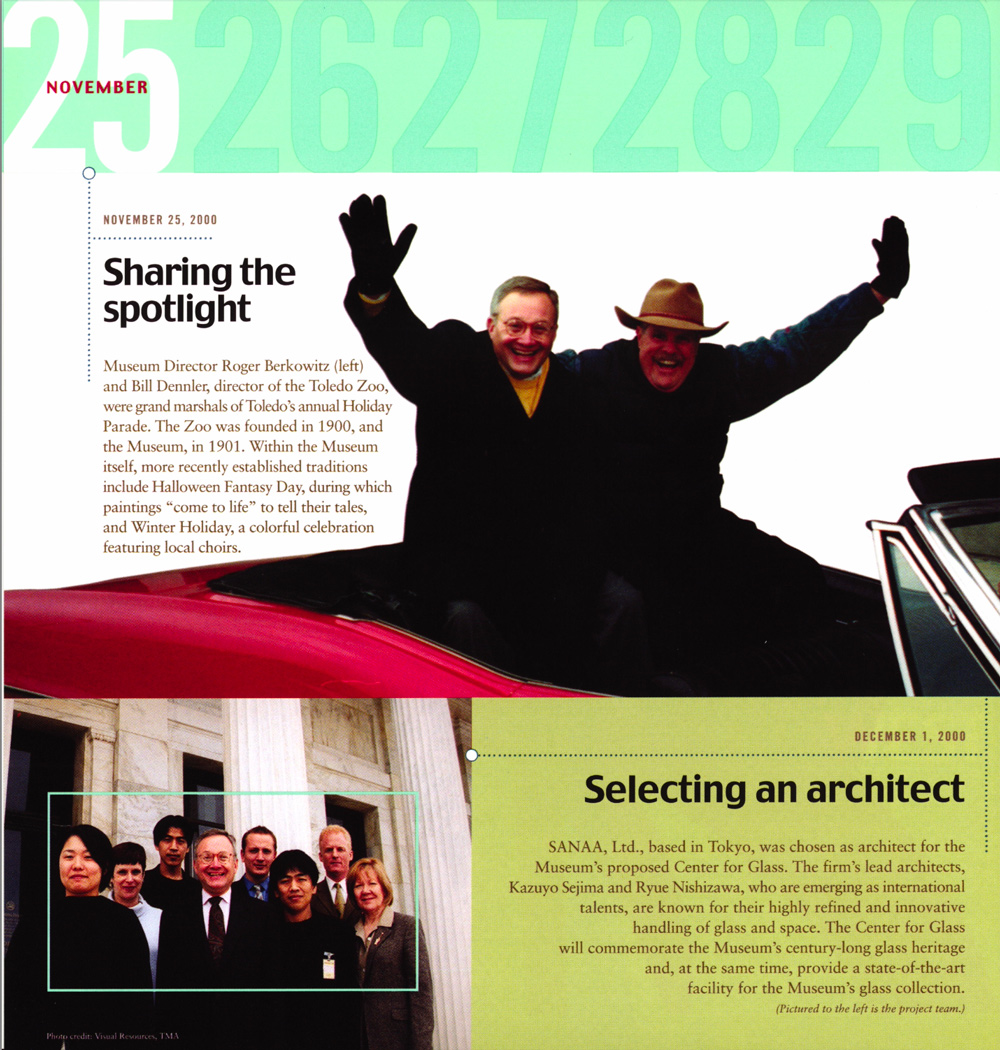
DECEMBER 1, 2000 – Selecting an architect: SANAA, Ltd., based in Tokyo, was chosen as architect for the Museum’s proposed Center for Glass. The firm’s lead architects, Kazuyo Sejima and Ryue Nishizawa, who are emerging as international talents, are known for their highly refined and innovative handling of glass and space. The Center for Glass will commemorate the Museum’s century-long glass heritage and, at the same time, provide a state-of-the-art facility for the Museum’s glass collection.
Letter to the Attorney General
Thank you for signing, and please add your name if you have not already, to the Petition to enforce Libbey’s Will, here.
April 4, 2026
To the Office of the Attorney General:
While our masterpieces are currently scattered in storage facilities across the country and our galleries are stripped to the studs, we refuse to let the Libbey Will be dismantled along with the walls. We are calling for State Intervention to ensure that the planned reopening does not become a permanent downsizing of our cultural inheritance.
We, the undersigned—including Toledo residents, born and raised Toledoans, visitors, friends, art historians, and stakeholders—formally request an investigation into the Board of Directors of the Toledo Museum of Art for apparent violations of the ITEM XXV–LAST WILL AND TESTAMENT of EDWARD DRUMMOND LIBBEY.
We believe the current leadership has deviated from the Trust’s mandates in the following ways:
1. Loss of continuous public exhibition
The Will requires that works be properly housed for public exhibition. Multi-year closures and removal of art from view undermine this mandate.
2. Dismantling of the collection’s integrity
Sales of major works and long-term international loans reduce the cohesion and accessibility of the collection.
3. Removal of art from its purpose-built home
The Libbey building was designed to safeguard and display the collection. Relocating works to storage and transit exposes them to unnecessary risk.
4. Public subsidy without public accountability
Despite tax-exempt status and public funding support, major decisions have been made without transparent public engagement.
5. Breach of the museum’s open-access mission
Extended closures exceed what could reasonably be considered “temporary” and deny access to a unique regional cultural resource.
We ask that your office exercise its authority under Ohio Rev. Code §109.24 to review these actions and ensure that this charitable trust is administered in accordance with its founding purpose.
The Toledo Museum of Art was created for the public—and must remain so.
Respectfully submitted,
[1,150 petition signers as of May 10 and counting.]
Read more about the petition to enforce Libbey’s will on this page of artistsoftoledo and please share:
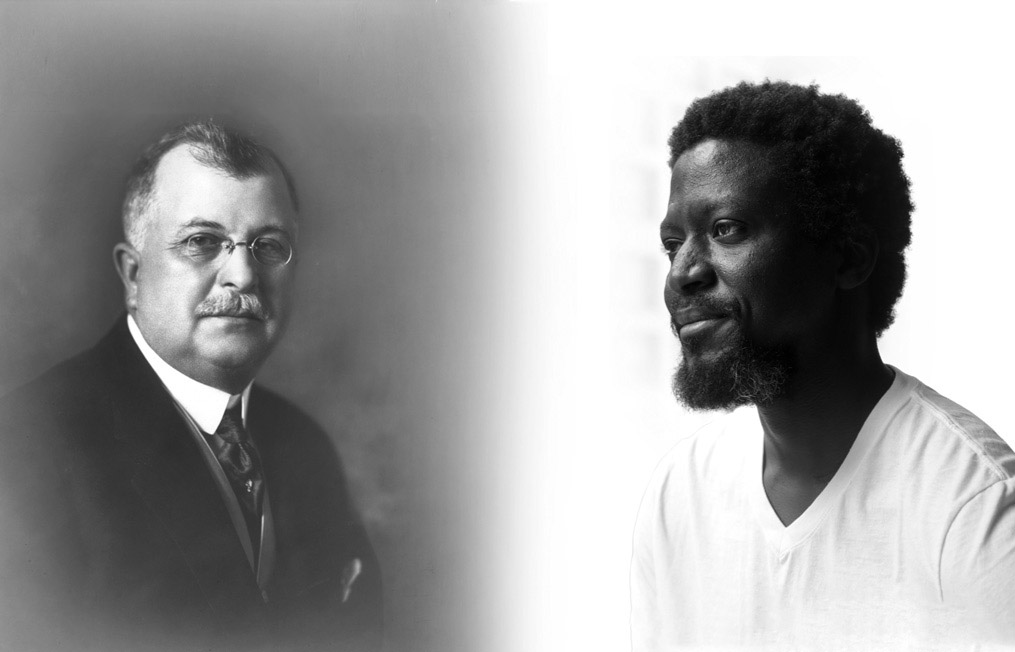
Edward Drummond Libbey (left) and Ibrahim Mahama (right). Composite image created for editorial commentary on cultural stewardship and institutional legacy.
What Toledo Is Losing: Stewardship Across Time
I find myself comparing Edward Drummond Libbey and Ibrahim Mahama. I began thinking about Ibrahim Mahama because my work along with my daughter’s work is currently part of an exhibition in one of the cultural spaces he has created in Ghana. More than a century apart, the two men each represent a different vision of how culture is built and sustained.
Ibrahim Mahama: Building for a Future He Will Not See
Ibrahim Mahama is a Ghanaian artist whose work engages collective memory and historical narratives deeply rooted in Ghana’s past and present. He has described his practice as a form of “time travel.” Internationally celebrated, Mahama has chosen to turn the profits of the global art market back into his home region of northern Ghana—building studios, research centers, archives, and public cultural spaces that serve artists and communities far beyond his own career.
Mahama’s work is often discussed in terms of materials, but its most consequential dimension may be institutional. Rather than withdrawing from Ghana after achieving international success, he has reinvested directly in place. His cultural spaces preserve memory, support research, and provide infrastructure for artists and the community.
Mahama does not dismantle cultural memory in order to innovate. He adds to it. His institutions are long-term civic commitments meant to outlast his own presence. They are built on the assumption that continuity itself has value.
Seeing what Mahama is building in Ghana made me reconsider what Toledo once understood a museum to be.
Edward Drummond Libbey and the Civic Ideal of the Museum
More than a century earlier, Edward Drummond Libbey made a remarkably similar decision. At the height of his success in the glass industry, Libbey endowed the city of Toledo with something radical for its time: a free, educational art museum meant to belong to the entire community. From its founding, the museum was free and educational, and civic at its core. It offered year-round Saturday art classes for children, college students, and adults. For nearly a century, it hosted the annual Toledo Area Artists Exhibition, a cultural touchstone that brought the local artist community together and helped launch countless careers.
Along the way, curators assembled an encyclopedic collection of art from around the world. The majority of the museum’s most valuable works were either gifted by the Libbeys or acquired through endowments they established. Edward Drummond Libbey and his wife, Florence Scott Libbey, articulated a clear governing principle: for every dollar spent on administration, an equal dollar should be spent on art. This balance was meant to keep the institution grounded in its purpose.
For much of the twentieth century, the museum thrived under long-serving directors who built steadily on this foundation. The Toledo Museum of Art was widely regarded as a model democratic institution—without having to announce itself as one.
Mahama reinvests success back into the community that produced it.
Libbey endowed permanence so art would remain available to those who lived with it. Different eras, different methods — the same ethic.
Continuity: How Stewardship Actually Works
Stewardship is the promise that what one generation builds, the next will care for and carry forward.
Cultural stewardship is slow. Its effects accumulate quietly over decades, often unnoticed while they are happening. Institutions like museums do not shape people through spectacle, but through repetition and presence—by being there year after year, generation after generation.
I understand this not only as an observer, but as a product of that system. I grew up with the Toledo Museum of Art as a civic constant, taking classes there from childhood through college. Art was not presented as exceptional or exclusive; it was simply part of life. That continuity mattered. It shaped how I understood art and culture as shared civic goods. Today, my work appears internationally, in an exhibition at the Savannah Centre for Contemporary Art in Ghana built by Ibrahim Mahama. That connection clarified something for me: Libbey’s legacy was never just a building or a collection. It was people.
What changes when art stops belonging to a place
and starts working for an institution?
Stewardship vs. Leverage
What we are seeing now treats legacy as something to be leveraged.
Leveraging art is part of the museum’s 2021 Strategic Plan – “TMA’s exhibitions will depart Toledo to traverse the globe, providing the Museum and its hometown the visibility it once enjoyed.” As Adam Levine stated to The Blade in 2022, “now we have a cultural shift and a new framework for how we can leverage this extraordinary collection to service the community.”
Dozens of masterworks — many long understood as highlights of the museum — have been removed from Toledo’s walls and sent abroad. Toledoans lose access, continuity, and presence, while the institution gains visibility, prestige, and philanthropic reach elsewhere. Whether or not these arrangements are called loans, they function like renting out the collection — converting Toledo’s inheritance into institutional capital.
This shift has been accompanied by a new level of opacity. At a December town hall, the director refused to disclose the total cost of the museum’s reinstallation. “The benefit of being private,” Adam Levine stated, “is that I don’t have to answer that question.”
With the collection built over more than a century through Libbey endowments and local stewardship, worth many orders of magnitude more than the physical systems used to justify its absence, the museum is undergoing a complete transformation, right down to the physical studs. It’s not merely a change in exhibition strategy, it’s a change in ethics. A museum founded on the principle that art should stay, teach, and belong now treats mobility as virtue and absence as acceptable. The people of Toledo are asked to trust – without transparency – that this leveraging of their inheritance will serve them.
Frank, a museum guard at the Glass Pavilion, 2014
Stewardship Includes Labor
Tourists [will be] shocked and delighted to be welcomed by a diverse and empowered staff so clearly loving what they do and the institution they serve.” – 2021 Strategic Plan.
The irony.
For generations, the museum guards at the Toledo Museum of Art were not simply security. They were trained, knowledgeable, and deeply embedded in the daily life of the museum — often serving as the most human point of contact between Toledoans and their art.
Longtime interpreters and art ambassadors, the replacement of museum guards with a third-party contract service signals another quiet shift: away from relational knowledge and toward transactional presence.
Additionally, “visitor services” workers at the entrances are being replaced by kiosks. Labor is increasingly treated the way the collection is: something to be optimized, externalized, and leveraged.
When a museum distances itself from its workers, it distances itself from its public. And when labor becomes peripheral, the institution risks hollowing out the very relationships that once made it matter.
The Central Question
Would Edward Drummond Libbey have wanted his museum dismantled, its masterworks dispersed, and its educational core deemphasized and long-time workers replaced in the name of reinvention?
And how would Ibrahim Mahama feel if the cultural institutions he is building today were stripped of their purpose a century from now and repurposed into something unrecognizable?
The most radical act a cultural institution can take is not reinvention but continuity—honoring the trust placed in it by the past while making room, carefully and responsibly, for the future.
These two men belong to very different moments in history, but both understood that culture does not sustain itself. It survives only when someone decides it is worth building — and worth protecting. The question for Toledo is what kind of stewardship it now believes in.
Mahama builds so culture can endure where it is made. Libbey endowed a museum so art would belong to the people who lived with it. That is the standard Toledo was given. And it is the standard against which this moment should be measured.
Within five years, changes were made at great speed—resulting in mass removals of artwork, off-site storage across the country, and a wholesale transformation of the museum’s physical space. I have documented this sequence here:
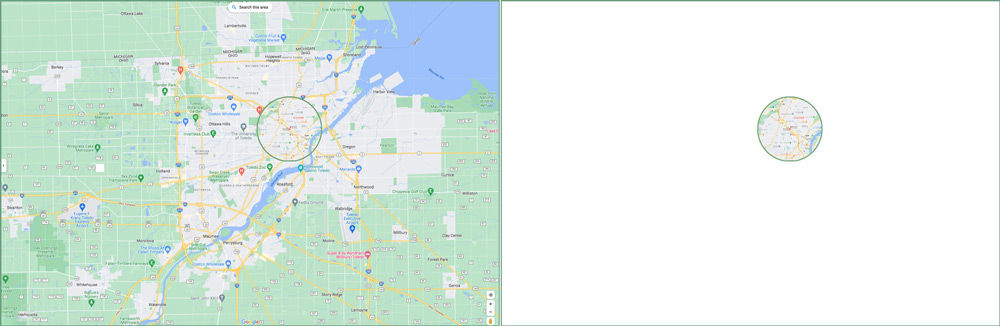
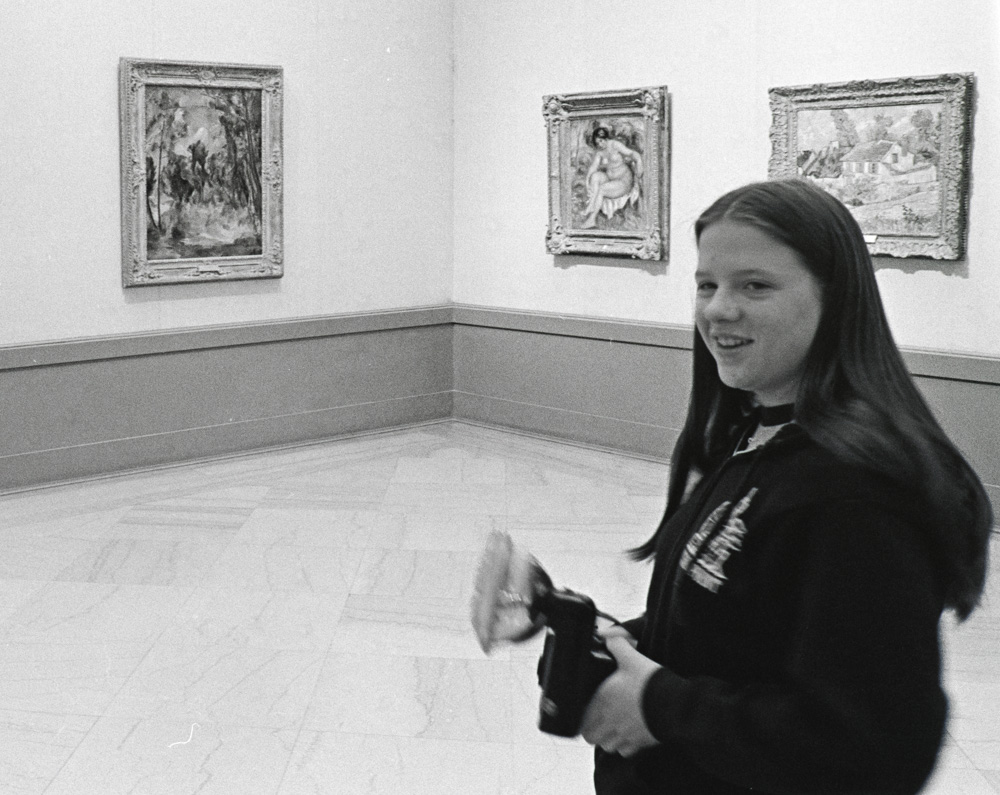
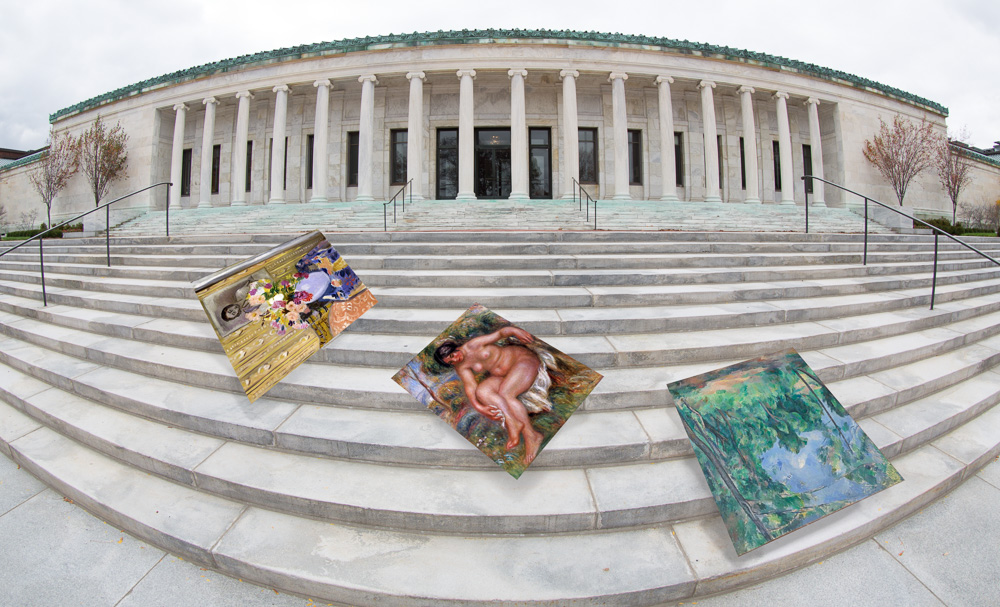
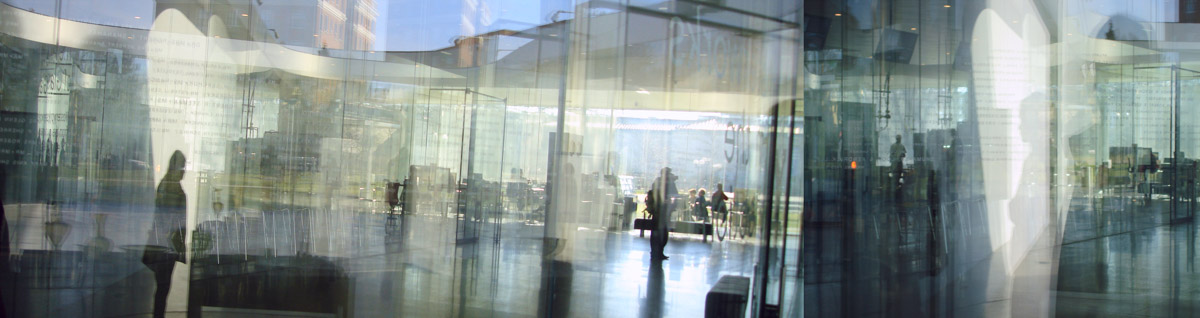
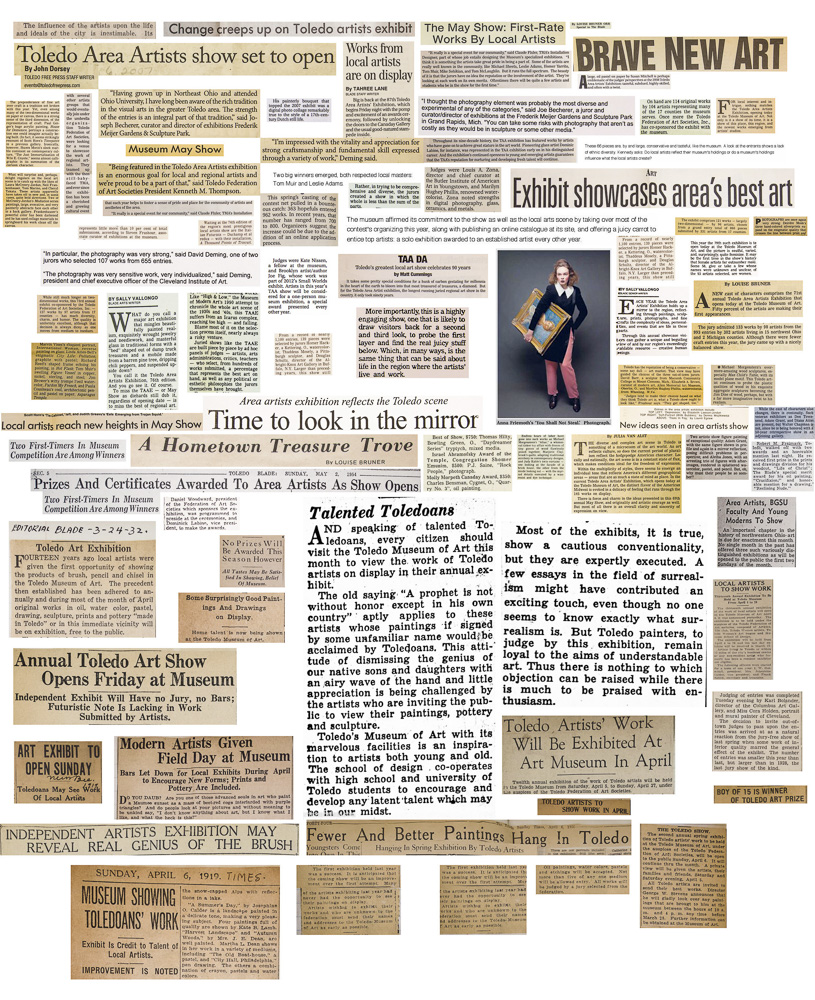
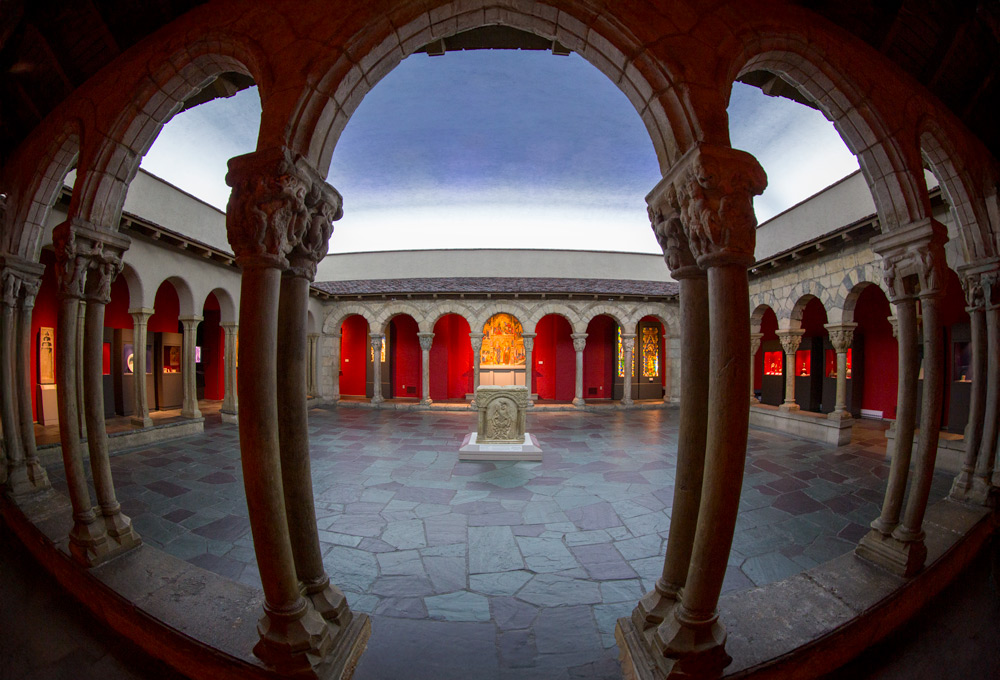
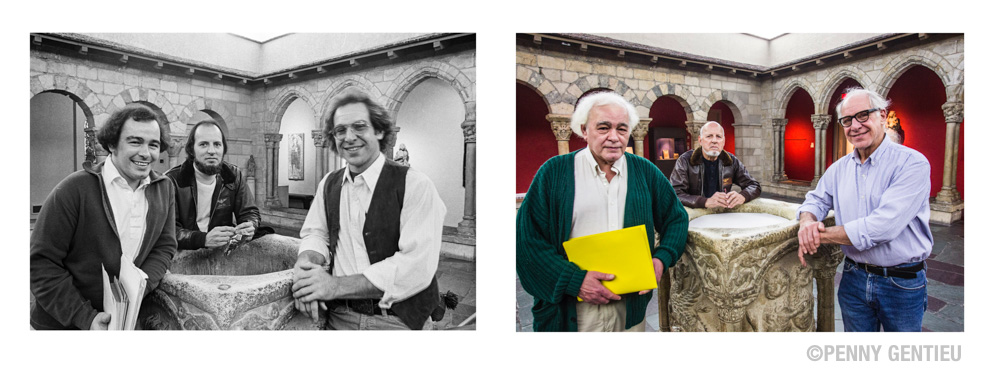
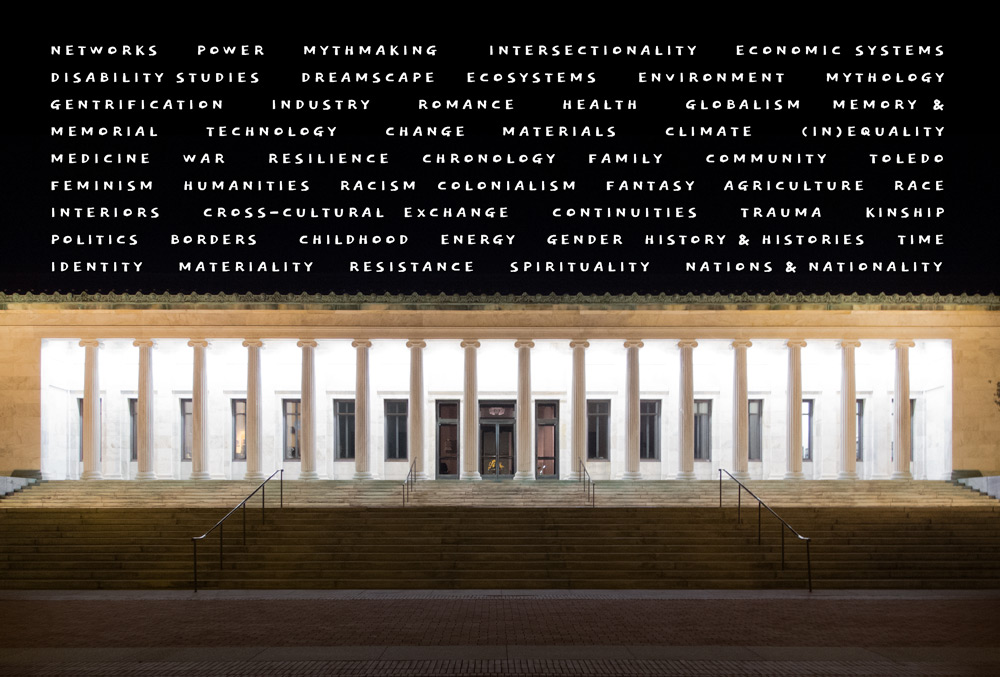
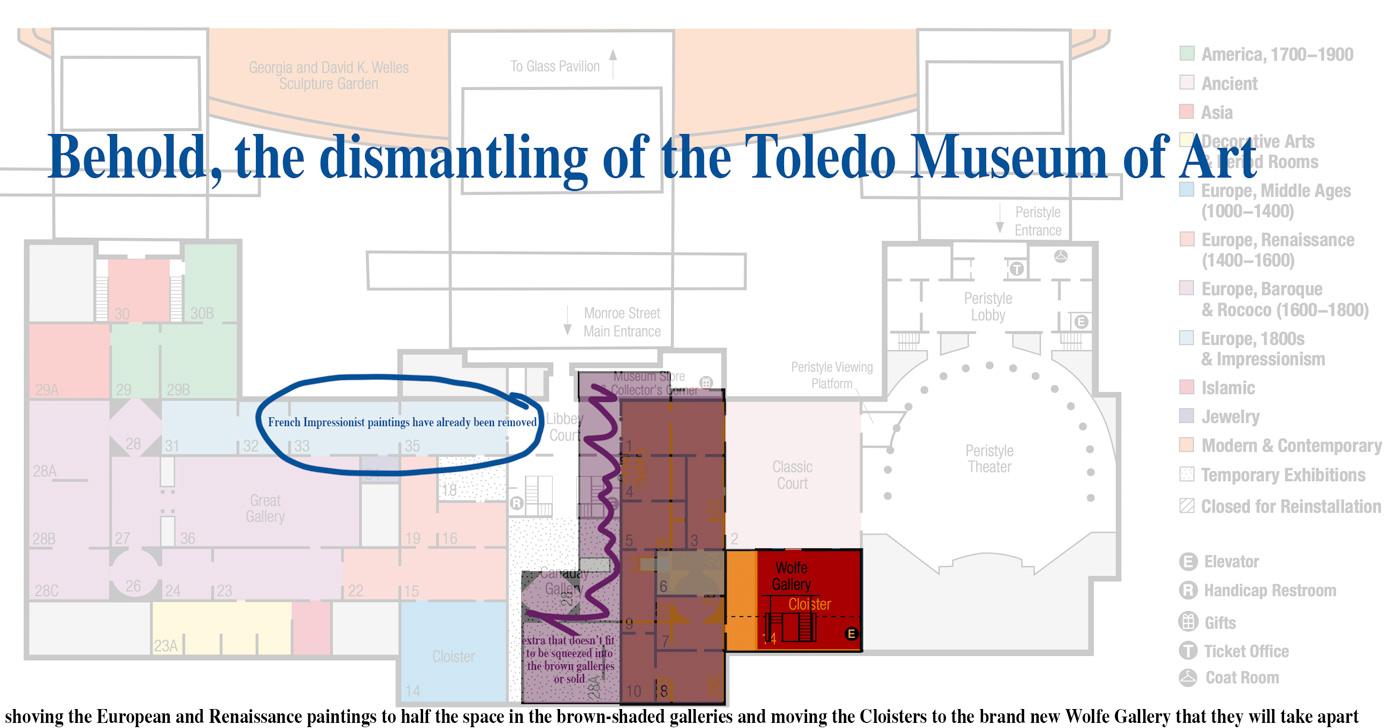
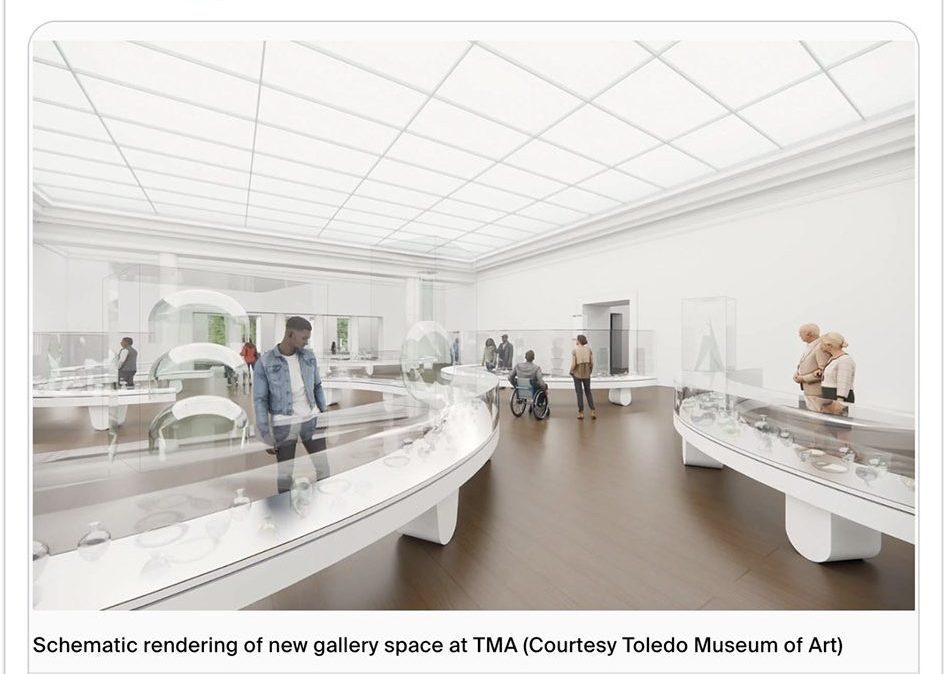
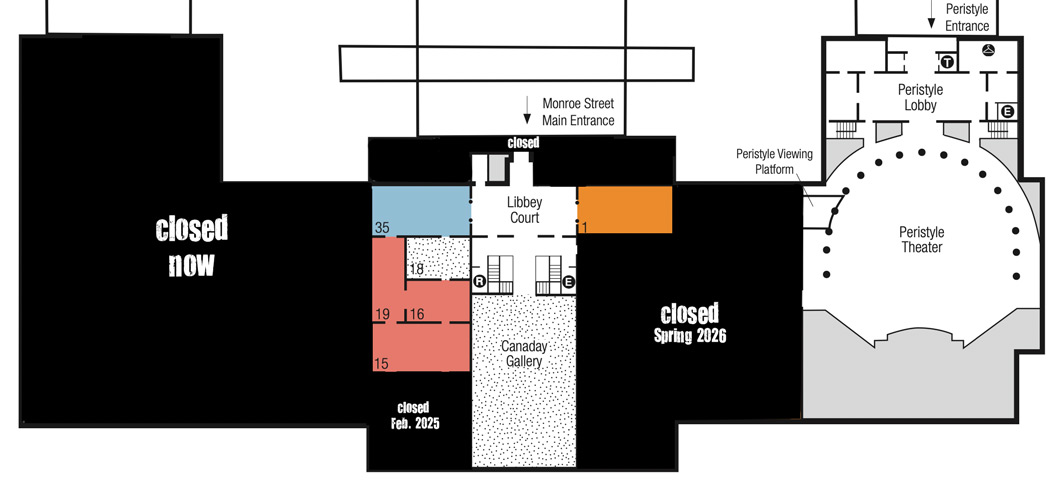
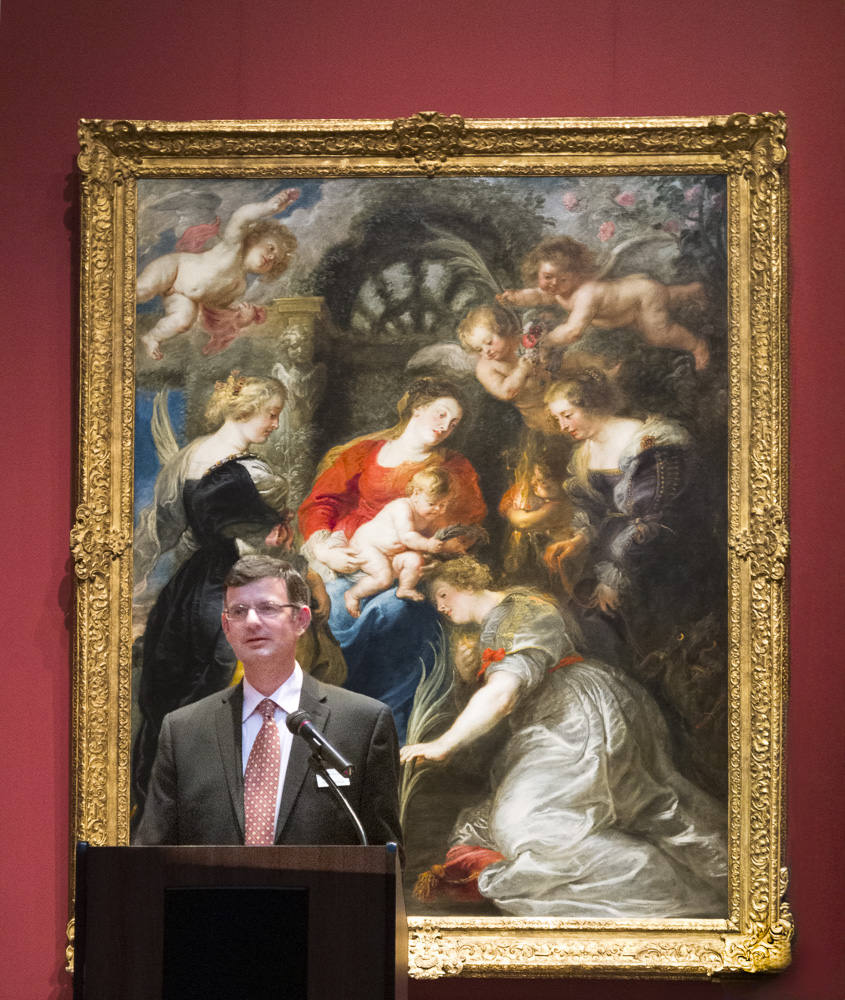
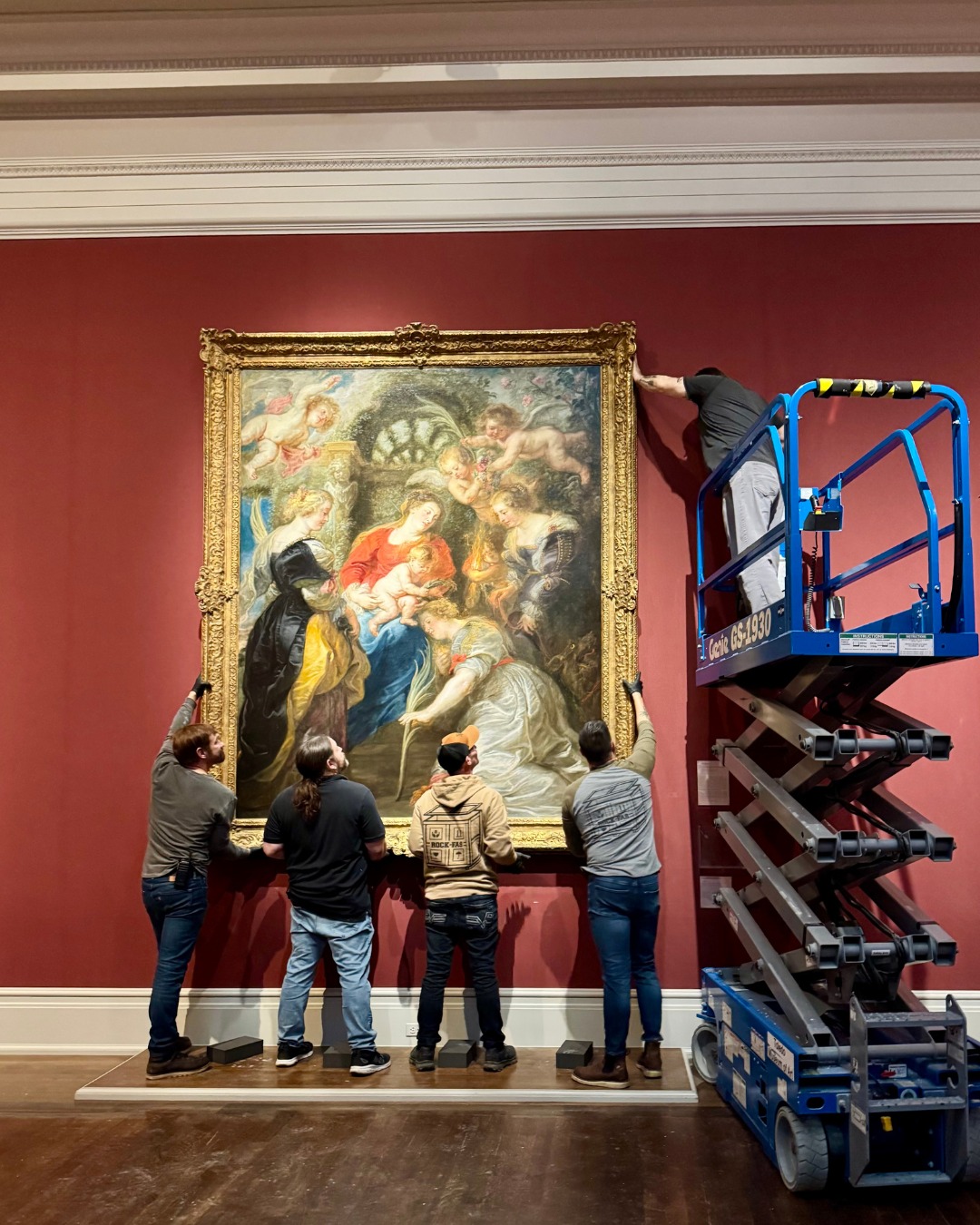
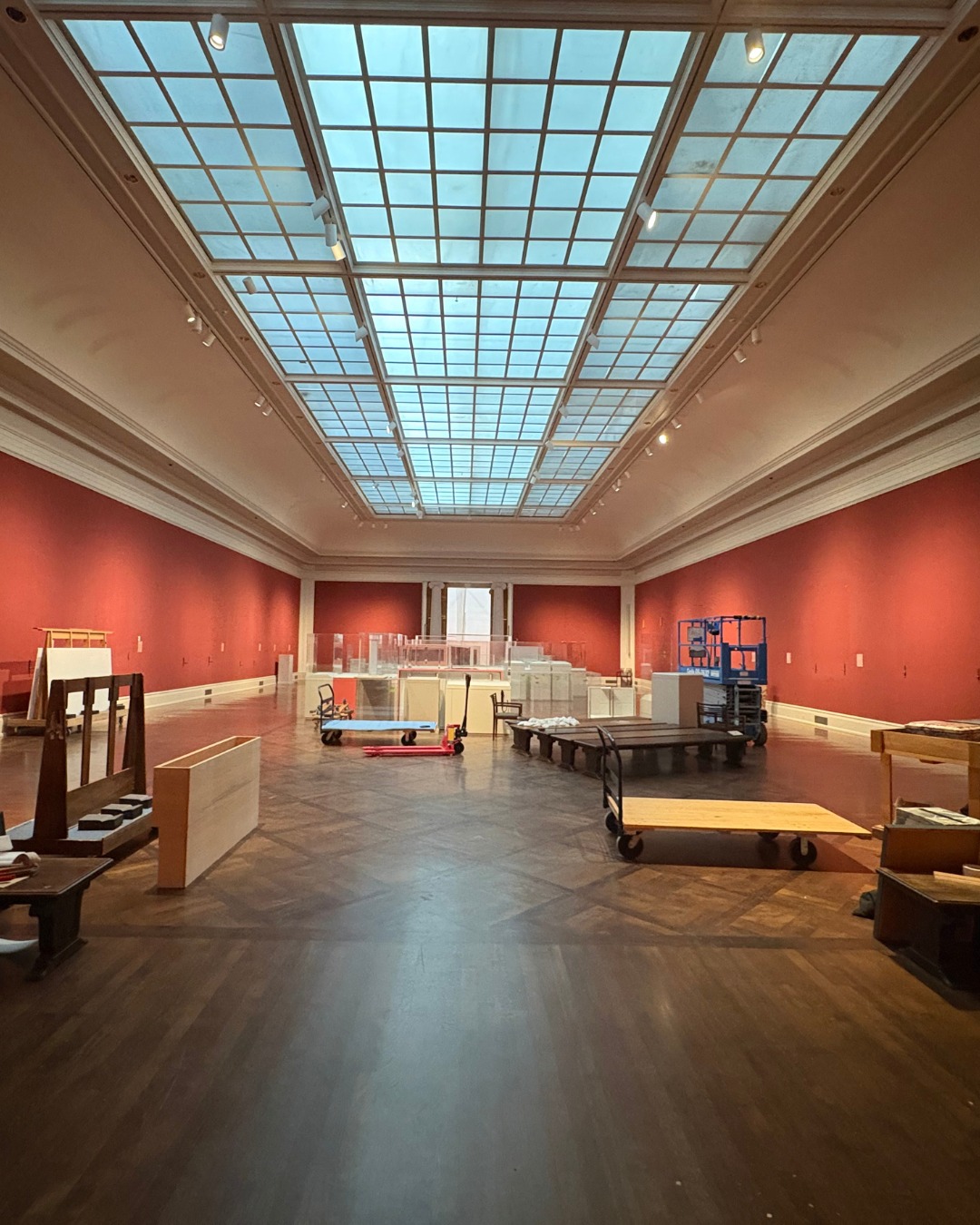
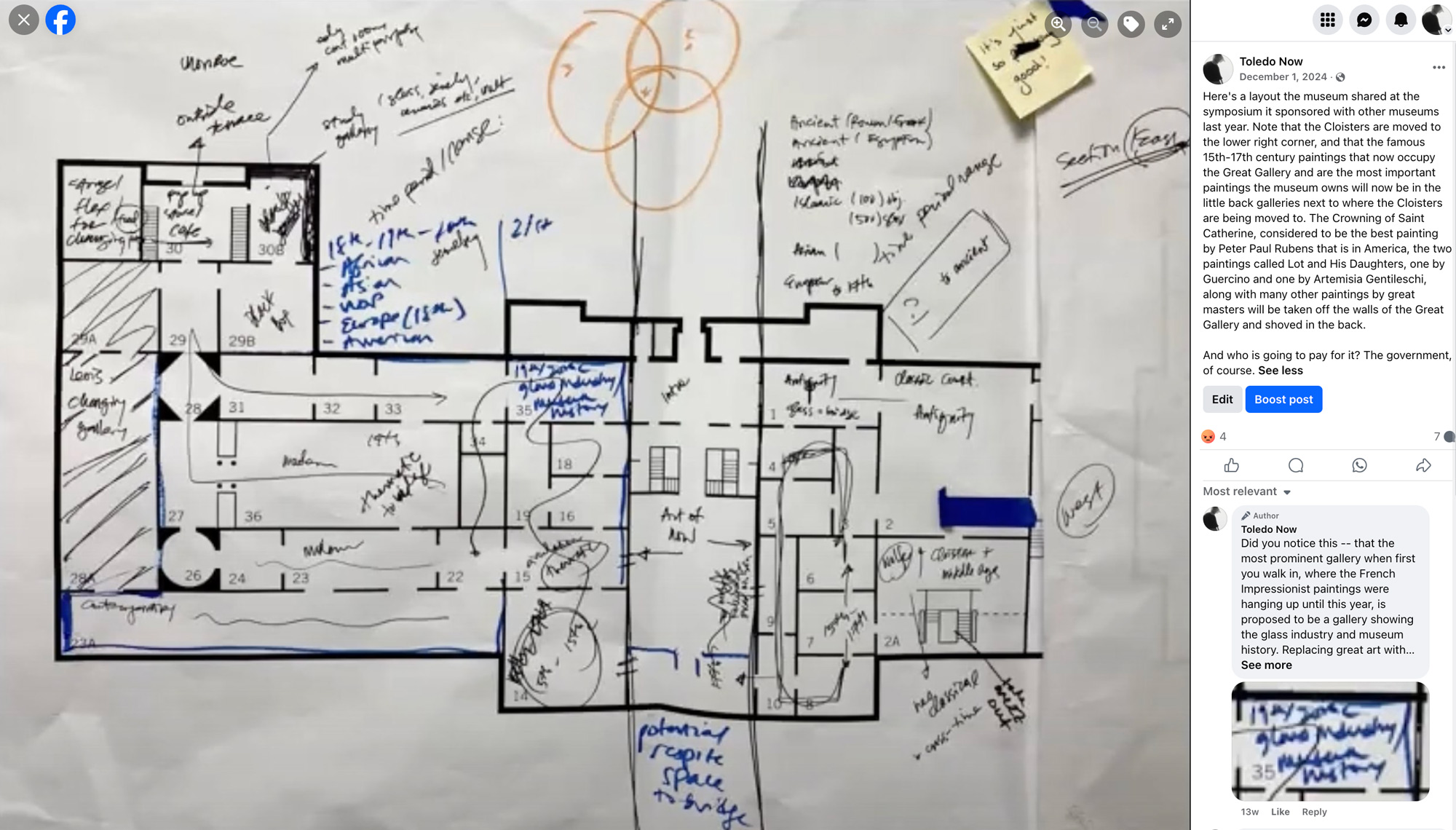
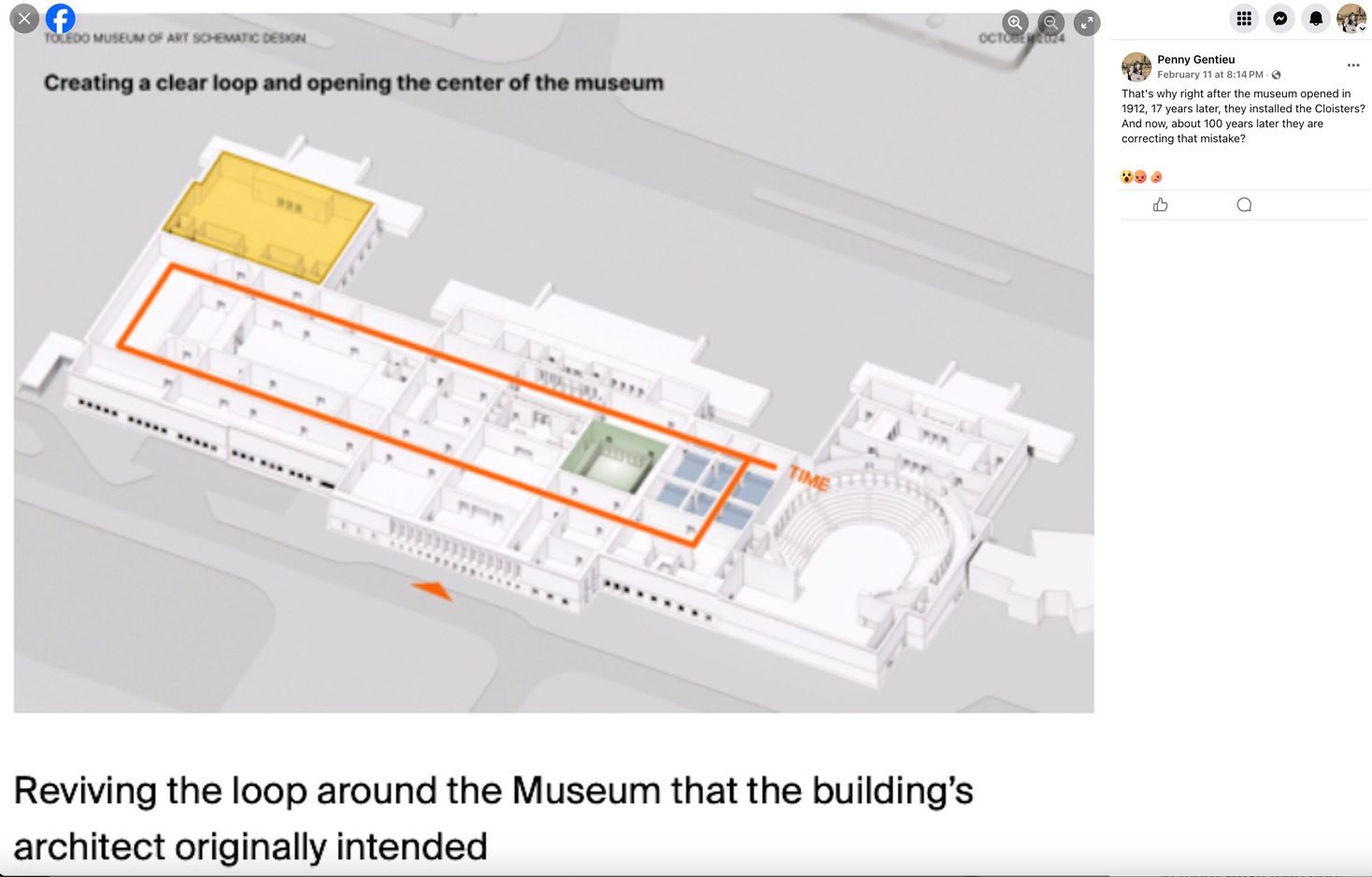
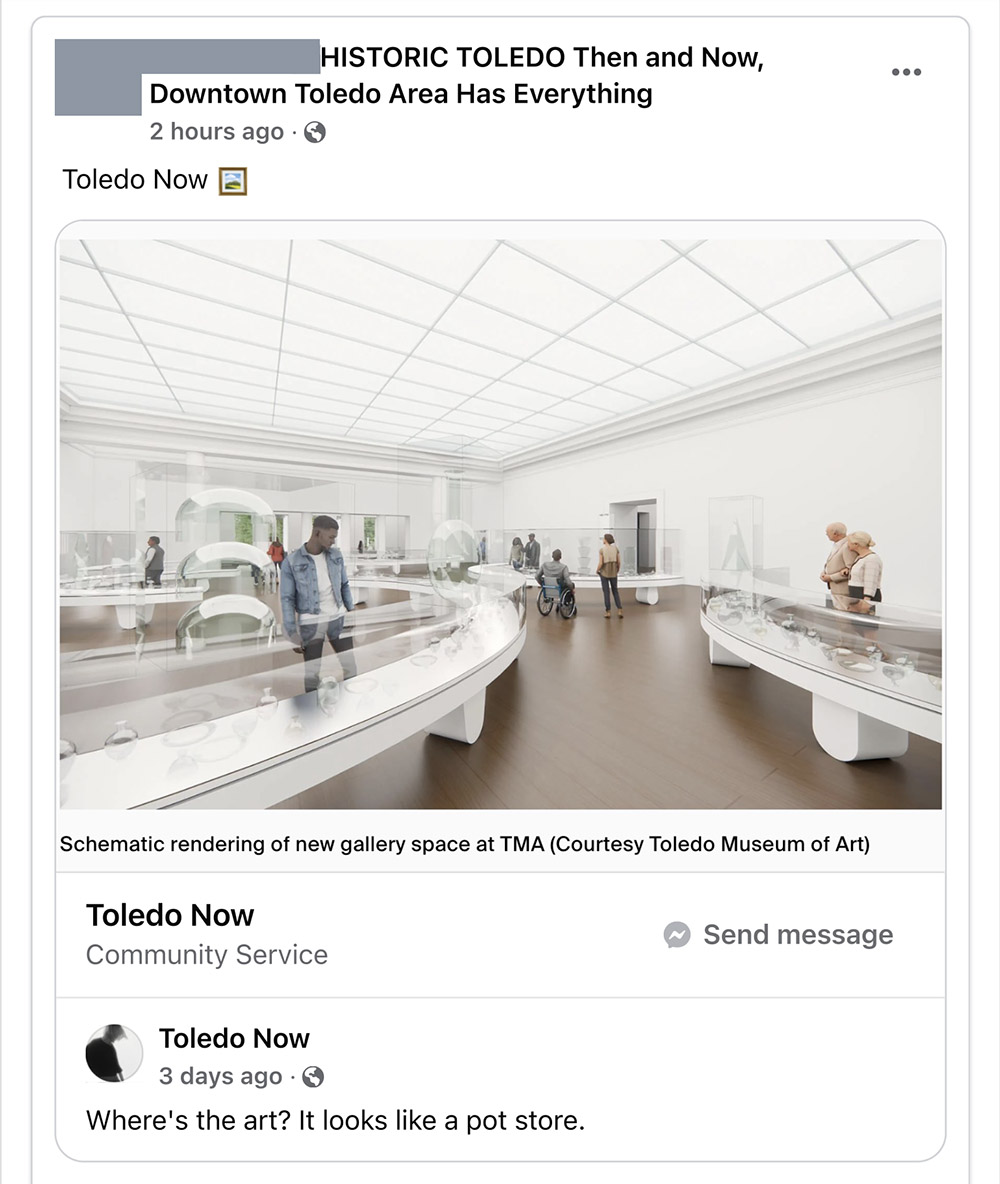
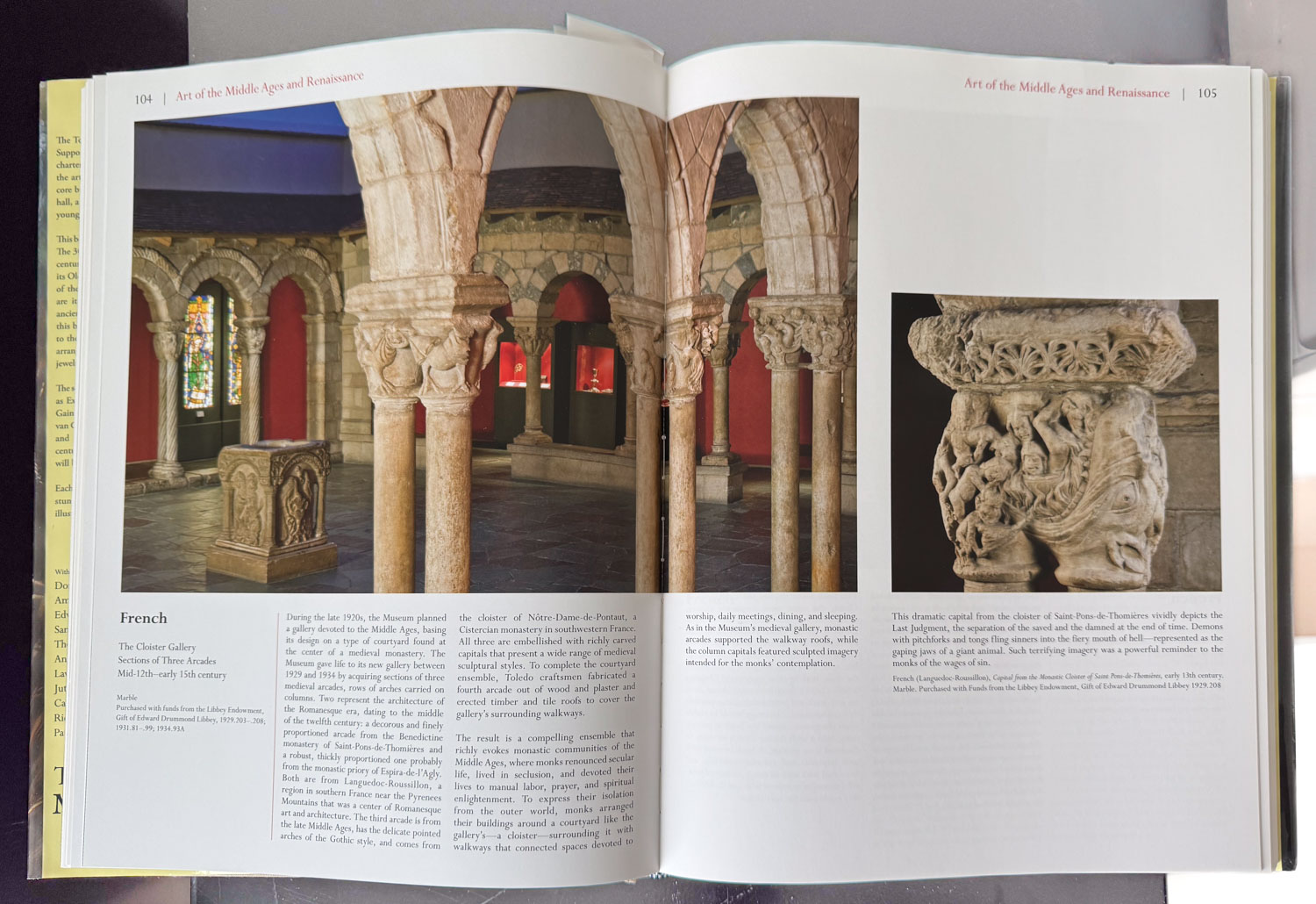
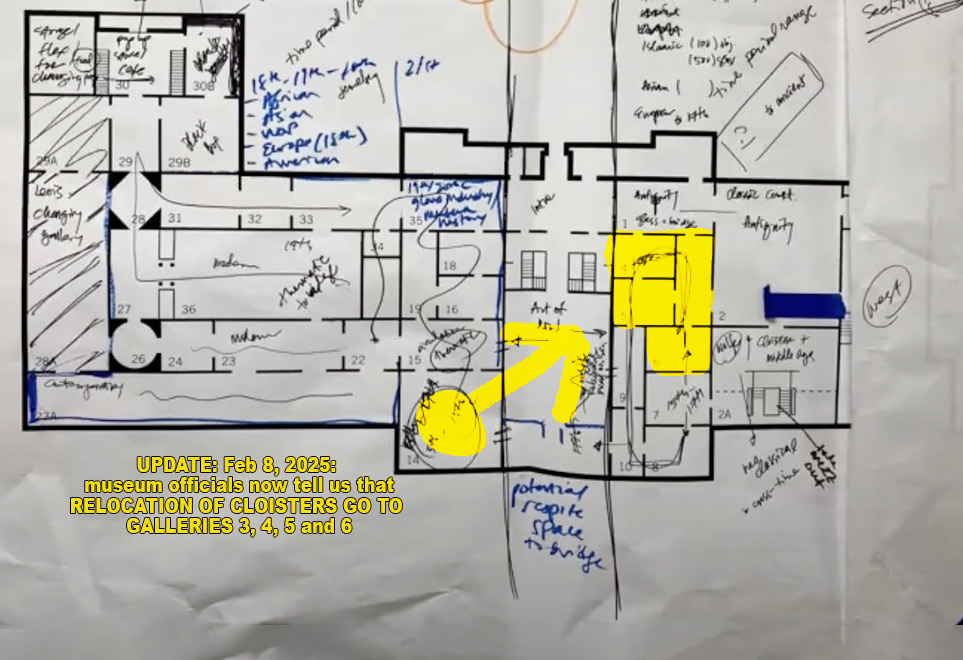
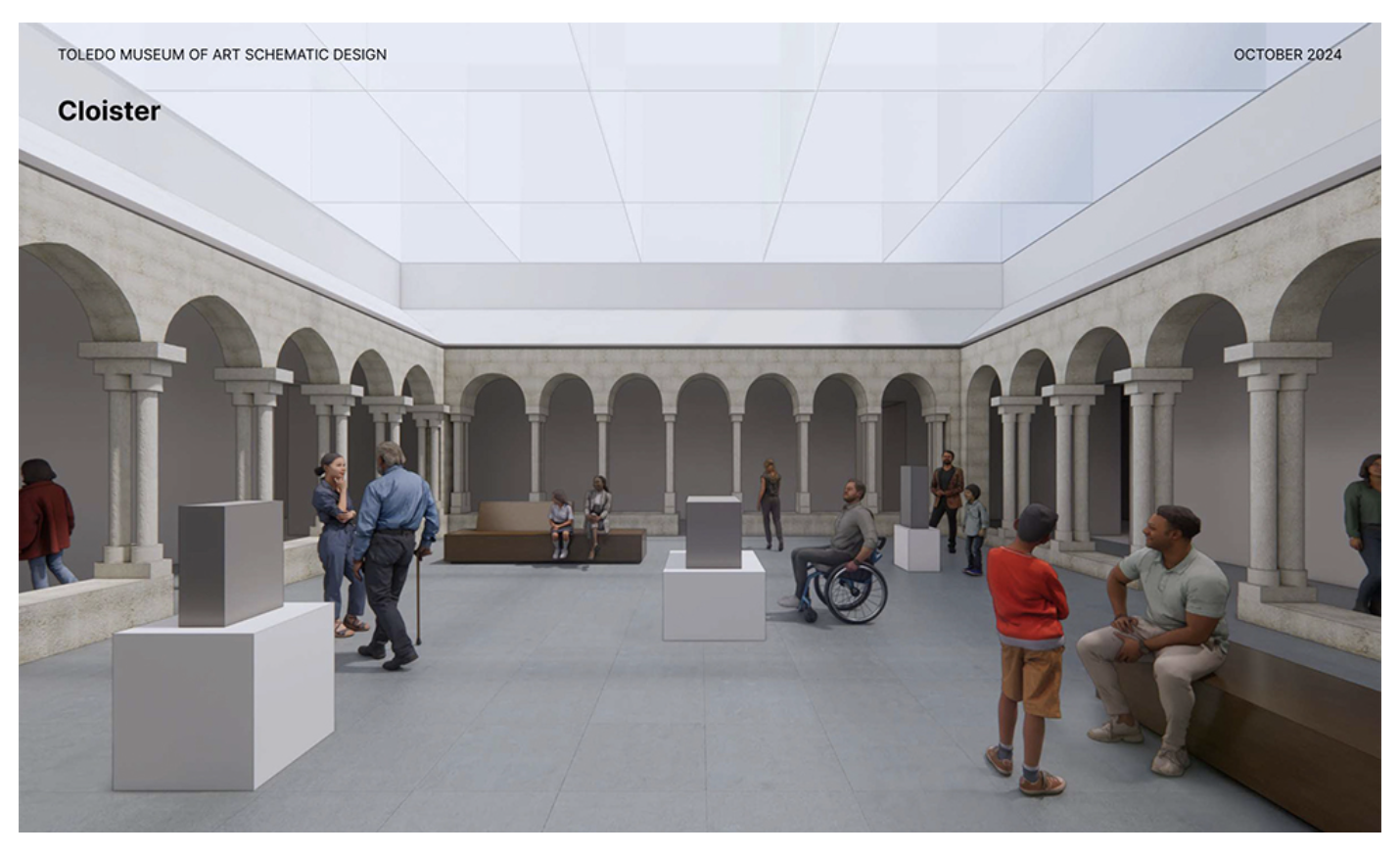
Fortune Magazine 1938: To Edward D. Libbey’s art museum – his enchantment draws 2,500 children every Saturday and 104 per cent of the population of Toledo in a year.Education was the central mission throughout the entire Twentieth Century.Map of Toledo (light gray) and the greater Toledo area (green) that the museum has always served compared to the circled two-mile radius of audience the focus for the reimagined museum.A student of the first photography class offered in the children’s Saturday classes, photographing in the Impressionist Gallery with Cezanne, Renoir and Van Gogh, 1979.In 2022, our three famous French Impressionist paintings by Matisse, Renoir Cezanne were taken off the wall and sold for $59 Million. And that was just the beginning.The Glass Pavilion, which opened in 2006, was built expressly to house the renowned glass collection. It will now be used for a different purpose.Headlines from 95 years of the Toledo Area Artists Exhibition, which ended in 2014.The Cloisters, installed in the museum in 1930_, was closed on Feb. 2, 2025 to be dismantled and moved two galleries over, next to the Ancient Court, as to compress time as art is arranged chronologically.Poets Bob Philips, Nick Muska and Joel Lipman before a poetry reading at the Cloisters, Toledo Museum of Art, 1979 and a reshoot in 2015.The heavy words of Toledo Museum of Art’s inspirational word cloud shown at their symposium, Expanding Horizons: New Approaches in Display and Interpretation, July 20232024: The art museum is renovating. Glass art will be interspersed amongst other artwork in the main building, arranged chronologically. The Impressionist paintings have already been relocated to the Glass Pavilion. UPDATE: Feb. 7, 2025 — they are lending 57 of the impressionist and 20th century core art collection to New Zealand, and according to New Zealand, it’s because the museum is renovating! But they had already moved these paintings to the Glass Pavilion, built in 2006 — are they also renovating THAT building? Yes.A schematic rendering of how the museum will look, shown to the public in November 2024. It was not received well.The closure of the museum, 2025 – 2026 – 2027, in order to renovate “right down to the studs” and rearrange the collection chronologically. Art is being sent to art storage rooms across the country.Some of the 57 Impressionist – 20th Century masterworks that were lent to museums in New Zealand and Australia in 2025 and 2026.These 144 post-Civil War paintings were off view by April 2025.The Crowning of St. Catherine, Peter Paul Rubens, 1631, Brian Kennedy standing in front of it on August 26, 2011, at the opening of the 93rd Annual Toledo Area Artists Exhibition. Brian Kennedy left abruptly in 2019, 18 months before the end of his contract.The Crowning of St. Catherine taken down in December 2025. Photo: Toledo Museum of ArtThe Great Gallery, dismantled in December 2025. Photo: Toledo Museum of Art. Where did the art go? To art storage rooms across the country. You might see some of your favorites when it opens again in late-2027, but then, you might not ever see your favorites again.
Meanwhile, at the SCCA in Tamale, Ghana…
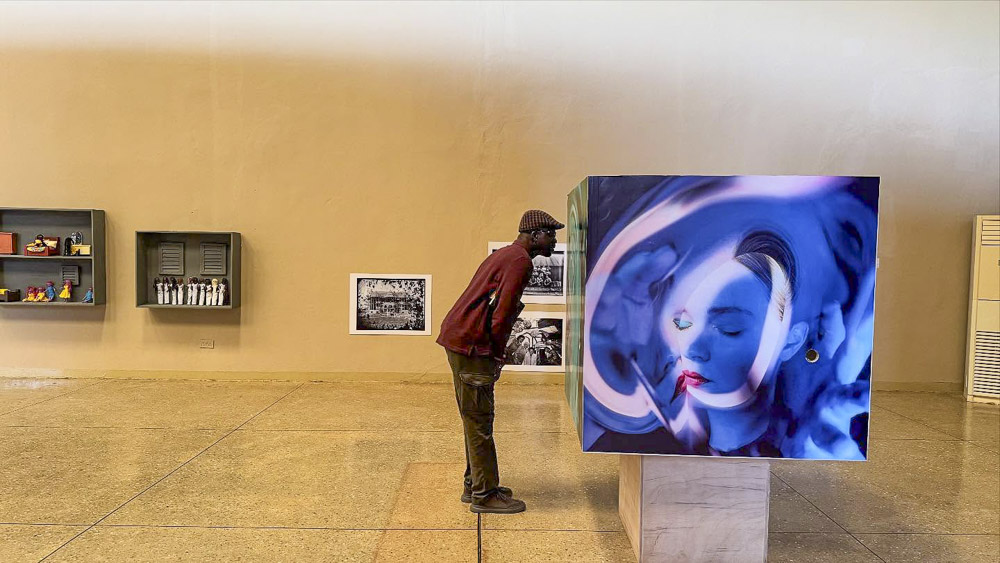
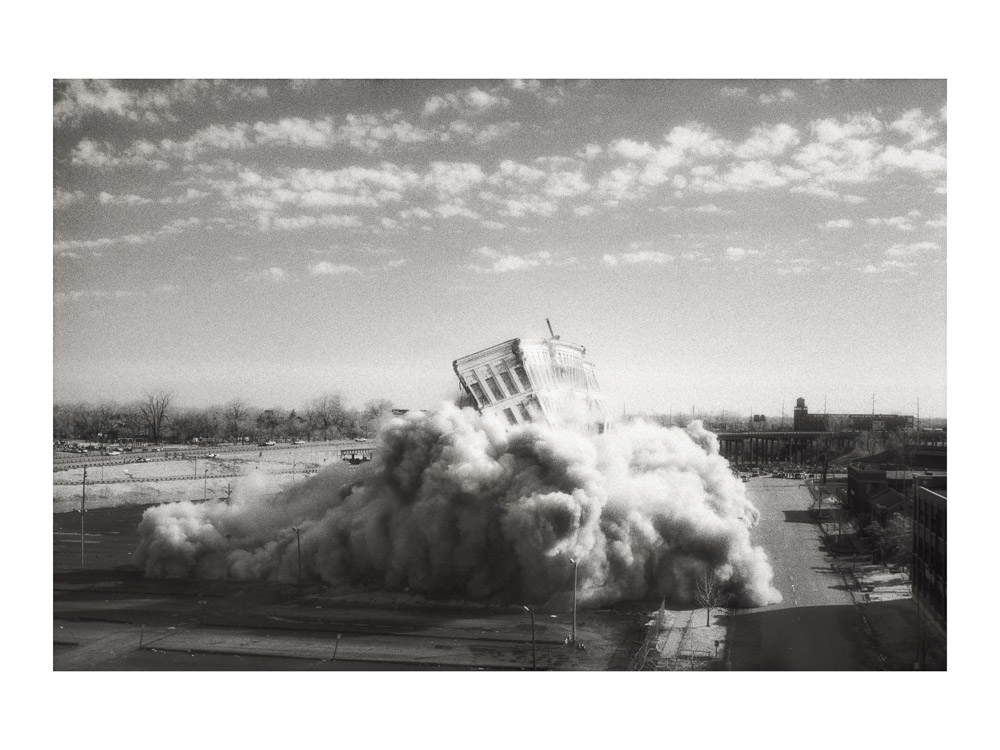
Museum of Modern Art curator Smooth Nzewi looking into our collaborative generational project, “The Beyond,” at the Savannah Centre for Contemporary Art (SCCA) in Tamale, Ghana. My daughter’s Vertigo Cube features peepholes to the past – Victorian interiors photographed by my great great grandfather in 1894. Photo: SCCAAmong our 21 photos on display at Ibrahim Mahama’s Savannah Centre for Contemporary Art (SCCA) in Tamale, Ghana is my photo of the implosion of the Toledo’s Jeep Administration Building on April 14, 1979.
The perspective offered here emerges from long-term observation, archival research, and a lifelong relationship with the Toledo Museum of Art. Photos @Penny Gentieu unless otherwise attributed.
With Lourdes University on the verge of closing, the Toledo Museum of Art was busy generating national press for purchasing a painting from Talladega College in Talladega, Alabama—an acquisition framed as an act of institutional rescue.
Talladega College, a small Southern college with an enrollment of roughly 700 students, faced a financial crisis. The Toledo Museum of Art stepped in, purchasing The Underground Railroad for an estimated $5 million, a move widely reported as helping to save the college from closure.
In the New York Times article “To Avert Crisis, Talladega College Sells Its Art Treasures” (October 29, 2025), museum director Adam Levine stated, “My objective and the objective of the Toledo Museum of Art is to support Talladega College.”
The painting—a mural depicting freedom seekers fleeing enslavement in the South, standing in Kentucky and looking north across the Ohio River to Ohio—will feature prominently in the museum’s reinstallation. It will remain at Talladega for a period before coming to Toledo, reportedly no later than 2027.
What went largely unexamined in Toledo, even as national coverage praised the museum, was the uncomfortable local reality.
An actual Underground Railroad stop—the Lathrop House—is located in close proximity to Lourdes University, the very institution now being allowed to collapse quietly in Toledo.
While the museum was applauded for “saving” a college in Alabama, Toledo was losing one of its own.
This is a city with one of the highest poverty rates in the nation. Its residents are struggling. Its educational institutions are fragile. Yet the Toledo Museum of Art continues to spend aggressively—pouring money into a sweeping, expensive, unnecessary reinstallation that nobody wants—while a university in its own backyard faces extinction.
What would have been genuinely meaningful to Toledo’s population is not symbolic generosity directed elsewhere, but tangible support for the community that sustains the museum.
The situation becomes even more troubling when governance is examined more closely.
Adam Levine sits on the University of Toledo Board of Trustees, and the university has reportedly promised to absorb displaced Lourdes students. It strains credibility to suggest that leadership at Toledo’s flagship cultural institution was unaware of Lourdes University’s crisis.
More significantly, Thomas J. Winston serves as Treasurer of the Toledo Museum of Art Board of Directors and also served as Treasurer of the Lourdes University Board of Trustees for the 2024–25 term. Joe Napoli is a member of both the Toledo Museum of Art board and the Lourdes University Board of Trustees. Susan Conda, a major donor to the museum, also serves on Lourdes’ board.
These are not distant or symbolic roles. They involve direct fiduciary responsibility and institutional oversight.
If individuals with governance and financial authority at both the museum and the university could have weighed in to help preserve Lourdes, why was that support not forthcoming? Why was a $5 million intervention possible for a college in Alabama, but not for a university in Toledo under their watch?
Why did the Talladega College bailout make national news while Toledo residents learned of Lourdes’ collapse only when it was too late? Why was there no sustained local coverage, no public reckoning, no warning?
What is striking is not simply what was reported, but where.
The museum’s $5 million purchase was covered extensively by national outlets, yet received little sustained scrutiny in Toledo itself—particularly as a local university was sliding toward closure at the same moment. At the same time, there was no comparable local reporting that alerted the public to the severity or imminence of Lourdes University’s crisis.
Two major institutional stories unfolded concurrently—one celebrated nationally, the other barely examined locally.
Instead, there was no visible effort to help—and little public discussion in Toledo about why.
No emergency partnership.
No museum-led fundraising campaign.
No $5 million intervention for Toledo.
What there was, instead, was praise—national praise—for symbolism.
The Toledo Museum of Art, and those who govern it, chose national optics over local responsibility. They chose abstraction over accountability.
The story being told inside the museum walls may be about escape and survival. The story unfolding outside them is about abandonment.
And that is a story Toledo cannot afford to ignore.
The Toledo-Lucas County Port Authority, led by TMA Board Secretary Thomas Winston, approved an $11M bond (part of a $25M total with Cleveland-Cuyahoga $7M and Columbus-Franklin $7M) for TMA’s HVAC system, exceeding the building’s $23.16M value (now $27.9M post-2024 tax hike). Vice Chair Sharon Speyer sits on both boards. This “port authority facility” funds a shift from Libbey’s “art for the people” to global elitism, as 57 masterworks head to Auckland.
The museum went to the Toledo-Lucas County Port Authority, asking them to install Port Authority Facilities into the museum in the form of an HVAC system. The port authority agreed and posted a bond for the museum as a part of their .4 mill operating levy that was passed by voters on November 5. More money came from the Cleveland-Cuyahoga County Port Authority and the Columbus-Franklin County Finance Authority for the total of $24.89 million for a new HVAC system.
How does the cost of an HVAC system exceed the value of the museum building itself? And why would the museum get the Port Authority involved? Why do they even need to replace the HVAC system when they recently paid Air Force One $605,020 in 2019 to replace the temperature controls?
We’ve been told that the museum is undergoing renovations, but if the AC costs this much – payments guessing to be around $2M per year for a 30-year term, where is the money coming from for the rest of the “improvements,” “remodeling” and “reinstallation?”
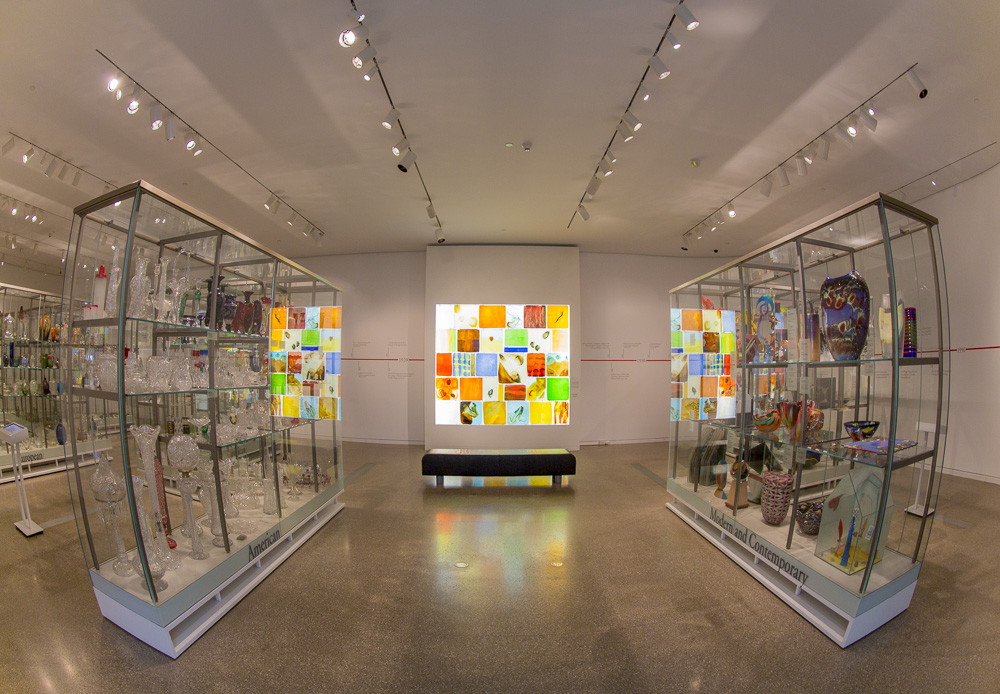
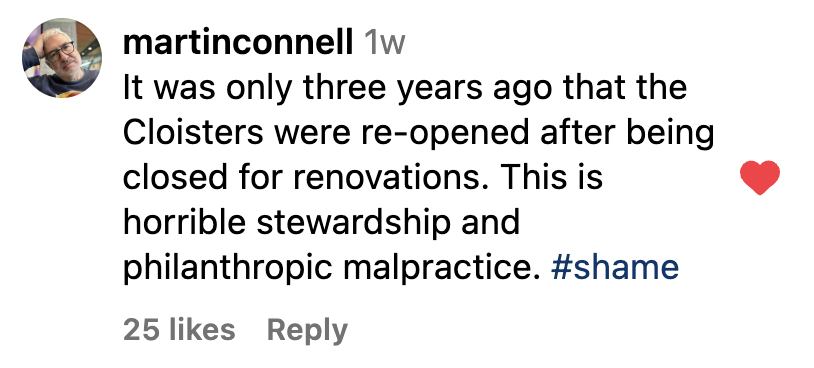
The recently renovated Cloister gallery gets disassembled (unbelievable, and will cost millions) to be moved just 40 feet to the northeast. New technologies and seating for every gallery, with art shifted around and arranged chronologically. The Glass Pavilion, which cost $30 million to build in 2006, will be repurposed (also unbelievable) as the glass gets removed and scattered amongst the art in the main building arranged by date.
The museum did not provide details about the cost for moving The Cloister. The spokesperson wrote that TMA is privately funded and the project is one small part of the larger reinstallation that is being funded through individual and corporate philanthropy.
Oh, really?
What will fall through the cracks during this seismic shift?
The Impressionist gallery will be replaced with the history of glass in Toledo and the Libbey Glass Co. – a boon for the City of Toledo but a lousy consolation prize for its citizens. I’m sorry Toledoans but we’re taking your paintings. But here’s something to make you feel proud about living in the Glass City. You get to know all about the 19th century history of the glass industry AND the museum history. It’s not quite the famous Impressionist paintings you love and expect to see here, but trust us, museums have a magic power to put anything on the wall and it will be deemed great and you will love it. “The superpower that an art museum has is when something goes up on the wall, it’s considered good. We set the canon.” (Adam Levine, 2022)
Remember the sale of the three French Impressionist paintings for $60 million in 2022, and the promise for new art from it, which never happened? From paintings gifted by Edward Drummond Libbey, they took the proceeds and made themselves a separate, private fund with it, duplicating the size of the Libbey Endowment, instead of putting it back into the Libbey Endowment, thereby both distancing themselves from the founder and keeping the money secret from the public. My guest editorial in The Blade published on March 18, 2023 called for an investigation.
I got flack from the establishment for this editorial, and I wasn’t allowed to share it on FB groups. The museum even tried to get most of my editorial retracted, but in the end, they couldn’t change one word because everything I wrote was either factual or my educated opinion. It is notable today that the TMA budget is actually $5M more now ($23M), when in 2021 they projected it to be only $2M more ($20M). Soon it will be $7M more, with the port authority assessment–a 40% operating cost increase in just 5 years. They don’t have much in recent exhibitions to show for it, and that includes the current show, “In a New Light,” specially hung paintings from their own collection that is presently being dismantled four months before the end of the show. It is my opinion that their dive into politics is a smokescreen for what is really going on, praying on Toledo’s modesty and blind trust to allow them free rein. That new branding on which they spent a fortune? It wasn’t made with Toledoans in mind.
A promise broken
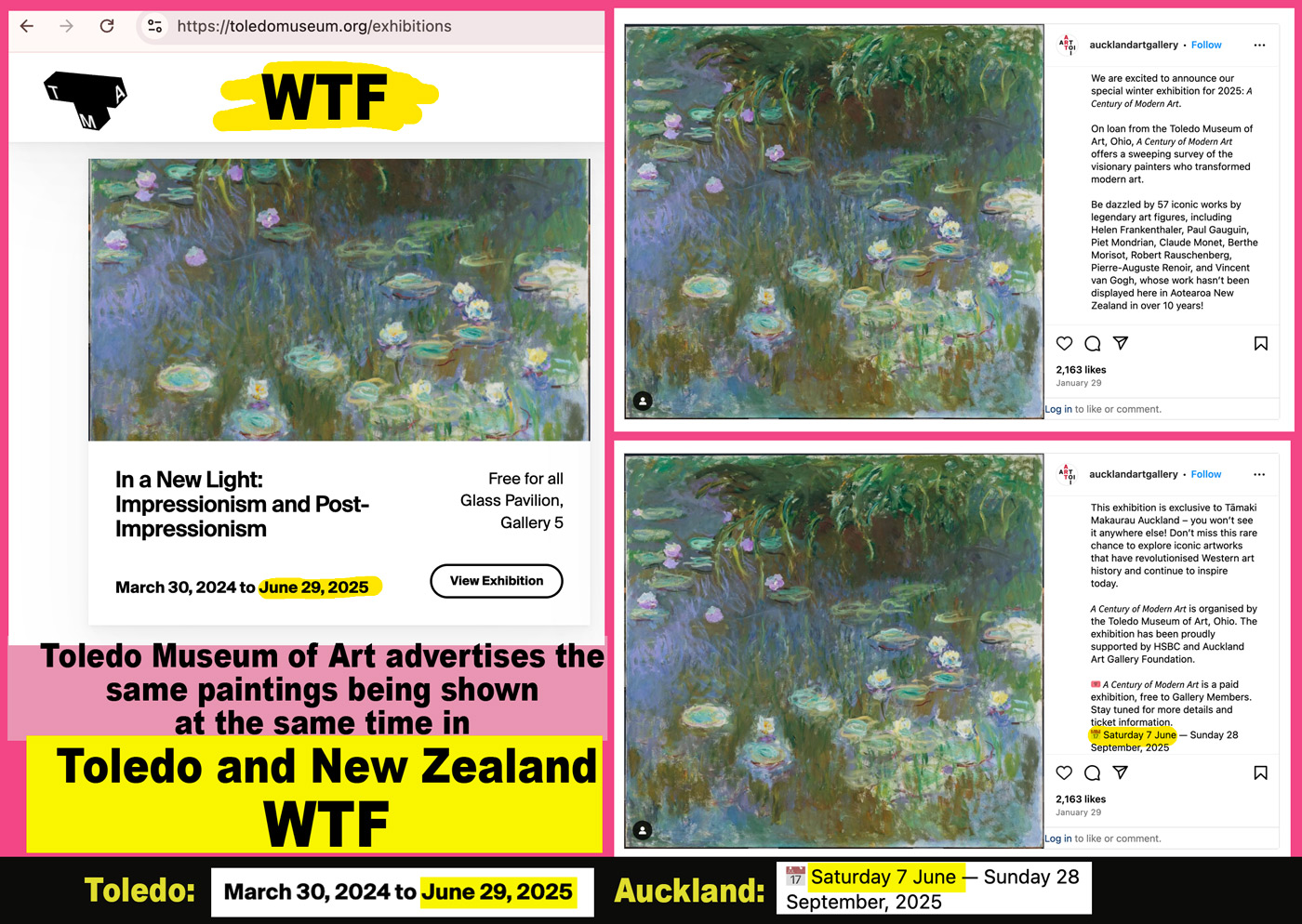
A promise was made to always keep the remaining Impressionist paintings on the walls, but now a secretive loan to Auckland of 57 masterworks for a show called “A Century of Modern Art” breaks that promise, as they pull works off the wall and changing the end date of “In a New Light” with no explanation. They don’t care how this looks to the locals.
If our mission is to integrate art into the lives of people, then rehanging our collection is only half of the equation. The reinstallation offers us a chance to go back to the conceptual as well as the physical studs, rethinking the museum experience for the 21st century. We are developing exciting plans on this front that we believe can create different paradigms for engagement. –Adam Levine
trading public funds for private prestige—
undermining its independence, veering from its roots
Such a massive export under the guise of renovations: 57 of Toledo’s most valuable paintings, Impressionist through 20th-century “offering a sweeping survey of the visionary painters who transformed modern art.” (Wow, wouldn’t we love to get to see that show?) This loan, which I believe is over four times larger than any other loan has ever been from the Toledo Museum to another institution (such as 12 to the Frick in 2002 for the celebration of TMA’s centennial), is on a par as if the Louvre was making the loan, a world-famous museum that has 7,500 paintings, not a mid-sized museum with only 750 paintings. These museum “stewards” are trading Toledo’s heritage for global prestige. They want to be a “global player” at the local public’s expense. Local government loves the free publicity. And of course, The Blade plays along. Libbey’s gift of art for the people is being taken from away from the people to be used for political exploitation, corporate greed – public assets serving elite networks and lining corporate pockets instead of serving the modest Toledo public as Libbey’s gift was intended – it is an utter betrayal of Toledo’s soul.
The founders’ vision was for a museum that “took art away from exclusive capitalism and gave it to the people.” But the new director takes art away from the people and trades it in for global elitism based on opportunistic capitalistic greed.
The heavy words of Toledo Museum of Art's reinstallation inspirational word cloud shown at their symposium, Expanding Horizons: New Approaches in Display and Interpretation.
Subject: Urgent Follow-Up: Further Concerns Over TMA’s Disposition of Core Artworks and Lack of Transparency
Dear Ms. DeHoff,
I hope you are well. I am writing again as a deeply concerned citizen regarding the troubling decisions at the Toledo Museum of Art, and to follow up on my February 10 email—which, like my previous correspondence, has not received a response. I have reached out on numerous occasions, yet my genuine inquiries continue to be met with silence and, more recently, outright censorship.
I am particularly disturbed by recent developments regarding our museum’s core collection.
I recently learned through a news report from New Zealand that TMA is loaning 57 Impressionist and 20th-century paintings—many are gifts from Edward Drummond Libbey and are featured in the museum’s “Masterworks” book—to the Auckland Art Gallery while TMA’s building undergoes renovations.
What is especially ironic is that Auckland is currently celebrating the recent bequeath of the art collectors, Julian and Josie Robertson with an exhibition called “The Robertson Gift: Paths through Modernity” Feb 9, 2024 – Feb 1, 2026, a collection of 15 paintings valued at $190 million.
Yet by interjecting the TMA loan into the mix, the Auckland Gallery is, in effect, dwarfing the impact of the Robertson Gift, since just two or three paintings from the Toledo collection are worth more than the total Robertson bequest that Auckland professes to be so honored to be given, and the Toledo show, “A Century of Modern Art,” consists of 57 bigger, better paintings.
Meanwhile, back in Toledo, the museum-going public is witnessing the shoving aside of the treasured Impressionist masterworks as the museum gets them out of sight, a core collection of gifts from Edward Drummond Libbey, and an important promise that has been broken.
Seems like all around the world, the gifts of generous museum donors are being dishonored.
In 2022, the day Director Adam Levine announced the sale of the beloved three famous Impressionists paintings, in the very same email*, he promised museum supporters that the other Cezanne, Matisse and Renoir paintings would always remain on view on the museum’s walls. Now to send these paintings away under the guise of renovations when the museum boasts of 280,000 square feet of gallery space is a real betrayal, and alarms are going off that something is seriously wrong with the museum’s stewardship.
Moreover, when I asked the museum for the complete list of the 57 paintings, Adam Levine dismissed my request, telling me that “this information of course will be public domain since the works will be on display in New Zealand!” (That is, if I want to hire a detective.) He said that sharing the full list would “just be used to sensationalize” my concerns. I should be talking to him directly instead of talking about this publicly, he said, in an attempt to shut me up.
This total lack of transparency, the efforts of censorship, coupled with sudden actions by the museum make me wonder, will we ever see these Impressionist paintings hanging on the walls of the Toledo Museum of Art again? After all, in just a few short years, the museum has sold three paintings, moved the other paintings from the prominent galleries in the main museum to the Glass Pavilion across the street, and now is sending this large collection to the other side of the world without any announcement, leaving museum supporters to find out from a news article from New Zealand; bringing light to a broken promise and the museum’s total lack of transparency, all while the community is stunned over the closing of the Cloisters, and unbeknownst that the Impressionist paintings are on their way out. All of this underscores suspicion.
Considering that the museum promotes the idea that people want to see themselves on the walls, it seems that these French paintings have been banished because they are too European for the demographics of the two-mile radius of the museum that the museum is using to advance an agenda. Maybe it’s all a guise to sell the valuable paintings, who knows?
Adam Levine certainly has minimized the importance of the Libbey Endowment to the museum by selling the three paintings in 2022 for $59 million and making a private fund out of the money. The museum has lost all credibility of being trustworthy – the one thing a museum must NEVER lose, as at the Toledo Museum of Art the current leaders are the custodians of the wonderful gift of cultural heritage that came from Edward Drummond Libbey and Florence Scott Libbey.
It is telling is that at the very same time of the January 29 announcement in New Zealand that didn’t reach the Northern Hemisphere until a week later, TMA announced the closure of the Cloisters on January 30, with only three days’ notice, announcing it on Facebook, spurring hundreds of impassioned comments from the community.
The Cloisters, consisting of ancient columns, capitals, and arches that were sourced from 12th to 15th century medieval sites in southwest France to evoke a medieval monastery cloister, collected and permanently installed into the museum over the span of five years, was the highlight of the east and west wing expansion of 1933 and symbolizes the heart of the museum. It was just renovated and reopened in 2022. But now it’s excised and relegated to the far east wing next to the Ancient court, replacing four nice little gallery rooms, just so the museum can put everything in alphabetical, oh, that is chronological order, a conveyer belt style loop design forcing visitors to look at art through a specific political prism. It sounds frankly hideous; hardly an idea worthy of gutting the museum. Adam Levine plans to use what’s left of our superlative collection for his radical ideology that he plans to use to set as an example for all other museums to follow.
Radical plan to gut museum was only revealed this month, February 2025
I ask that you ensure that our public heritage is not sacrificed at the whim of the current museum director who doesn’t seem to like the museum and wants to change everything about it, right down to the “physical studs” of the building itself, as he was quoted saying in a recent Channel 11 news article.
If our mission is to integrate art into the lives of people, then rehanging our collection is only half of the equation. The reinstallation offers us a chance to go back to the conceptual as well as the physical studs, rethinking the museum experience for the 21st century. We are developing exciting plans on this front that we believe can create different paradigms for engagement. –Adam Levine
There is nothing in the 2021 five-year plan about gutting the museum and redoing it down to the studs. Back in 2018 there were plans to renovate and money was collected for that but the plan seemed to be abandoned when the museum announced their five-year plan in 2021. What happened in-between was that the director Brian Kennedy resigned just one year short of his contract, leaving the museum in the lurch. After a year or two Adam Levine was hired. But right away Adam Levine made the blunder of telling people that the museum would stay neutral during the George Floyd demonstrations. Having to walk back his statement, ever since then the museum has been practicing self-flagellation — the DEI (DEAI) came in and made sweeping changes to the museum administration, adding layer upon layer of bloated bureaucracy, and here we are now, at the sacrificial alter offering up our entire museum, the gift of Edward Drummond Libbey, witnessing it becoming a shadow of its once self.
A collection created by donor funds and connoisseurship collecting, now it’s done by identity politics, federal dollars, and the turning of the back on the founders by a director who stated publicly in a 2022 Forbes interview:
The superpower that an art museum has is when something goes up on the wall, it’s considered good. We set the canon. –Adam Levine
Levine sold a Cezanne, Matisse and Renoir with the excuse that the museum never intended to have multiple examples by the same artist in their collection. But that is not true. I researched it – see my list of multiple paintings by the same artist; of the roughly 800 paintings in the TMA collection in 2022, 57 are by the same artist. Collecting these paintings was clearly intentional.
The Toledo Museum of Art has never sought to have multiple examples by the same artist-fewer than 11% of the artists in our collection are represented by two or more paintings; masterpieces by Cézanne, Matisse, and Renoir will remain regularly on view on our walls. –Adam Levine
He cut ties with the founder Edward Drummond Libbey by selling gifted paintings for $59 million and not putting that money back into the Libbey Endowment but instead into a private fund. (see, April 8, 2022 email to museum supporters.)
The three paintings being sold will provide the Museum with more than $40 million, greater than the total corpus of the current Libbey Funds supporting our art purchases. We will use these proceeds to create a new acquisition endowment –Adam Levine
The museum did not provide details about the cost for moving The Cloister. The spokesperson wrote that TMA is privately funded and the project is one small part of the larger reinstallation that is being funded through individual and corporate philanthropy. –Doreen Cutway, museum spokesman and senior public relations manager
The museum went to the Toledo-Lucas County Port Authority, the President and CEO of which is also the Secretary of the Toledo Museum of Art Board of Directors, Thomas Winston, asking them to install port authority facilities into the museum in the form of an HVAC system. The port authority eagerly agreed and posted a bond for the museum as a part of their .4 mill operating levy that was passed by voters on November 5. More money was asked from the Cleveland-Cuyahoga County Port Authority and the Columbus-Franklin County Finance Authority for the total of $24.89 million for a new HVAC system.
The museum has received many millions of dollars from Ohio and from the federal government in recent years, all grants are public record on the corresponding Ohio and federal websites. Grants that are hurting the fundamentals and founding principles of the museum.
The museum is probably taking advantage of the generous NEA Arts & Artifacts Indemnity Program to insure our 57 artworks for a billion dollars or more to send them off to New Zealand. Otherwise the loan wouldn’t be feasible. And if that program is stopped, in the current political environment while our paintings are abroad? Oh well, it’s mostly the work of old white men anyway.
As I noted above, in asking for the complete list of 57 renowned paintings going to New Zealand, Adam Levine refused to share it, saying he was afraid that I would use it to sensationalize my concerns. What is left for me to sensationalize? Adam Levine has provided all the sensationalism himself already.
I respectfully urge you, as Chair of the Board, to address these issues publicly. The Toledo Museum of Art is a treasured institution built and endowed by the Libbeys as a gift to the people of Toledo, and decisions of this magnitude must be made with full transparency and not just pushed on community using tactics like censorship and gaslighting. I ask that you halt the destruction of the Cloisters, cancel the loan to New Zealand and rehang the Impressionist and 20th century paintings.And then find new leadership that will provide proper stewardship and keep our museum intact.
Thank you for your time and attention to this critical matter. I look forward to your response.
Sincerely,
Penny Gentieu
Again, I’d like to point out Adam Levine’s statements in his April 8, 2022 email about the sale of the Cezanne, Matisse and Renoir:
The Toledo Museum of Art has never sought to have multiple examples by the same artist-fewer than 11% of the artists in our collection are represented by two or more paintings; masterpieces by Cézanne, Matisse, and Renoir will remain regularly on view on our walls.
For the record, here is a list of 16 of the 53 artists of the 57 artworks going to New Zealand, major works for which information has been released to the “public domain” as Levine put it, as reported in the Auckland press release. The artists in bold have only one painting in the TMA collection. There are 37 other artists (4 artists have more than one artwork in the show) and the museum refuses to make those names public at this time. But with this list of 16 names only, it seems like the entire museum collection of Impressionist to Modernity may be shipped off. What would Edward Drummond Libbey and Florence Scott Libbey think of that? What does the public think?
Cezanne
Degas
Helen Frankenthaler
Édouard Manet
William Merritt Chase
Modigliani
Berthe Morisot
Monet
Pablo Picasso
Pissarro
Robert Rauschenberg
Renoir
Vincent van Gogh
James McNeill Whistler
Gauguin
Mondrian
Adam Levine rationalized the sale of the three impressionist paintings by saying that it was never the intention of the museum to have multiple examples of the same artist, that fewer than 11% of the artists in our collection are represented by two or more paintings; here is a list that I made of multiple paintings by the same artist. It’s obvious that the purchase of multiple paintings by the same artists was intentional.
Regarding the much-loved highlights of Toledo Museum of Art’s internationally-renowned collection being sent overseas
The objection is not that TMA is lending one or two paintings, the objection is that 57 is a huge number of beloved masterpieces to be taking away from public view and sending to the other side of the world — 57 — outrageous! And why didn’t the museum publicly announce this loan of an extreme number of paintings being sent to New Zealand for a special exhibition?
Cezanne Degas Helen Frankenthaler Édouard Manet William Merritt Chase Modigliani Berthe Morisot Monet Pablo Picasso Pissarro Robert Rauschenberg Renoir Vincent van Gogh James McNeill Whistler Gauguin Mondrian
Sent by email on February 6, 2025:
Dear Charitable Law Section, Ohio Attorney General’s Office,
I write as a concerned citizen to follow up on my previous correspondence regarding the Toledo Museum of Art’s (TMA) reckless decisions concerning its core cultural assets. In addition to the issues raised earlier—namely, the planned dismantling of the historic Cloisters, the demolition of the Wolfe Gallery, and the repurposing of the Glass Pavilion (a $30 million structure built in 2006 specifically to house its renowned glass collection)—breaking news from New Zealand now reveals further alarming developments.
Reports from across the world indicate that TMA is loaning 57 Impressionist and 20th-century paintings—many being gifts from Edward Drummond Libbey and described as “the much-loved highlights of Toledo Museum of Art’s internationally-renowned collection”—to the Auckland Art Gallery in New Zealand while TMA’s building undergoes renovations. Notably, most of these paintings had already been moved to the Glass Pavilion one year ago, and this decision to send such core works overseas has not been publicly announced on TMA’s website or through any press release. Given that TMA houses 280,000 square feet of gallery space and these works form the core of its collection, their removal not only deprives the local public of access to many of their most beloved paintings but also puts these invaluable works at significant risk. How are these works insured? Is TMA relying on the NEA’s Arts & Artifacts Indemnity Program or another mechanism to safeguard artwork potentially valued at up to $1 billion? Is it safe in today’s climate to depend on federal funds for such crucial protections?
Furthermore, this move is particularly alarming in light of the Auckland Art Gallery’s current major exhibition, “The Robertson Gift: Paths through Modernity.” This exhibition, which displays art movements very similar to those represented by the loaned TMA works, is effectively duplicative—ironically underscoring the historical and cultural significance of donor gifts while highlighting TMA’s pattern of secretive decision-making. Adding to the dismay is a stark reminder of an April 8, 2022 email from Adam Levine, in which TMA assured the public that “masterpieces by Cézanne, Matisse, and Renoir will remain regularly on view on our walls,” emphasizing that fewer than 11% of the artists in their collection are represented by multiple works. Clearly, these current actions contradict that promise.
It is outrageous that TMA now plans to relocate the historic Cloisters—featuring authentic 12th- to 15th-century columns gifted by Edward Drummond Libbey—to the site currently occupied by the Wolfe Gallery, at an estimated cost between $2.5 million and $10 million. This move risks irreparable damage to these fragile, centuries-old artifacts. Equally troubling is the decision to demolish the Wolfe Gallery—a space renovated just 13 years ago with a $2 million donation from Frederic and Mary Wolfe, two esteemed patrons who have since passed away. Such actions blatantly disregard donor intent and raise profound ethical and financial questions regarding TMA’s management.
Moreover, the repurposing of the Glass Pavilion is equally disturbing. Designed and funded specifically to house TMA’s world-renowned glass collection, plans now call for removing much of that collection to be integrated into the main museum. This decision not only undermines the Pavilion’s purpose but further endangers priceless works of art.
The lack of transparency surrounding these decisions is deeply disconcerting. The public was only informed of these drastic changes days ago with the sudden announcement of the Cloisters’ closure—a clear indication that museum leadership deliberately sought to avoid scrutiny.
I respectfully urge your office to investigate whether these actions align with TMA’s legal obligations regarding charitable gifts and responsible nonprofit governance. The pattern of secretive, reckless decision-making displayed here is eroding public trust in cultural institutions and endangering priceless works of art.
Thank you for your prompt attention to this critical matter.
Poets Bob Philips, Nick Muska and Joel Lipman at a poetry reading at the Cloisters, Toledo Museum of Art, 1979 and a reshoot in 2015.
What’s happening to the museum? Core collection getting sent off to New Zealand while slated for being in a show at the Glass Pavilion and the Cloisters getting dismantled — a total shock and all at once!
pages from Toledo Museum of Art Masterworks, published in 2009
On January 30, 2025 the museum announced on Facebook that it would be closing the Cloisters on February 2, until sometime in 2027. You had to dig into the comments to find out that they plan to dismantle it and move it two galleries over.
The Cloisters at the Toledo Museum of Art was a gift of Edward Drummond Libbey.
Although it underwent an expensive and extensive restoration and renovation three years ago using donor funds, now the museum plans to move it a few galleries over. Now it will be closed for three years.
Relocating the Cloisters requires careful planning, engineering expertise, conservation efforts, and logistical coordination. It will be a massive undertaking with risks to the artifacts’ preservation and historical integrity. It will cost millions of dollars.
WHAT FOR?
The Cloisters gallery was carefully assembled to recreate the feeling of a medieval monastery using authentic architectural elements, including the columns, capitals, and arches. These pieces were salvaged from European sites and brought to Toledo, where they were integrated into a new, custom-designed space.
The columns, capitals, and arches were sourced from various medieval sites in Europe. Dating from the 12th to 15th century, two different rows of columns representing the Romanesque era came from Languedoc-Roussillon in southern France near the Pyrenees. One from the Benedictine monastery of Saint-Pons-de-Thomieres, and another from the monastic priority of Espira-de-l’Agley. Another came from the late Middle Ages, the Gothic style from the cloister of Notre-Dame-de-Pontaut, a Cistercian monastery in southwestern France.
Ninety five years ago, the Toledo Museum of Art’s curators created a floor plan and structural layout that would allow the columns to be displayed in an authentic-looking cloister setting. The arrangement richly evokes a medieval monastery cloister, where arcaded walkways surrounded an open courtyard.
Since the columns were not originally designed for this space, engineers reinforced them with modern supports. Some columns may have been cut, restored, or modified to fit the proportions of the museum. The stone elements were mounted on modern bases to provide stability.
Each column was positioned carefully to align with the capitals and arches above. The museum likely used mortar and hidden steel reinforcements to secure them while maintaining an authentic historical appearance.
The surrounding stonework and flooring were designed to blend with the medieval elements, enhancing the historic ambiance. Lighting and display techniques were added to highlight the carvings and textures of the ancient stone.
The wishing well, a central feature of the Cloisters, was also a salvaged artifact. In medieval cloisters, wells were essential for water collection and often had religious or symbolic significance. It was installed as a focal point, inviting visitors to interact with the space in a contemplative way.
What the move will be like
Moving the Cloisters at the Toledo Museum of Art would be a complex and delicate process due to the historical, structural, and logistical challenges involved.
The columns, capitals, and arches are centuries old and made of fragile stone, which may have cracks or weaknesses from age. Disassembling them could risk damage or breakage, especially since they were modified and reinforced when installed in the museum. The hidden supports and reinforcements that stabilize the structure may make removal difficult without causing unintended damage.
The solution to that is to conduct a structural assessment using 3D scanning and imaging technology, carefully documenting how the pieces were assembled before dismantling. They need expert stone conservators to ensure safe handling.
The columns and arches are made of heavy stone, which requires specialized lifting equipment and precise handling. Moving them intact would need custom crating and heavy-duty transport methods.
They will need to use cranes, forklifts, and specially designed supports for moving and reinforce fragile parts with protective padding and structural braces.
Each column, arch, and capital fits together in a specific way. If pieces are lost or damaged, it could compromise the historical accuracy of the reassembled cloister. The original mortar and reinforcement materials may not be reusable, requiring careful restoration.
They will need to create a detailed reconstruction map of how each piece fits together, label each piece precisely before removal, and consult architectural historians to ensure the authenticity of the reconstruction.
Changes in temperature, humidity, and lighting at a new location could accelerate the degradation of the stone. Moving might expose the artifacts to vibrations, pollutants, or handling-related damage. They will need to maintain climate-controlled storage and moving conditions.
Additional permits, legal fees, or repatriation claims.
Extended project timeline costs.
Total Estimated Cost: $2.5 Million – $10 Million+
Cost to Toledo’s history and culture: Immeasurable.
On January 30, 2025 when the museum announced the closure of the newly renovated cloisters with only three days notice, there was a public outcry on the museum’s Facebook post with thousands of reactions and hundreds of comments, for example:
Announced in the Toledo Free Press article dated February 8, Patrons pay tribute to Cloister Gallery, the new location, to Galleries 3, 4, 5 & 6.
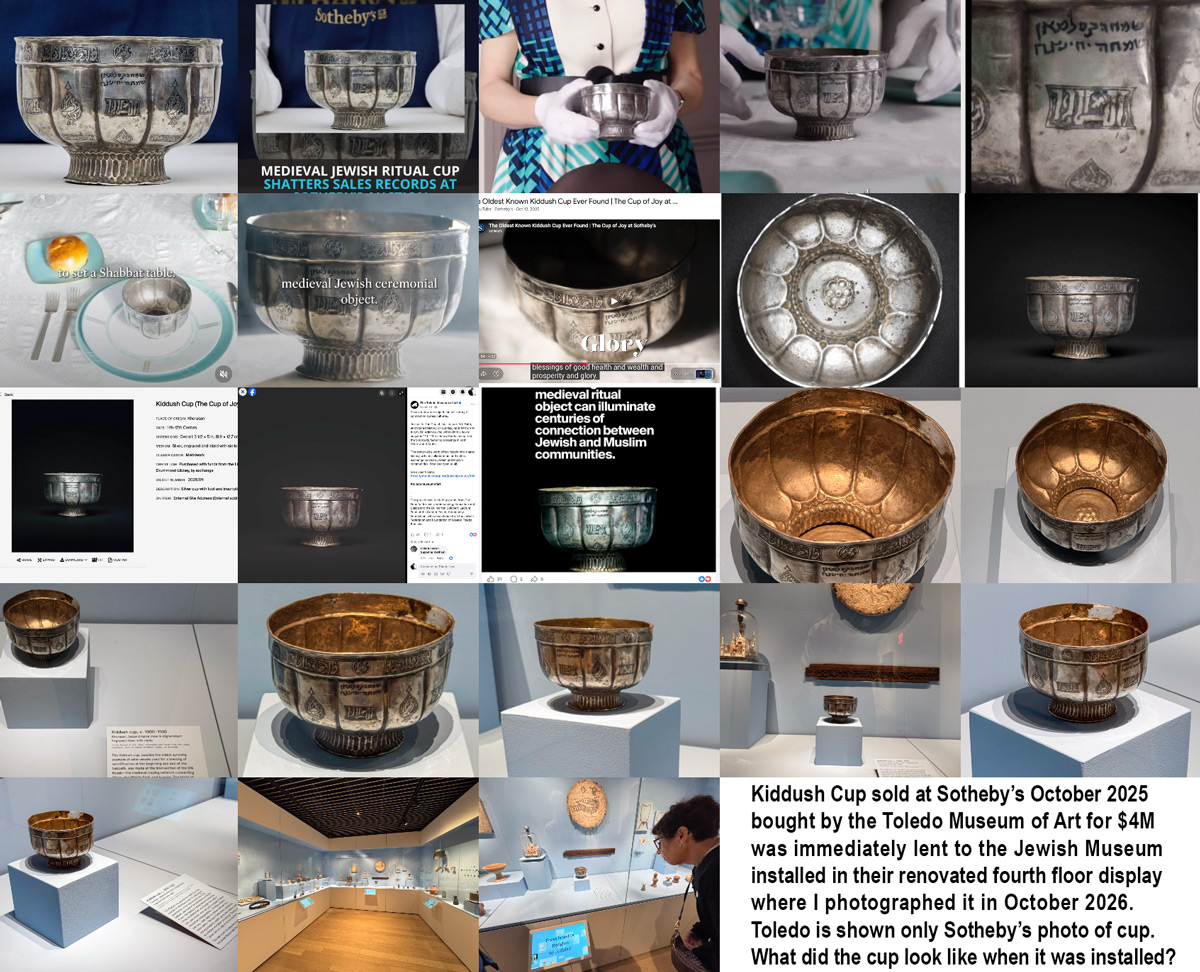


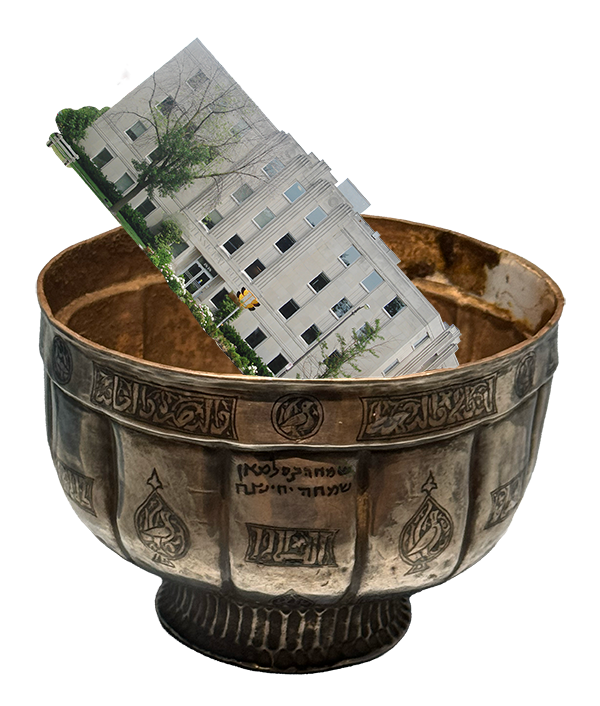
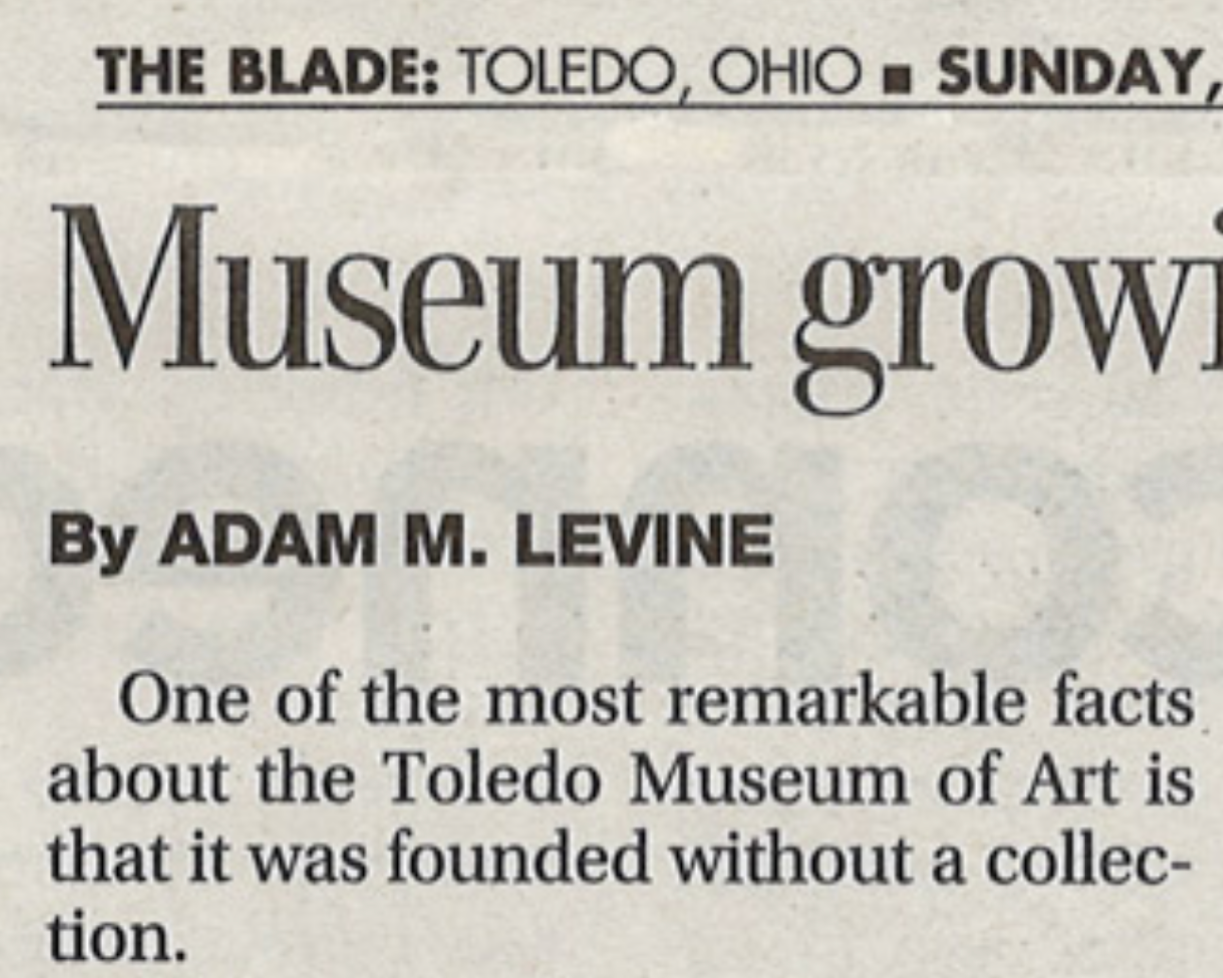


 “Since assuming directorship in 2020, Dr. Levine has led the museum through a period of significant growth…” Oh really, when the attendance never recovered after the pandemic and now the entire main building of the museum is pretty much closed, for years, to fix the HVAC and reinstall the art? Great art has been sold, and the renovated museum will have less gallery space, with no additional storage, on a smaller campus, since the Professional Building was sold last year for $2 million.