Categories
Artists of Toledo

Dear Toledo Museum of Art….

This is my reply to The Toledo Museum of Art’s reply to my September 3 blog post about what the museum did to our Toledo Area Artists Exhibition this year. My answer is in red.

Ms. Gentieu-

Your passionate devotion to Toledo artists is certainly evident in the exhaustive research, time and effort you have put into artistsoftoledo.com. However, that passion, when applied to this year’s Toledo Area Artists show, had led you to some conclusions that are simply false.

 It is your right not to like this year’s format. It is your right to criticize that format and the decisions Museum staff have made in the interest of creating a more compelling and high quality curated exhibition. However, I must clarify some of the information that you are providing as “fact”.

To clarify what you are saying here, you claim that the museum wanted to make a more compelling and high quality curated show of our 95-year old Toledo Area Artists Exhibition. That’s how you try to justify taking most of the Toledo area artists out of it and putting in your own employees, etc… what an insult.

This is a curated show. The curator, Halona Norton-Westbrook, was selected from an international pool of candidates to be the Museum’s third Mellon Fellow. Part of her role here is to oversee one major Museum project or exhibition. At the time she made artist selections she had been in Toledo less than one year.

Yes, she selected two museum employees for the show. She did not select several others who applied. Yes, she selected former TFAS presidents. She does not know those people personally nor was she aware of their connection with TFAS. She did select an artist or two that have had contentious relationships with the Museum in the past. Again, she did not know the background, nor was it relevant to her selections.

It was about the artists, their portfolios and her vision for the show. Period. Ms. Gilman was part of the process as a sounding board, but did not insert any artists into the final selection nor veto any. 

You state that this was a curated show. However, no theme or premise for a so-called “curated” show was given to artists in the CALL FOR ENTRIES. In fact, the only mention of a “curator” in the CALL was in this sentence: “Please consider this portfolio a way of introducing your body of work to the curator.”

Artists were told that “artists would be chosen based on their entire portfolio submitted.”  Yet you now claim that this show is somehow “curated.” Meaning what, exactly? You didn’t bother telling the general public whatever theme it was you were looking for – you didn’t inform the many or all 462 artists who paid $30 to enter, which adds up to be $13,860. 

Artists who entered were informed that Amy Gilman, the associate director of the Toledo Museum of Art, would be one of two judges jurying their work, according to the CALL FOR ENTRY, The Blade, and the museum’s own website. (See, below.) Amy Gilman was the “important” and “prestigious” judge that most artists wanted to get their work in front of. Now you say that it was Halona Norton-Westbrook, a 2013 graduate, who picked the artists. Halona Norton-Westbrook, with an undisclosed notion of a particular curatorial idea for the show, not shared with the entrants, (at least not with most of them.) Amy Gilman, you now tell us, did not participate in the selection. Amy Gilman was just a “sounding board” for Halona Norton-Westbrook, a recent graduate, who was given the Toledo Area Artists Exhibition to do because she needed to “oversee one major Museum project or exhibition” to fulfill her role as a Mellon Fellow.  What a strange project for the museum to give her. What a supreme waste of Mellon Fellowship funding, as it turns out, since Halona Norton-Westbrook has made such a mess of it.

Artists paid $30 each, x 462 = $13,860, collected under the false pretense that Amy Gilman was an actual judge as was stated in the CALL FOR ENTRY and elsewhere. Here are three places that state both Amy Gilman and Halona Norton-Westbrook were the judges. But now you disclose that Halona Norton-Westbrook was 100% responsible for picking the artists, therefore she made all the jury calls, not Amy Gilman, who you say had nothing to do with either adding or subtracting artists, that she was just a sounding board.


On Call For Entry.org:


On TMA’s website:

In The Blade:

o

You state that Halona Norton-Westbrook did not know the museum employees that she picked, nor did she know that she picked the two most recent past presidents of the Toledo Federation of Art Societies, even though all the entrants were required to submit CV’s (curriculum vitae, a detailed resume). She had been working at the museum for 10 1/2 months before picking her winners, but you claim she didn’t know Jefferson Nelson or Timothy Gaewsky or the librarian’s husband. And I suppose you want us to believe that she had no idea about the history of this venerable show nor had she any knowledge of the recent changes with the Federation’s involvement in the show. Yet you want to impress us that you picked Halona Norton-Westbrook from “an international pool of candidates,” so it’s hard to believe that this candidate could be totally ignorant about the Toledo Museum of Art’s history or the history of the 95-year old Toledo Area Artists Exhibition, especially since it was a project she was given to fulfill for her fellowship here. Isn’t Halona Norton-Westbrook (recent graduate) a highly educated woman? 

The show is about celebrating artists. The artists were selected because their work spoke to Ms. Norton-Westbrook. On another day, with another curator, some of the other great artists who applied will be selected. Your criticism of the selection process is also a criticism of the artists selected because of the inference that they were selected for who they know, rather than their exceptional work.

Indeed. The circumstances that The Toledo Museum of Art created make for an ugly show even before it opens. There are countless artists in the Toledo area who do exceptional work who were not lucky enough to be chosen. Undeniably they would have had better odds if they worked at the Museum, were married to someone who worked at the Museum, or were the two most recent past presidents of the Toledo Federation of Art Societies, the group that relinquished control of the show to the Museum in 2011. Why did the Federation relinquish that control, was it because the museum demanded it of the Federation?

If you are a Toledo area woman, you had even less of a chance to get in the Toledo Area Artists Exhibition: your odds were 1 in 232 (compared to 1 in 51 for being a Toledo area man). Even then, being a close friend of the Staff seemed to help.


The geographic location of the submitting artists was not a consideration in the selection process, other than they met the 150-mile radius requirement. We felt the original 17-county model discriminated against our Michigan patrons by not including Ann Arbor and Detroit, Ann Arbor being our largest source of visitors outside of Toledo and surrounding suburbs. Just because something has been done for a long time does not make it fair. 


Discriminate? What a potent word to explain why you would add Detroit and Ann Arbor artists over Toledo area artists in the Toledo Area Artists Exhibition, a 95-year old community-based exhibition celebrating the work of Toledo area artists (hence, the name.) Detroit and Ann Arbor have their own museums and their own flourishing art communities. Couldn’t imagine these art communities would ever think they would be discriminating by not featuring Toledoans in their own local art shows. On the other hand, the fact that only two Toledo area women were chosen to be in this year’s Toledo Area Artists Exhibition is a good example of real discrimination.


Your insinuation that this was “fixed” is just wrong. Your other insinuation that the Museum is somehow profiting from entry fees is also wrong. The total investment in TAA by the Museum is approximately $80,000. We never have, nor will we ever, make money on the show.

You are the one who is using the word, “fixed” but now that you mention it, that hits the nail right on the head. I believe that you took money from unsuspecting artists under false pretenses. I think you should give all artists their money back and apologize.

The opportunity for local and regional artists to have their work displayed in a world class museum is one that is not widely available. Most museums have discontinued their local artist shows. The Toledo Museum of Art remains committed to local artists, through TAA, our Community Gallery shows, selling local artist works in our store, glass residency programs and much more. 

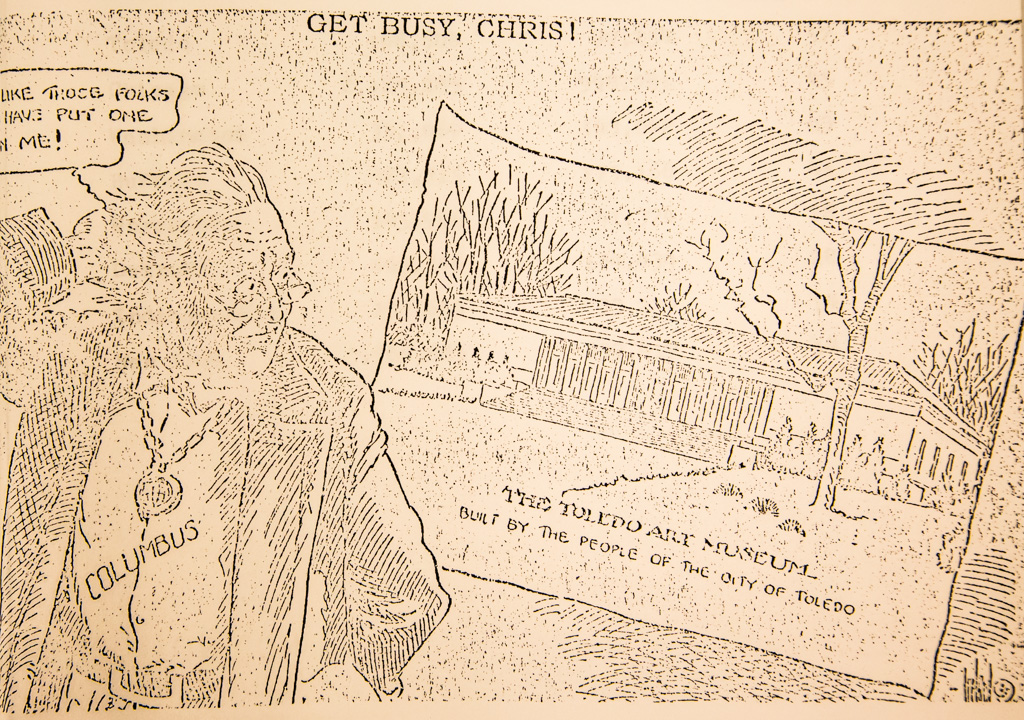
Most museums do not have the history that The Toledo Museum of Art has. The Toledo Museum of Art was started by artists. The museum has meant a great deal to the city of Toledo as well as to the entire community, because the community built the museum and the community supports it. The museum used to help the art community. Now, there is very little left at the museum for the local art community. Except for the chosen few who happen to work there — you might put them in a show (if they are men, that is, not your women employees). What the museum does have now for the local art community, especially for the women artists, is an overwhelming attitude of contempt, which is all too well being playing out in the way it is handling our very special, unique and historic community oriented tradition, which started 1918, almost as old as the museum itself, our Toledo Area Artists Exhibition.

Love it or hate it, we hope people will come to TAA and judge for themselves.

Kelly Fritz Garrow Director of Communications kgarrow@toledomuseum.org

The museum took our name, Toledo Area Artists Exhibition, and took Toledo area artists and Toledo area women out of the show, and instead, stuffed the show with insiders and out-of-towners, while still having the audacity to call it the Toledo Area Artists Exhibition. All the while collecting $30 per entry as if it was business-as-usual. Why would anyone think that is a good idea?
 
Categories
Artists of Toledo

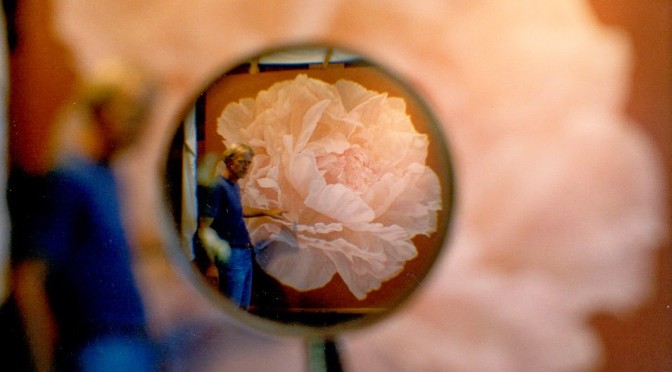
Sometimes when you look in the microscope you see the whole thing.

Photo by Steve Coffin of John Botts and his Big Peony painting. Corte Madera, California


This photo came today in my email — a photo of John Botts, my painting teacher at the Toledo Museum of Art School of Design. Wow. I owe so much to John Botts — he made me see what I really was, which is a photographer. When he saw the first photographs I took, he gave me a book — the first edition of Robert Frank’s book, The Americans.


It is probably fair to say that the Toledo Area Artists Exhibition this year is the most controversial Toledo Area Artists Exhibition there has ever been, and not for the art either, because we don’t get to see the art until November.  The show is controversial this year because of the circumstances created by the Toledo Museum of Art and the questionable decisions that the museum has made that put the show and the museum in a bad light even before it opens.


excerpts from the press release about the 95th Toledo Area Artists Exhibition on Toledo Museum of Art website

Were they really? Pleased with our region? Doesn’t seem so.


Out of all those entries that they looked at — 4,175 images, 44 videos, and two audio entries, the museum curator in-house judges could barely find any Toledo artists for the show who didn’t work at the museum, or weren’t friends of theirs, etc. or weren’t the most recent presidents of the Federation of Toledo Art Societies, the group that was formed in 1918 to put on this show, to put in the show.

And then the curators had to go beyond the Toledo area to fill it in with out-of-town artists from Akron, Cleveland, Columbus, Detroit, Grand Rapids Michigan, Muncie Indiana. Our Toledo Area Artists Exhibition.

We have so many artists in the Toledo area, yet in a show that has only 28 artists this year, cut down from a show that had 76 artists last year, a show that historically ranges anywhere from 70 to 120 artists — of 90% real Toledo area artists, the museum this year  has to go 150 miles out in all directions to pick out 17 artists who live outside of the 17 counties that comprise the Toledo area – the 15 counties of NW Ohio and the two bordering counties in SE Michigan?

Then, with our show taken over by metropolitan areas that are not our own, over half of the meager remaining 11 artists chosen actually from this area, from all the 4,175 images that they got to select from, are artists within the “Museum nucleus?”

Is that okay with you?

Do we really have to drink this water?

 o

Is it fair that 435 artists paid $30 each thinking that they were entering a fair competition (435 x $30 = $13,050) when they never had a chance because the museum judged it and got to put in their employees and friends, then fill it up with a pick of artists in big metropolitan areas not our Toledo area, that the museum has the audacity to call the 95th Toledo Area Artists Exhibition?

The reason why the annual TAA show started using outside jurors after eight years into their history was so that the show could be judged fairly and without conflicts of interest.

So this year, 2014, for the 95th annual show, why did museum staff members make themselves the jurors of the 95th Annual Toledo Area Artists Exhibition? Was it so they could unfairly get to pick fellow museum employees and friends, for some unknown reason, or maybe it was because they got Christopher Knight to be the money judge and they wanted to make themselves look good?

How does that make you feel, big vibrant Toledo art community? Are you ready to trade in your chance at entering the TAA show every year, along with the chance of winning and getting recognition for your creativity at the great white marble pillared Toledo Museum of Art, for the condescendingly concurrent series of workshops run by the Federation to teach you how you can be more professional like those “full time” “professional” artists who are supposedly so much better than you, that are showing in your place, in your TAA show?

This show belongs to us, the Toledoans, to help “us all” be better artists, as well as, in return, for “all us” artists to contribute to and continue the artistic cultural history of Toledo that is and can only be us. And why don’t we clean up our water too.

Please keep the Toledo Area Artists Exhibition at the Toledo Museum of Art and for the Toledo area artists. It’s our legacy and it belongs to us. It’s our tradition.

The Toledo Area Artists Exhibition for Toledo area artists is the oldest regional art competition affiliated with a museum in the United States. It gives the art community a great sense of pride to compete and get in to the prestigious museum show, that features and celebrates the talents of Northwest Ohio and Southeast Michigan. It’s 95 years old.  Must it go so soon, so young in European terms, just a baby in comparison.

Categories
Artists of Toledo

Herral Long Photographed the Pulse of Toledo for Sixty Years

Herral Long, beloved long-time Blade photographer passed away on Saturday, June 14.
He photographed every United States president since Dwight D. Eisenhower, as well as day-to-day newsworthy events in Toledo for six decades. He was forever curious and experimental as a photographer and often said that taking a great picture was like catching a butterfly.

He was an award winning photographer and named Ohio News Photographers Association’s first Photographer of the Year in 1967.

He was a free spirit and founding member of Joyce Perrin’s Any Wednesday, a gathering place for poets, artists and musicians, a Toledo art scene tradition which has been going on since 1964.

He played a dulcimer and wrote songs for his wife, Marcy, who had Alzheimer’s disease, believing that one’s sense of hearing is the last to go.

He began photographing for the Blade in 1949 and retired in 2009. Herral Long arranged the timing of his retirement so that The Blade would have to keep on a recently-hired photographer, Amy Voigt, whose position was about to be eliminated. Herral felt that she was very talented and by his stepping down, it would give her an opportunity.

In a 1969 Toledo Museum of Art Catalog for a show he was in, it is reported that he was interested in mountain climbing, sailing, photography, palm reading.

He was a wonderful, charming person and friend to all.

Categories
Artists of Toledo

Marguerite Michaels and her Art Collection

Marguerite Michaels is an awesome supporter of the arts. I met her a few years ago at Marcia Derse’s Christmas sale. She told me she had recently bought one of my Confabulations photos at the Hudson Gallery. It was the one of two women on the sidewalk. At Marcia’s, she bought my abandoned church photo from my Still Standing series — maybe it reminded her of the time that she almost became a nun (she went through everything but the final vows.) Later, she bought my Woolworth’s photo and an artist book I made of my mother, Audrey Gentieu’s movie star pastel portraits. She took great pleasure in building her art collection, which went gangbusters during the “great recession.” She bought a ton of local art, and I for one really appreciate her for that.

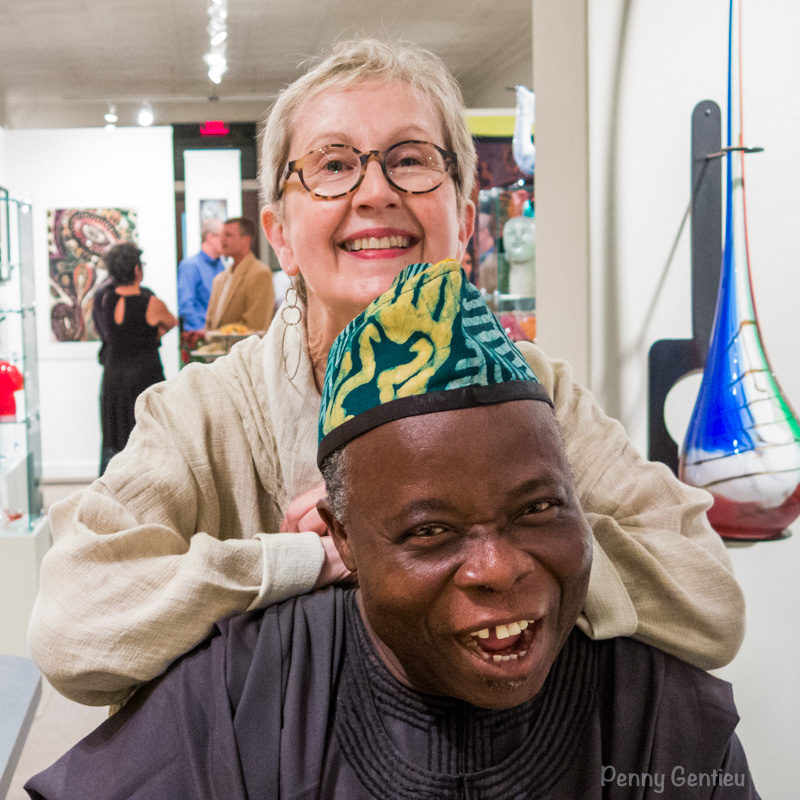
Marguerite is a strong and brilliant woman. After realizing that becoming a nun was not her calling, she moved to New York, where she worked for Time Magazine as a journalist, and eventually became the Bureau Chief in Nairobi.  Living in Africa, Marguerite became well-versed in African Art and collected it. She came back to Toledo around 10 years ago, for the same reason that brings many of us back — to help family. She immersed herself in collecting all kinds of art, and she brought contemporary African art to Toledo. In October 2013, Marguerite helped curate and sponsor an African Art exhibition at the Hudson Gallery. This photo above is Marguerite with artist Tunde Odunlade at the show.

Marguerite is bold and courageous. For all the things she has done in her life, she has utilized her fullest heart and soul.  She has now decided that, for whatever personal reasons, she did not need any of her collections in her life anymore and is selling everything. Just like that. No regrets, no emotion holding her back from her mission. Her latest chapter as a collector has abruptly come to an end. Her estate sale, which includes the entire contents of her house, is taking place every day this Easter week, culminating on Saturday. Her collection of Toledo artists is an eclectic snapshot of contemporary local art — work by Mr. Atomic, Willis Willis, Dave Wisnieski, Jan Dyer, Scott Hudson, Jay Bumbaugh, Lana Pendleton Hall, Richard Reed, Karl Mullens, Annie Crouter, Skot Horn, Paige Koosed, Bob Beach, Dominic Labino, Baker O’Brien, Ann Tubbs and yours truly.

Categories
Artists of Toledo

Edith Franklin never lost her childhood playfulness.


Edith Franklin, ceramicist and one of Toledo’s finest artists, passed away last night, August 31. She was 89. Edith was an inspiration to so many of us. She was small in stature but large in personality, and never one to rest. She was a woman-about-town, always attending events. Her presence will be sorely missed.

I met Edith in 2009, not long after I started my Artists of Toledo.com website. I photographed Edith and her artwork at her home in Ottawa Hills. Because she was aware of my historical research experience, she asked if I would be interested in helping her organize her papers. We spent weeks going through boxes and trunks, pulling out the most relevant records, which she then donated to The Ward M. Canaday Center for Special Collections, at The University of Toledo. I posted some items on her page on my website, here: https://artistsoftoledo.com/franklin/.

Edith was a potter at heart who worked in clay for nearly seven decades. Always open to new ideas, she was experimental with her work. She participated in the historic Studio Glass Workshop that took place at the Toledo Museum of Art in 1962. The pieces she made at the workshop are now in the museum’s collection and were featured in the May-August 2012 issue of ARTMATTERS.

Edith was proud to have attended every day of this year’s Glass Art Society (GAS) Conference, which celebrated the 50-year anniversary of the 1962 workshop that started the Modern American Studio Glass Movement. Edith walked the runway, modeling haute couture made out of glass, at the 2012 Glass Fashion Show.

Categories
Artists of Toledo

William Machen, Toledo’s First Artist


This is William Machen’s painting, Central Ave. Bridge, of the Ten-Mile Creek Crossing Central Avenue in Toledo right south of where the Jeep factory used to be, in the living room of the artist’s descendants, Jim and David Machen.


That’s David Machen standing in front of the painting, holding a Blade article from 1970 about the expressway coming through that beautiful wooded area.


Closeup of the Blade photo.


Where the cows are standing (1875), is probably where the Jeep factory would be built 50 years later.


About 60 year after the Jeep factory was built and nine years after the Blade photo was taken, here’s Tom, my husband, on top of the Jeep Administration building one month before it was imploded in 1979. Photographing Tom at the Jeep Administration Building was our first “date.”

We had brunch with the Machens today to discuss how we can try to save and restore Machen’s severely damaged stations of the cross paintings at St. Francis de Sales Parish. These paintings are such an important part of Toledo’s history. We need to write letters and raise money for the restoration. We think we know a good home for them. Machen was Toledo’s first artist.

Categories
Artists of Toledo

My mother, Audrey Pinkerton Gentieu, child prodigy

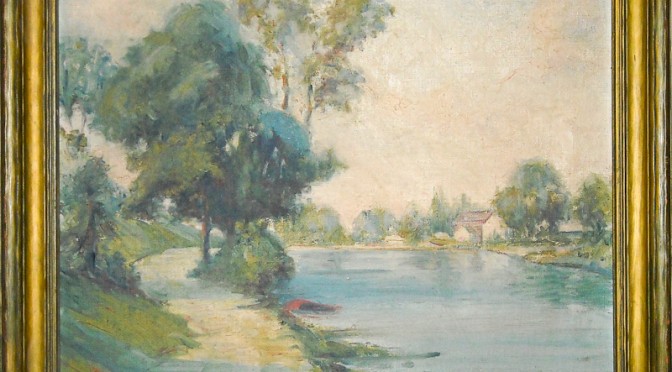
It would have been my mother’s 89th birthday last week, on October 18. Audrey Gentieu was a great artist, even as a young girl. I knew that she was prolific at an early age, but it never really hit home until yesterday when I received an email from someone in Florida who sent me a photo of this landscape oil painting that my mother painted when she was only 12 years old. I was pleasantly surprised to see this painting that my mother painted when she was so young, and that it was technically so sophisticated. Isn’t it great how the internet can bring people together, with something so close to our heart.https://artistsoftoledo.com/audrey-gentieu-1922-2009/


Categories
Artists of Toledo

Wil Clay

I am very saddened to learn tonight that Wil Clay died.  I feel fortunate that I met him last year and photographed him at his studio. I admired him for his accomplishments in the publishing world as well as for his paintings and sculptures. Wil Clay illustrated a children’s book about Rosa Parks — I photographed him with his portrait of her. And I photographed other important works. In addition, one of his favorite teachers was Ernest Spring from Macomber High School, and I photographed him with a painting he owned of his. This painting was in the City Paper this fall — of the Rose’s Sail & Rail Diner. I had looked forward to showing him that but hadn’t quite yet. Wil Clay seemed young and vibrant. It just makes you realize how delicate life is.

Categories
Artists of Toledo

Edmund H. Osthaus and my giant Pierre Project

Du Pont Company Calendar. Top picture is a lithograph of a painting, two side pictures of navy and army gunners, bottom scene of field with dogs. Hagley Museum & Library

Over Thanksgiving, on our way to Princeton from Baltimore, we stopped at the Hagley Library in Wilmington Delaware to look up one of Toledo’s most famous artists, Edmund H. Osthaus, painter of dogs. The Hagley is renown for its archives of early American industry, centering upon the history of America’s first large corporation: The Du Pont Company. Next to the library is the Hagley Museum. It’s more like a living museum, consisting of Du Pont’s large village of restored nineteenth-century powder mills and yards.  The Du Pont Company manufactured explosives and gunpowder.

Back in 1992, it was the Hagley Museum and Library where I first experienced the joys of historic research, and where I became hooked. My initial contact with the library came soon after I learned that my great great grandfather, Pierre Gentieu, was a photographer. The library owns his photo collection. I called the library and the pictorial curator, Jon Williams, sent me xeroxed pages from a book regarding Pierre’s photos and his work for Du Pont. He said that Pierre’s photographs were integral to the restoration of the Hagley Museum in the 1950’s. I surmised that Pierre was considered a bit of a rock star at the Hagley. Because of Pierre, I felt like they rolled out the red carpet and that was pretty cool! It was a great beginning to a long and fascinating journey into the research of my photographer ancestor.

It felt similar last week after I enquired about Edmund Osthaus. My last-minute email to Max Mueller, imprints curator at the library, asking to research Edmund Osthaus the following day resulted in a rolling cart carrying folders of original source documents and precious items from the pictorial collections, as well as introductions to the new administration director, Joan Reynolds Hoge-North, and to Debra Hughes, the curator of the museum (incidentally, who is not only from Michigan but from Ann Arbor as well, my favorite getaway close to Toledo.) My research at the Hagley has only just begun…

Edmund Osthaus, who came to Toledo in 1886 at the invitation of David R. Locke (creator of the Petroleum V. Nasby letters) to head up the brand new Toledo Academy of Fine Arts, who then became a charter member of The Tile Club group of artists that dreamed up the Toledo Museum of Art, was in his 30’s in the 1890’s when Du Pont first commissioned him to create paintings of hunting dogs for advertisements for their new product, “smokeless” powder. Osthaus and Du Pont enjoyed a prolific association for about 20 years until around the time of WWI when Du Pont transitioned from manufacturing explosives to chemicals. Du Pont used Osthaus’s watercolor and oil paintings for postcards, signs, calendars and reproductions that were displayed in hunting lodges and clubs across the country. This exposure undoubtedly did quite a bit to boost Osthaus’s fame. I’m curious, how exactly did it happen?

Among the archives at the Hagley were handwritten letters from Osthaus’s son Franz and other relatives. I learned that Nina Stevens, the assistant director and wife of George W. Stevens, the first director of Toledo Museum of Art, and Osthaus’s wife, Isabel Carlton were cousins, and there was a suggestion of a rift with the Toledo Museum that apparently only Franz would know. Juicy!

The Hagley Museum and Library is a very cool place. Not only was it key to my discovery of a personally significant link to an ancestor, but now I find it to be the repository for a cache of information on an important “branch” of Toledo’s communal artistic family tree. My Pierre project lasted a good 15 years, resulting in a manuscript and “maquette” for a book that I hope someday to publish. Working on Artists of Toledo.com conjures up all the wonderful feelings I had working on my ancestor project, and I don’t even have to worry about getting it published as a book because as a “work in progress” website, it’s an ongoing publication that is instantly accessible to the world, yet could be a never-ending project for me. I consider it my giant Pierre project.

(I wonder if Pierre ever met Edmund Osthaus, after all, Pierre worked in the Du Pont office until his retirement in 1912. That would be amazing! Okay, I admit, it would be amazing only to me!)

Categories
Artists of Toledo

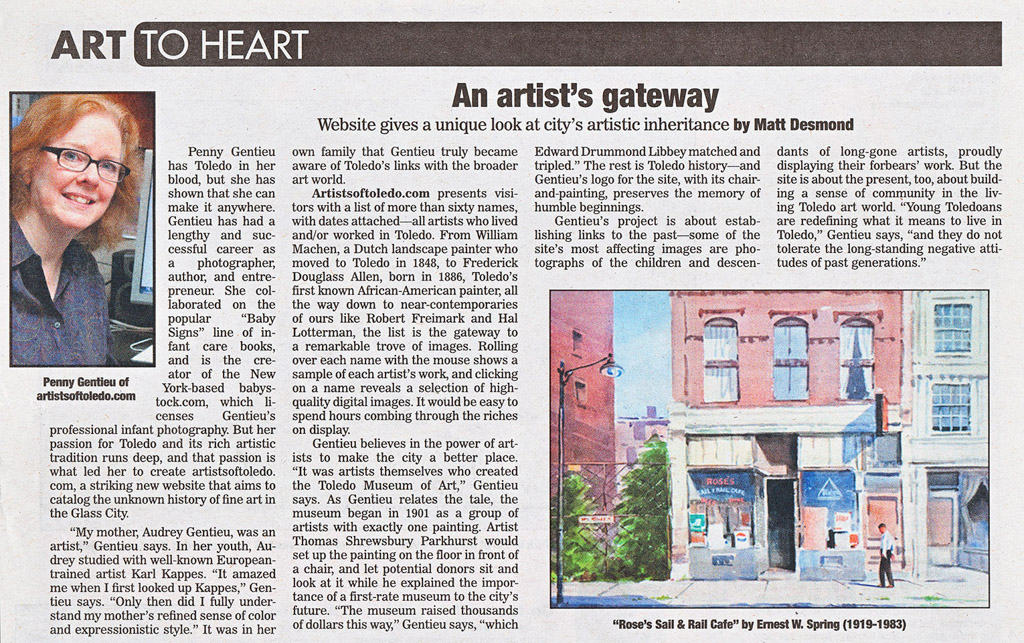
An artist’s gateway

Article in the City Paper today about artistsoftoledo.com –

Website gives a unique look at city’s artistic inheritance  by Matt Desmond

City Paper, October 15, 2010