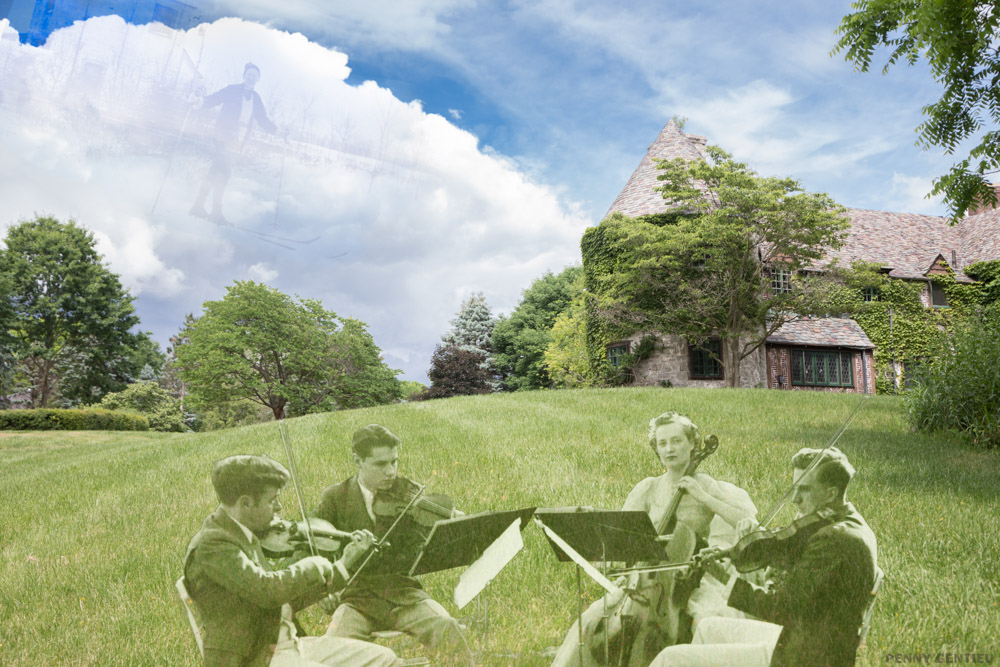
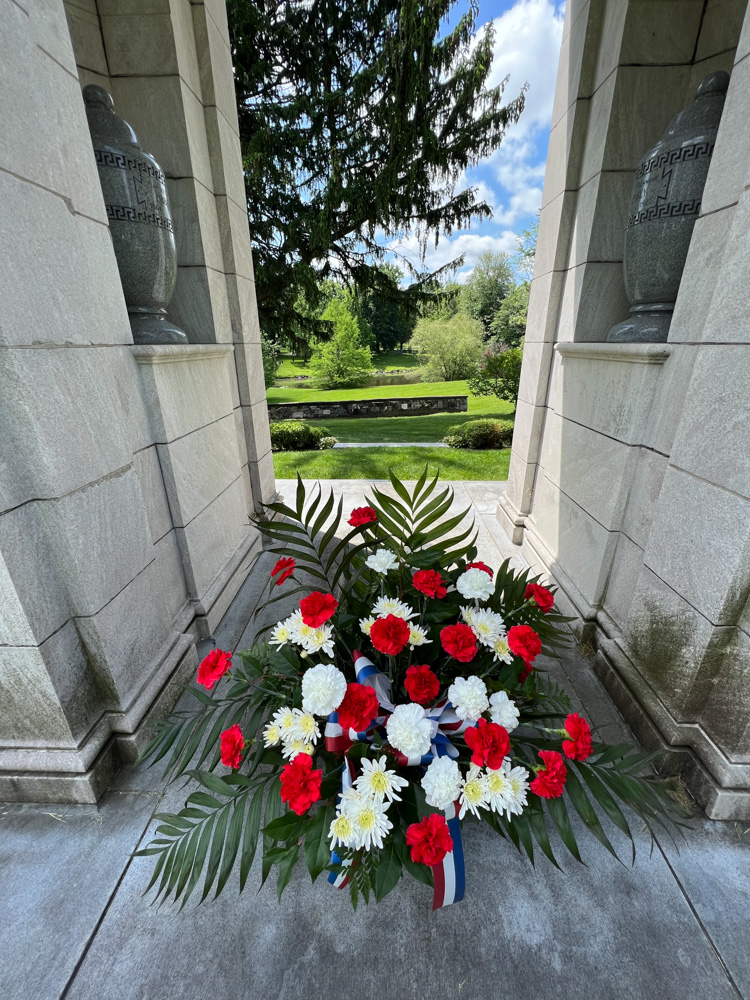
Doreen Canaday and Lyman Spitzer’s wedding on June 29, 1940, at the Canaday family estate, Inlands, in Ottawa Hills.
Doreen Canaday Spitzer (1914 – 2010) connected Toledo to ancient Greece and the universe. Doreen’s epic story encompasses 3,500 years and a vast amount of space.
Doreen was an archaeologist, and she had a great deal to do with the reconstruction of an ancient pillared building in Athens, Greece. Her husband, Lyman Spitzer is one of the inventors of the Hubble Telescope — the first camera in outer space, reaching out to trillions of galaxies. They lived in Princeton, New Jersey where Lyman was a professor at the university, and together they raised a bright family.
Doreen is the daughter of Ward M. Canaday, one of Toledo’s great industrialists, famous for being the “Father of the Jeep.” He is the namesake to the Ward M. Canaday Gallery at the Toledo Museum of Art and the Ward M. Canaday Center for Special Collections at the University of Toledo, which are just two of his major endowments to the city and to the world.
Inlands as viewed from across Ten Mile Creek, 1929
When Doreen was 12, in 1926, Ward and Mariam Canaday built a French medieval farm house on 15 acres in Ottawa Hills. It was built to look as if it was from another time, and it was furnished from another time with ancient items gathered on a family history trip to Europe.
Ward and Mariam died in the 1970’s. In 2021, after the third owner passed away and the house was in-between owners, I had the honor of photographing the house. It was Doreen who opened the door to her world for me, through a book she wrote about her parents, By One and One, and a scrapbook that she made in the 1970’s for the long-time Inlands workers.
Doreen’s interest in archaeology during her studies at the American School of Classical Studies in Athens, Greece inspired her father to devote his time and considerably skilled business efforts to the reconstruction of the Stoa of Attalos in the Ancient Agora, a large area which is below the hill of the Acropolis in Athens. He was a trustee of the school from 1937 until he died in 1976.
View of the excavation site, 1952, of the Agora and Stoa of Attalos, Acropolis in the background. This photo is hanging in the office of the Stoa, photographed in 2022.
It’s hard to imagine that the ancient agora (which was an active market and meeting place 2,600 years ago and the heart of ancient Athens) had not been excavated until the American School of Classical Studies set forth to do so in the late 19th and 20th Century. It was Ward Canaday’s tremendous business skills that brought forth the reconstruction of the Stoa of Attalos open-air mall, recreated as close as it could be to its original glory within only two or three years. It was made into a museum. A tree was planted, called the Toledo Tree, marking Toledo’s commitment to the restoration, in 1953.
Tom and I took a trip to Greece. We hunted down the Toledo Tree, the first tree planted in the freshly excavated Agora. I photographed the long pillared Stoa of Attalos on one end, and the Temple of Hephaistos across the way. It was thrilling, and so profound to reflect on the story of the Canaday family’s important contribution to the excavation of the Agora and the recreation of the Stoa of Attalos.
Inlands, seen through a cluster of stars is known as Messier 15, located some 35 000 light-years away in the constellation of Pegasus (The Winged Horse). It is one of the oldest globular clusters known, with an age of around 12 billion years. Doreen by the Inlands front door, 2021
Frank and Molly, Ward’s mother, Mariam and Ward – Canadays all.
Not to question the veracity of the Brooklyn Museum, but William Penn came 56 years after the first European settlers. The Dutch were the first, and through their Dutch West India Company conducted successful trading of goods with the Lenape. When the Dutch made deals to purchase land –– there is nothing “falsely” claimed or “stolen” land about it –– the Dutch understood that the Lenape could remain living on the land, and that the Dutch would protect the tribe from their enemies — who were other tribes that they happened to be in conflict with. The Europeans were generally non-violent and peaceful. It was General-Director Willem Kieft, 15 years into the settlement, who became violent and waged a highly unpopular 3-year war on the Native Americans in 1642. He was ousted through the Dutch settlers’ Remonstrance to the Dutch government. The Dutch people were tolerant of different groups of people living together. Hence, in 1682 William Penn and his group of Quaker refugees sought haven from religious prosecution.
But, whatever.
French Impressionist/early modern paintings in Brooklyn Museum’s collection (all of them):
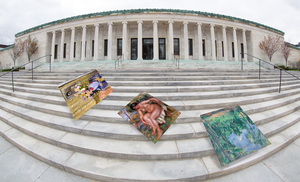
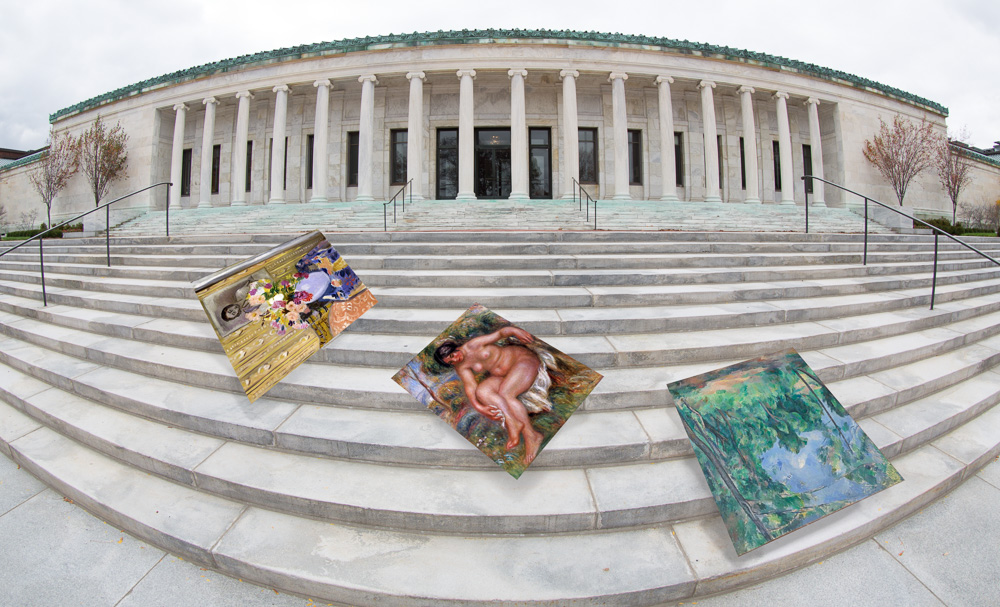
Observation: Not one of the Impressionist paintings in the Brooklyn Museum was even close to being as good as the Cézanne, Matisse, and Renoir that were deaccessioned by The Toledo Museum of Art on May 17, 2022. And to think that museum director Adam Levine told museum supporters that Edward Drummond Libbey would want the Toledo’s Cézanne, Matisse, and Renoir large oil paintings to be deaccessioned, as if they were “mediocre.”
Model of the Jan Martense Schenck house that was built in Mill Basin, circa 1675-6. The actual house is displayed on the 5th floor of the museum. Duke Riley’s trash art exhibition is incorporated into it.
Seeing myself in the Art. (Which isn’t too difficult, considering that my Dutch immigrant ancestors, Elbert Elbertsen Stoothoff and Aechtji Cornelis Cool, lived within a mile of this house, and had a house just like it back in the seventeenth century. And I don’t think they’d like seeing modern-day garbage art hanging in their old house and being blamed for it. Their son-in-law, Colonel Thomas Willett Jr. was the sheriff of Yorkshire (including Long Island, Westchester and Staten Island) in 1676.
Neue Galerie
Standing in front of the portrait of Adele Bloch-Bauer by Gustav Klimt at the Neue Galerie.
Observation: none of these paintings are as good as the three paintings by Cézanne, Matisse, and Renoir that were recently deaccessioned by The Toledo Museum of Art.
Cézanne and Matisse sold to the same buyer. Who was it? Was it prearranged?
Cézanne and Matisse sold to the same buyer. Who was it? Was it prearranged?
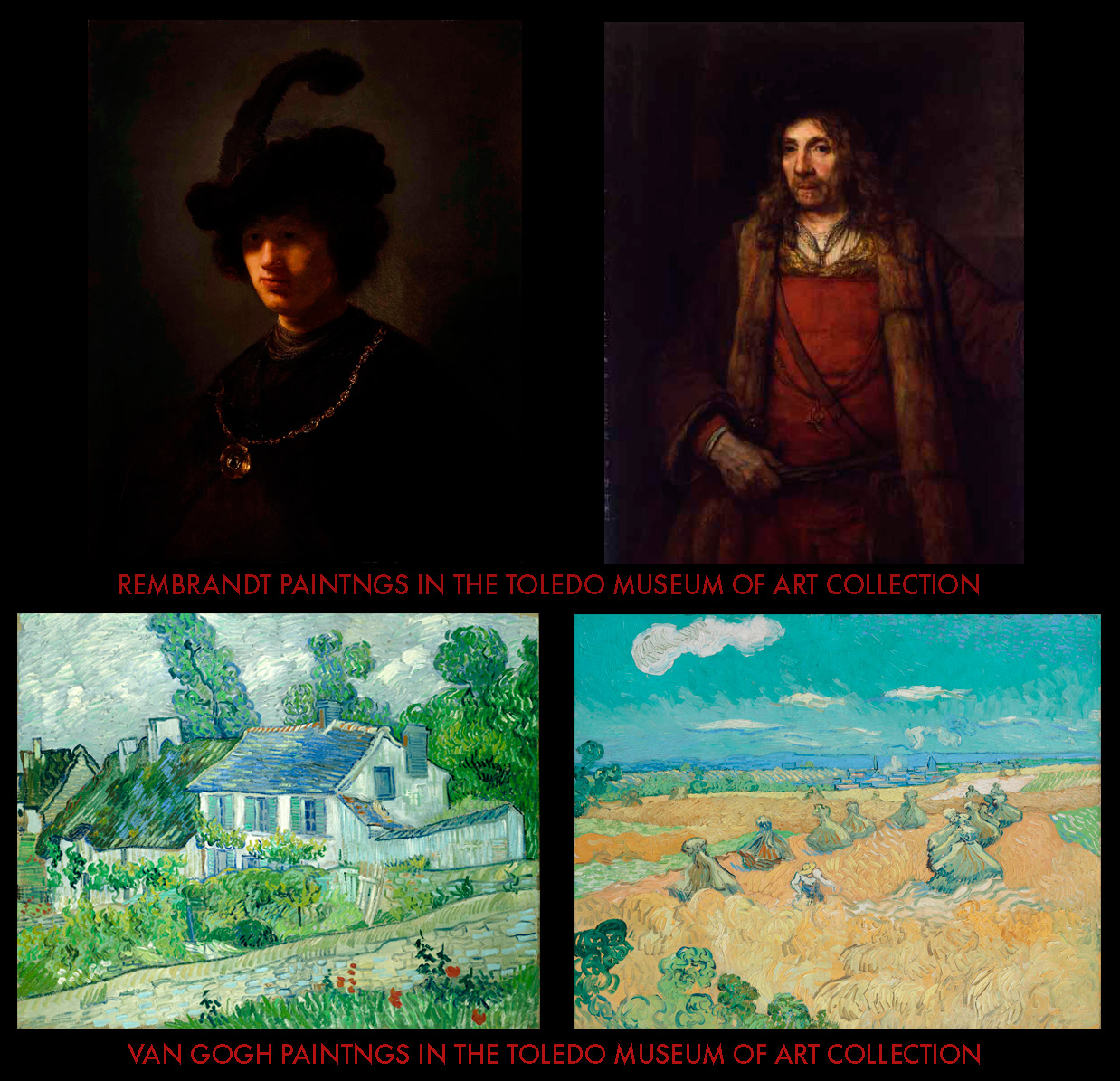
“The Toledo Museum of Art has never sought to have multiple examples by the same artist,” Adam Levine told museum supporters as to why the museum deaccessioned three paintings by Cézanne, Matisse and Renoir in April 2022. Above are two examples of what the Museum has two of: two Rembrandts and two Van Goghs.*
Questions about the deaccession of our Cézanne, Matisse, and Renoir paintings from the museum’s collection
To rationalize the deaccession of the paintings by Cézanne, Matisse and Renoir, Adam Levine told museum supporters that the paintings were inferior, and that the museum never sought to have more than one example of any given artist. He said that the Libbeys would want them to rid the museum of these paintings because they were mediocre, quoting Edward Drummond Libbey himself: “Let the multitudinous array of the mediocre be relegated to the past and in its place be found the highest quality, the best examples and the recognition of only those thoughts which will stand for all time.”
Those were lies. The paintings were not mediocre, and Libbey’s quote was taken out of context. The museum has always intended to have multiple examples of certain important artists. The Toledo Museum of Art is a teaching museum. These paintings were a big part of a small but strong collection of French Impressionist art, historically significant as marking the beginning of modern art, and the Toledo Museum of Art and the people of Toledo were so lucky to have them. Seems like it was for the money, and an eager buyer who wanted to buy our famous French Impressionist paintings from our collection, that made our museum officers want to sell them.
The day before the sale, The Blade ran an article by Jason Webber, CONTROVERSY SURROUNDS TOLEDO MUSEUM OF ART SALE OF THREE PAINTINGS. In the article, the Toledo Museum of Art’s 2019-2020 interim director, John Stanley, who is retired now, spoke for the museum, saying he thought the deaccession was a “brilliant idea,” saying something to the effect of, what do those people who object to it know about art anyway, and “this is the world we live in.”
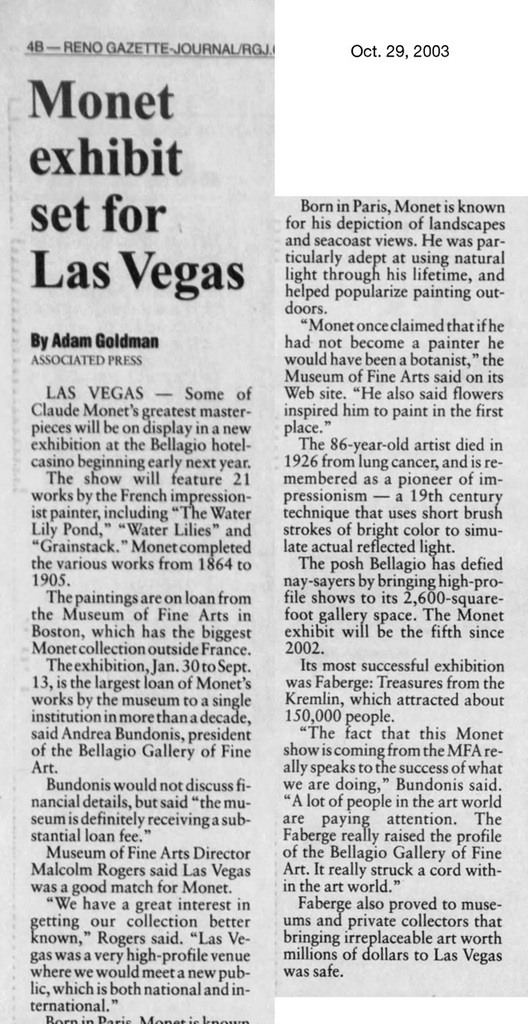
If that is not weird enough, to top it off, we discover John Stanley’s connection to a Las Vegas casino regarding French Impressionist paintings, and the owner of the casino, who collects them. John Stanley was COO of the Institute of Fine Arts, Boston when the museum rented 21 Monet paintings to the Bellagio. The owner of the casino, Steve Wynn is well-known as a collector of French Impressionist paintings. (This Vanity Fair article, Steve Wynn, the Uncrowned King of Las Vegas, mentions his masterpieces by van Gogh, Matisse, Picasso and Renoir.)
Meanwhile, Adam Levine is going overboard to make up for his 2020 George Floyd memo mistake, in which he published a memo he wrote to his staff advising that the museum was remaining neutral. Now, two years later, it seems he still can’t do enough to make up for it, but is the Toledo community being played, perhaps as a convenient distraction?
So we have to ask…
Who bought the paintings the museum deaccessioned last month? Did the buyer have any contact with anyone working at or associated with the museum before the decision was made to deaccession them or before they were sold?
Why is John Stanley on the “Art Committee,” when he is not a curator, and his educational background is in business and finance and not in art? Who else is on the “Art Committee?”Isn’t John Stanley retired, as reported in The Blade’s September 8, 2021 article about his 1.5 million gift to the museum? Is he a paid consultant, and if so, what for? Does he live in Toledo or New York, or somewhere else?
Our famous French Impressionist paintings thrown out the door.
How did the museum decide to deaccession exactly those three paintings out of all the 30,000+ artworks that the museum has on display in our museum and in storage? Is selling artwork for the money an approved ethical reason to deaccession? How did all three deaccessions happen to be French Impressionist oil paintings exclusively? Was someone interested in the paintings before the museum put them up for sale?
Will the new museum officers be determining the one best painting of every artist that the museum has in its collection, and deaccession all others? Will it depend on outside interest of the possible sales of culled artworks? Will the museum curators be doing the same kind of collection culling with our collections of prints, drawings, photographs, books, sculptures, furniture, and ceramics?
Will the new Robert and Sue Savage Community Gallery be curated by outside curators? Will it be for serious professional local artists, or will it be for neighborhood outreach projects? Will it only be for people who live in the two-mile outreach radius that the museum is concentrating on, as outlined according to the museum’s strategic plan, Program 3 listed under Objective 1? (Toledo Museum of Art Strategic Plan, /OBJECTIVE 1: Transition to Active Community Outreach and Engagement –“TMA will maintain a focus on the two-mile radius immediately around the Museum.” /Program 3: Engage Local Artists.)
The New York Philharmonic requires musicians to audition behind a curtain, so that the reviewers or judges don’t know the race or the sex of the performer; the musicians are chosen on their artistic merits. Can the museum share with us the results of the survey they made of the classifications and rating systems of the artwork in our collection? How do they determine the sexual orientation of the artist? Will they be requiring that information about local artists who want to show at the Robert and Sue Savage Community Gallery?
Are the new acquisitions going to be based on a quota system?
Will they be leveling up the museum’s collection of paintings to have an equal number of paintings by women artists, since the museum has been so male-centric, and if so, will the percentages match the population’s racial, poverty-level, and zip-code demographics of Toledo? Will they be buying, or selling, paintings to make it equitable?
According to Adam Levine in his April 8 letter to museum supporters, Important announcement from The Toledo Museum of Art, “We will use these proceeds to create a new acquisition endowment.” Does that mean they are creating a new acquisition endowment with the approximate $54 million they took from the paintings? For the two paintings that were originally purchased from the Edward Drummond Libbey Endowment, why isn’t the money being returned to the Edward Drummond Libbey Endowment until such time that it is used to by new art, as is required?Did they talk to the family of Mrs. C. Lockhart McKelvy about the deaccession of her gift of the Renoir?
When the director says that they are going to draw less from the Libbey Endowment, does he mean that they are going to sell two of its most valuable paintings and create a whole new endowment, free of any of the restraints or ties to the past?
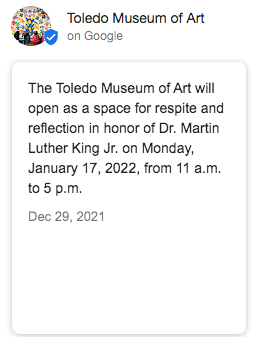
On January 17, 2022 this year, why couldn’t the museum figure out how to celebrate its own 110th anniversary on the same day that you opened the museum on a Monday for MLK Day?If the leaders of the museum cannot feel comfortable honoring the museum’s own history while at the same time wanting to honor Black history, then shouldn’t we have better leaders? Shouldn’t the least we expect from Adam Levine or any director is that they show respect for The Toledo Museum of Art’s own history? And shouldn’t we also expect them at the very least to be good stewards of our best artwork and not to sell it off for the money, since it is a museum we are so lucky to have as Toledoans, and we want to keep our best artwork safe for future generations?
What percentage of the museum’s expenditures on new artwork in the past 10 years went to buy “diverse” artwork?
According to probate court records, the museum has been taking upwards of $500,000 out of the Libbey Endowments ($300,000 from Edward’s, and estimating that it is around $200,000 from Florence’s) over the past two years, granted for June 30, 2020 to June 30, 2022, on account of Covid, taking from the part of the endowment funds that are are meant to be used only to buy art. They filed and received a temporary variance on the Endowments’ rules, so they could use the money not to buy new art, but instead for expenses on “the direct care of art,” since the museum is somehow suffering financially. How is it that the museum is deserving of that variance to use the Endowments’ art acquisition money for expenses, when they have been hiring more employees, giving raises to employees, adding employee benefits, and sending employees off into the field to do things like to set up “art-making stations” in housing revitalization projects with developers? Why didn’t they want to buy diverse art with that money?
Considering that the museum didn’t use that variance money on art purchases as the museum expands “outside of its walls,” (indicating that the museum has plenty of money), but they got the money for “direct care” of the artwork in their collection, but instead of caring for the artwork, they sold the museum’s three great paintings out of a collection they are expected to care for, according to the fiduciary duty as the director and the officers of the museum, to set up a new endowment to buy new art, but why didn’t they buy new art with the $500,000 in the first place, without selling our three great paintings?
Don’t they care about how it appears that they could be buying museum board members’ votes, when there is a conflict of interest and ethical considerations regarding the museum doing business with board members? For example, buying insurance, accounting, managing investments, and other kinds of deals with various organizations, when the officers of the various organizations are directors on the board – how could the directors possibly vote no against any deaccession proposal, or anything that is recommended by the director, when financially, their businesses are so entangled with the museum? To be put in such a position, how are they are expected to be loyal to both interests at once, if one interest is the organization they work for, and the other interest is the public interest, say if they thought in their heart that the paintings should not be deaccessioned, but then they don’t want to rock the boat or interfere with the business relationships of their organizations doing business with the museum?
We should not tolerate the director and officers lying to us and selling our best art. They had a fiduciary duty first and foremost to care for these particularly important paintings that were a major part of our French Impressionist collection and our collection as a whole and keep them safe for future generations. That’s what museums do.
*Other artists of which there are two or more paintings in the Toledo Museum of Art collection include: Jean-Siméon Chardin (two bought at the same time in 2006 by esteemed curator emeritus Larry Nichols, a big deal was made by the museum about these two paintings being added to the collection), François Boucher, Thomas Couture, Charles Courtney Curran, Edgar Degas, Wilder M. Darling, Eugène Delacroix, Thornton Dial Jr., Gustave Doré, Thomas Doughty, Henri Fantin-Latour, Beverly Fishman, August Franzen, Gajin Fujita, Carl Frederick Gaertner, Luther Emerson van Gorder, Francesco Guardi, Childe Hassam, Martin Johnson Heade, Yoshida Hiroshi, Carl Robert Holty, Manuel Hughes, Roberto Humeres S., William Holman Hunt, Jozef Israëls, Karl N. Kahl, Gabriel Liston, Jacob Maris, Anton Mauve, Jean-Francois Millet, Joan Miró, Claude Monet, Edmund Henry Osthaus, Giovanni Paolo Panini, Camille Pissarro, Henry Ward Ranger, Pierre-Auguste Renoir, Niklaus Rüegg, Sebastiano Ricci, Sir Joshua Reynolds, Frank Stella, Yves Tanguy, Anne Vallayer-Coster, Élisabeth-Louise Vigée-Le Brun, Benjamin West, Alexander Helwig Wyant, Jacques Blanchard, Charles Loring Elliott, Thomas Gainsborough, Giovanni Paolo Panini, Gustave Courbet, Nicolas Poussin, Aert van der Neer, and Joos van Cleve. But now the museum only has one painting by Cézanne, and only one painting by Matisse, because they sold the other two for $57 million.
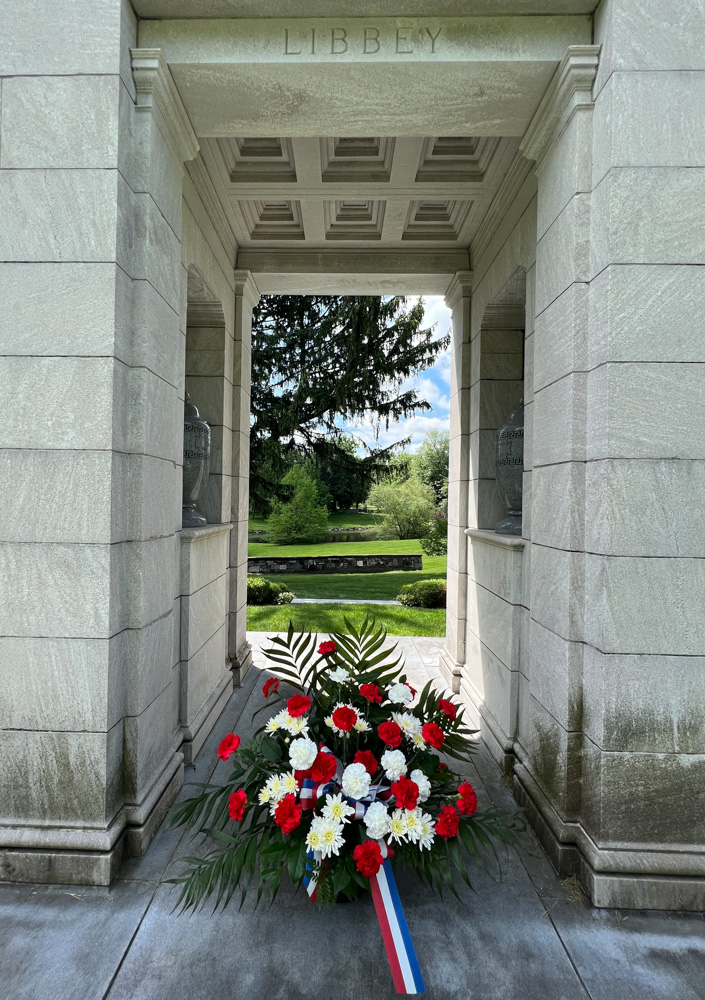
Why does the museum put flowers on the Libbey grave, three times a year, every year?
What reputable museum sells valuable paintings from their great French Impressionist collection to “broaden the narrative of art history?”
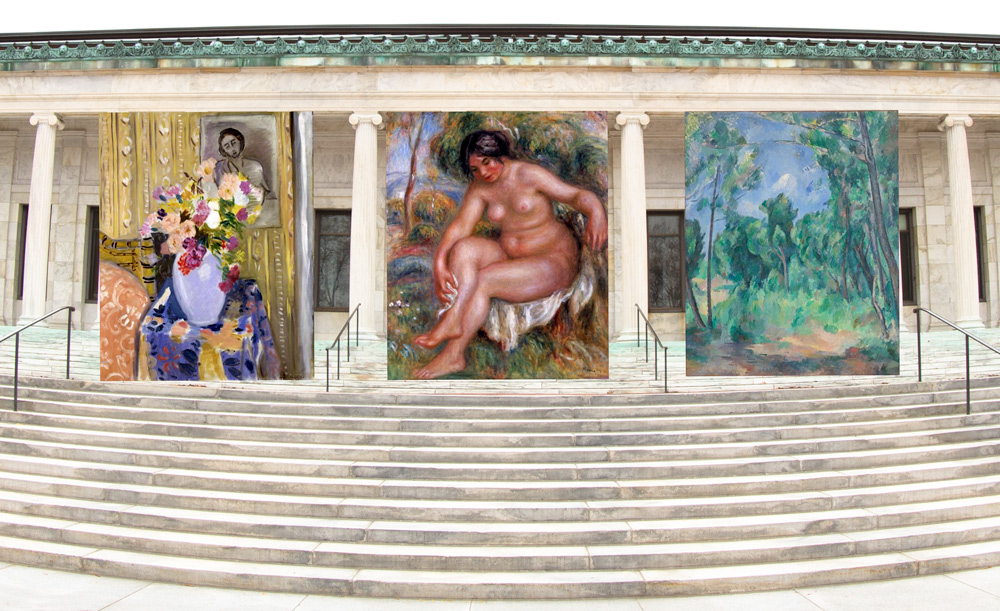
Selling off Paul Cezanne’s Clairière (The Glade); Henri Matisse’s Fleurs ou Fleurs devant un portrait; and Pierre-Auguste Renoir’s Nu s’essuyant simply makes no sense. These and other proven lasting works draw people to the museum from near and far. EDITORIAL – TOLEDO MUSEUM OF ART SHOULD KEEP ITS TOP TIER The Blade, Editorial Board, April 25, 2022
Diversity is achieved through addition, not through subtraction. Removal of the works from the collection does nothing for diversity. There are ethical guidelines in the field that concern reasons for deaccession and increasing diversity is not among them. One could say that it’s performative rather than substantive. It looks like you’re doing something, when the question remains are you really doing something by taking great works of art out of a collection. – Christopher Knight, Pulitzer prize winning art critic and author of COMMENTARY: AN OHIO MUSEUM IS HOLDING THE BIGGEST SALE OF ARTWORK YET. IT’S UNCONSCIONABLE (Los Angeles Times, May 6, 2022), as quoted in the The Blade, Jason Webber, May 16, 2022, CONTROVERSY SURROUNDS TOLEDO MUSEUM OF ART SALE OF THREE PAINTINGS
The Edward Drummond and Florence Scott Libbey President, Director and CEO of the Toledo Museum of Art, Adam Levine, portrayed the Matisse, Cézanne, and Renoir paintings as being mediocre, disingenuously invoking Edward Drummond Libbey’s approval in a Libbey quote, as if Libbey would approve of the deaccessions of these valuable, famous and popular paintings. Mr. Levine wrote this in his April 8 deaccession justification letter to members:
As Edward Drummond Libbey put it in 1912: “Let the multitudinous array of the mediocre be relegated to the past and in its place be found the highest quality, the best examples and the recognition of only those thoughts which will stand for all time.”
Mr. Levine said that deaccessions, such as that of these three masterpiece paintings, are written “by design” in the wills of Edward Drummond and Florence Scott Libbey.
Twisting the intent of Edward and Florence’s wills, who by the way have paid for about 85% (just my BFA college-educated guess from looking at the museum’s online catalog) of all the art in the Toledo Museum of Art, as well as having paid for the building itself, their wills which stated that the proceeds of anything sold from the collection has to be spent on artwork only, is a basic ethical principle regarding the deaccessioning of artwork in any museum collection. But Adam Levine, 11th Director of the Toledo Museum of Art, made it seem as if Libbey intended for the art in the collection to be traded as if it was a stock portfolio! Indeed, Adam Levine told Christopher Knight in regard to selling the Cézanne, it was time to pull the trigger.
Adam Levine pulled the trigger on our famous Impressionist paintings and shot them out the door.
The rules in the wills
From the Edward Drummond Libbey Will:
All paintings, other pictures and works of art by me bequeathed said The Toledo Museum of Art, its successor and successors, by this my Will, or by any codicil thereto, and all paintings, pictures and other works of art by it or them acquired by expenditures from said income, shall at all times be properly and appropriately housed in one or more rooms of The Toledo Museum of Art in said City of Toledo, each of which rooms shall at all times be designated and plainly marked “The Edward Drummond Libbey Gallery”; each and every of said painting, other pictures and works of art shall at all times be plainly marked “Gift of Edward Drummond Libbey”, and shall be kept adequately insured against loss from fire, theft and other causes. Said The Toledo Museum of Art, its successor and successors, may temporarily loan for the purposes of public exhibition elsewhere any such painting or other picture or work of art, upon taking proper security for its safe return; and it and they may, from time to time and at its and their discretion, sell or exchange any painting or other picture or work of art purchased by expenditures from said income, and from the proceeds thereof may acquire some other or others.
From the Florence Scott Libbey Will:
One-half (1/2) thereof in the purchase of paintings, statuary, furniture and other works of art, each of which, when so acquired, shall have designated thereon, or near thereto, the following words: “Florence Scott Libbey Bequest in Memory of her Father, Maurice A. Scott”, and shall be permanently installed in one or more rooms of the building or buildings of said Museum of Art, each of which shall be designated and known as the “Maurice A. Scott Memorial Gallery” and the other one-half (1/2), thereof to be used and expended by said The Toledo Museum of Art, its successor and successors, for any of its corporate purposes. Any articles, so purchased, if deemed advisable or desirable, may be sold or exchanged, and the proceeds of every such sale used as income in the purchase of some other work of art.
Building the museum’s fine collection took many years, and much effort went into it. French Impressionism is popular and valuable work; it is very accessible; it is considered to be the starting point of modern art. The Matisse (purchased in 1935) and Cezanne (purchased in 1942) were purchased with funds from the Libbey Endowment, Gift of Edward Drummond Libbey.
Adam Levine wrote in his April 8 letter to museum supporters:
The Toledo Museum of Art has never sought to have multiple examples by the same artist—fewer than 11% of the artists in our collection are represented by two or more paintings;
We will use these proceeds to create a new acquisition endowment.
YIKES!
using the sales of the Cézanne, Matisse, and Renoir to create a new acquisition endowment!! But doesn’t the Libbey will specify that proceeds from any sale be used for art, right now, not to be used to create a new entity of a new endowment — the money is not even going back to the Libbey Endowment to be used on art soon enough? What about the Libbey name and attribution to the gift of the artwork that will be purchased? What about Mrs. McKelvy? What the heck! What’s the set-up cost going to be for this “new endowment” and how many hands are in that pot?
Gee Wiz!
If only Adam Levine had been fired on the spot after he came out with his crude George Floyd memo that stated how the staff should stay neutral. Instead, the museum trustees went along with his rationalization that there was something fundamentally wrong with our museum, as if it reflects bias and discrimination against the black community. Nothing could be further from the truth, except for the hiring of Adam Levine and keeping him on after he published his thoughtless memo.
A field day
The Toledo Black Artist Coalition had a field day.
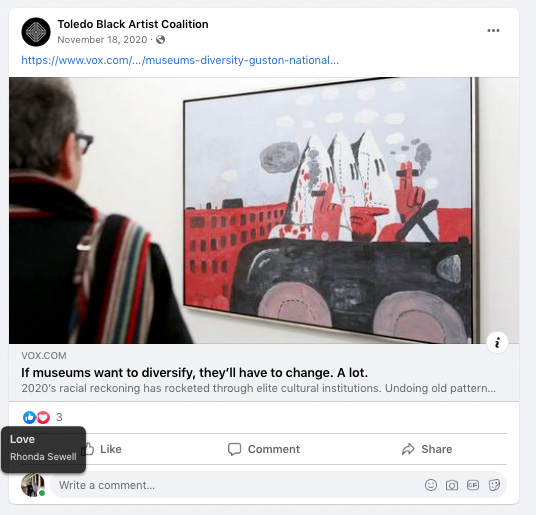
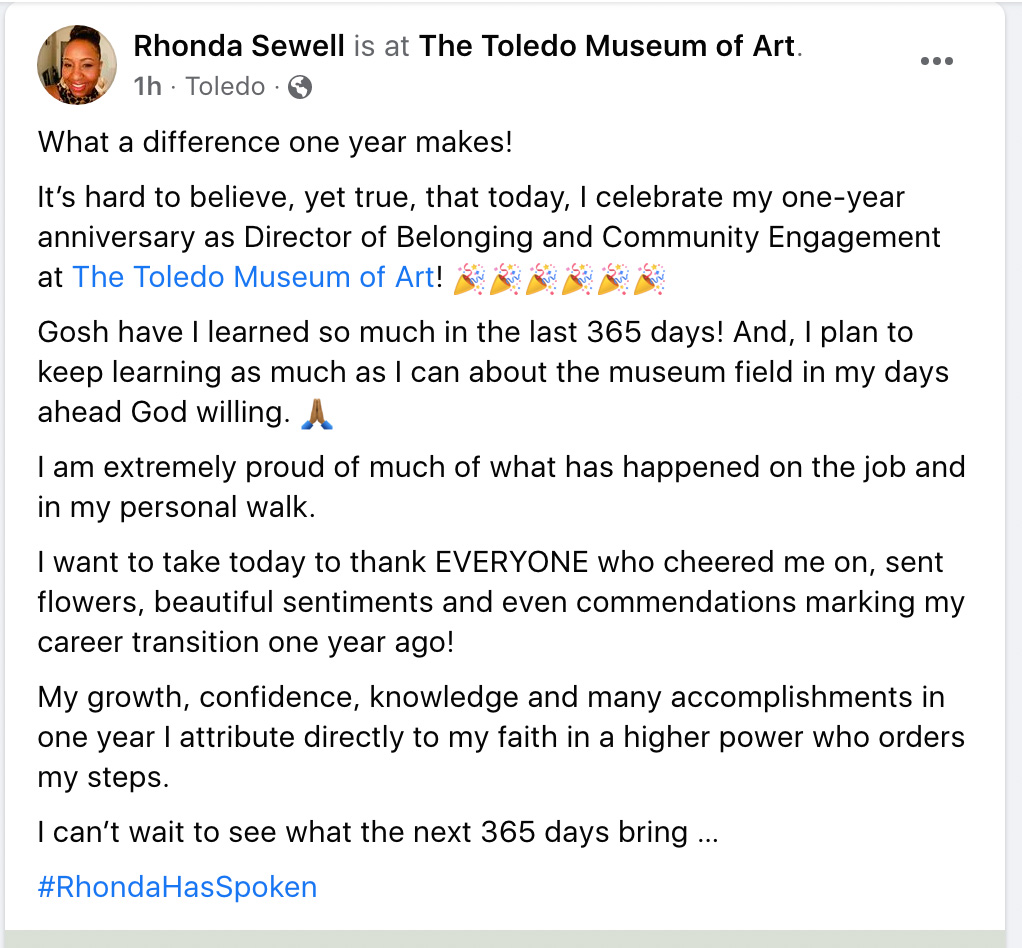
November 18, 2020, five months before she was hired by the museum to be the first “Director of Belonging and Community Engagement,” Rhonda Sewell’s heart emoji on a Toledo Black Artist Coalition Facebook post, implying that the Toledo Museum of Art is elitist and racist. It is important to note that the painting by Philip Guston in this post does not have anything to do with the Toledo Museum of Art. “On Monday, January 17th the Toledo Museum of Art is open as a gathering place to celebrate the life and legacy of Dr. Martin Luther King, Jr. Come enjoy a full day of programs and exhibits that celebrate African-American artists and culture. Feel the united spirit of our diverse Toledo community.”
This year, the museum opened its doors on a Monday for the first time in 110 years to celebrate Martin Luther King Jr. Day. It just happened to be the 110th anniversary of the day the museum opened the doors for the very first time, ever. But there was no mention of that at the museum. Mum was the word. I was there, and I asked several employees, including a trustee who was going around introducing herself, and none of them knew. The museum historian knew though — they called and asked her! Couldn’t the museum figure out how Martin Luther King Jr. Day and the 110th anniversary of the opening of the new museum could be celebrated together? How pathetic that they had to sell out the museum’s history in order to honor black history.
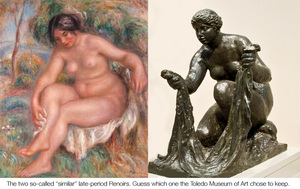
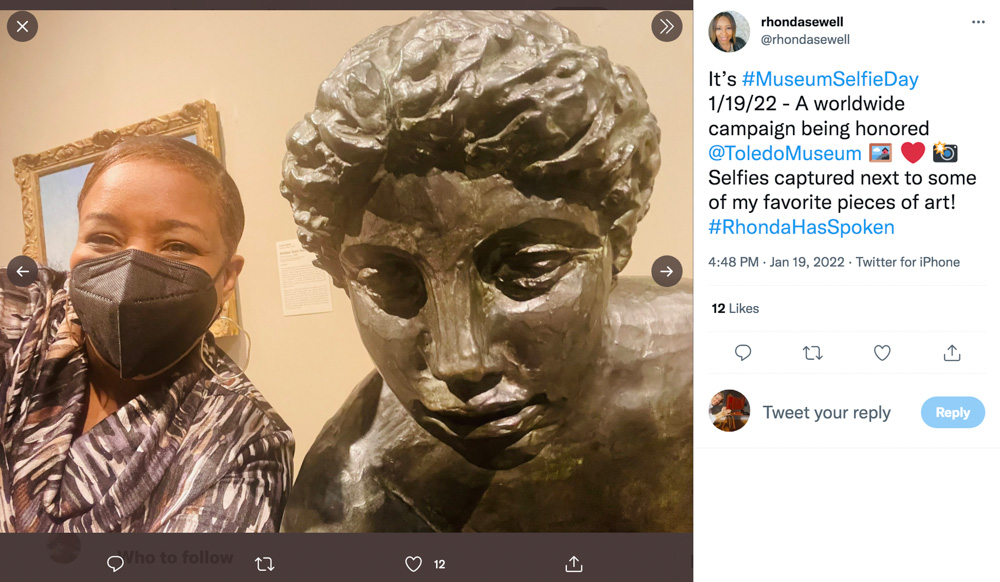
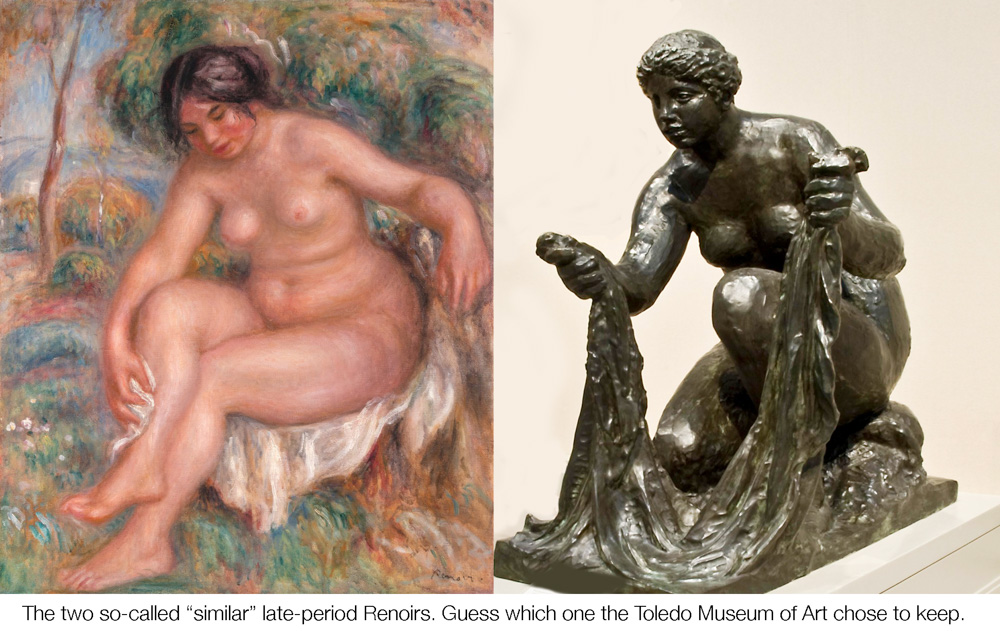
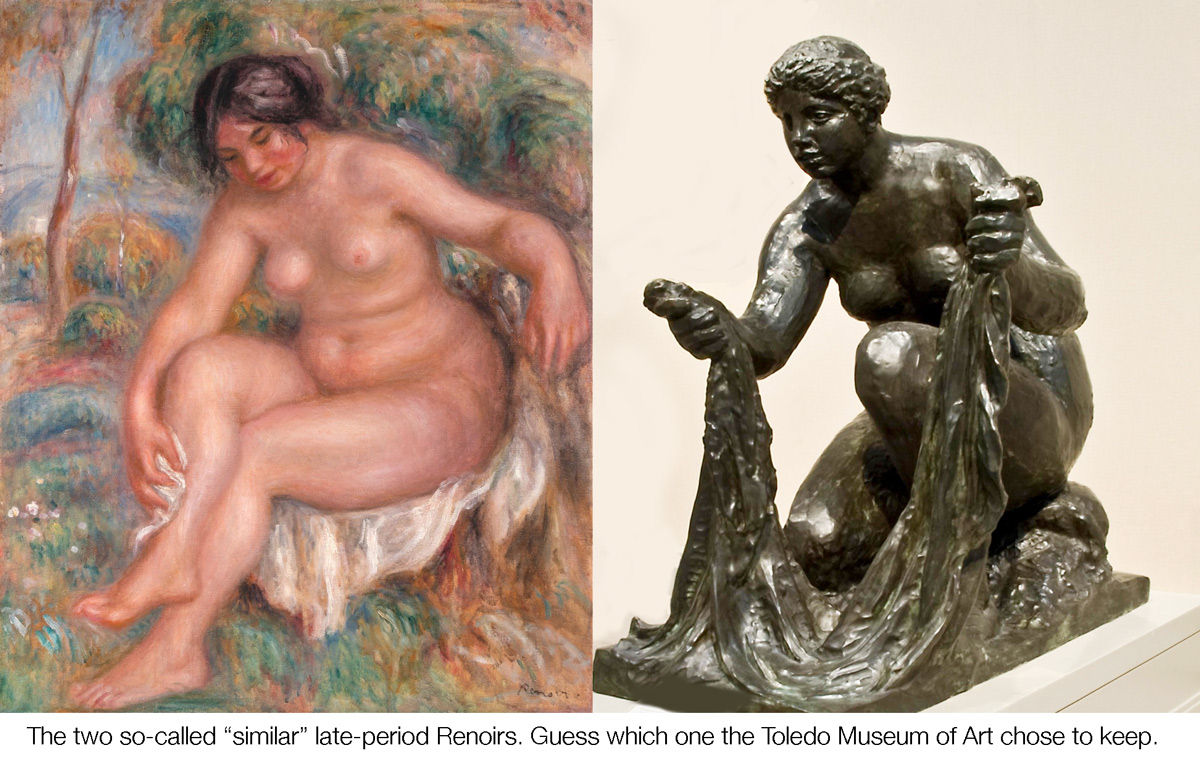
“Belonging and Community Engagement” Director Rhonda Sewell’s January 19, 2022 tweet – a selfie with one of her favorite pieces of art – the Renoir sculpture of a nude woman in bronze that was deemed to be so similar and so much better than the Renoir painting of the nude white woman, that the painting had to go.The two so-called “similar” late-period Renoirs. A painting that is too similar to a sculpture! Guess which on the Toledo Museum of Art chose to keep. What is the museum telling us? Its value on the open market was merely 5% of the total of the three, and this painting was a valuable part of Mrs. McKelvy’s female-eye-curated collection bequest. Was it thrown in as a symbolic sacrifice, or as a distraction? Will details be revealed that make it even more sinister than we can imagine? Read on….April 26, 2022: What will next year bring? A museum without its venerable French Impressionist collection. A divisive museum. If that is Rhonda Sewell’s idea of progress, then congratulations.
The “brand” of “belonging”
Is it good stewardship for the Director of The Toledo Museum of Art, Adam Levine, to add two new departments — “Branding” and “Belonging” – erasing and re-writing the museum for the black community (some would call it pandering), while at the same time dismantling the museum’s wonderful French Impressionism collection for $50+ million? Adam Levine has ridded us of a good third or more of ourvaluable, popular, historically significant French Impressionist paintings, calling it in the name of “diversity.” One thing is for sure, he is getting a lot of negative publicity.
And then there’s this.
To sell our Renoir, Matisse and Cézanne out from under our valuable public collection, into secret, private hands, only for us to find out that the two most expensive paintings were sold to the same buyer, sales that are shrouded by the convenient secrecy of a Sotheby’s auction, then to discover a casino connection to our former “interim” director, John Stanley… who strangely became the museum spokesman for The Blade’s article on May 16, 2022, CONTROVERSY SURROUNDS TOLEDO MUSEUM OF ART SALE OF THREE PAINTINGS saying that, basically, what do those people who object to the deaccessions know about art anyway, and “this is the world we live in….” It’s outrageous!
Hired to oversee the business aspects of the 2018 plans for the museum building renovation, then used as the interim director when Brian Kennedy suddenly left the museum one year before the end of his contract, John Stanley isn’t on the board of museum trustees, but for some reason, he is on the so-called “Art Committee” that recommended the deaccession (even though he has no degree in art – only in business and finance, and was hired by the museum to work on the new construction – so what does he know about art?) But when the going got tough with the public outcry against the auction, John Stanley was the spokesman the art museum put out front to deal with it.
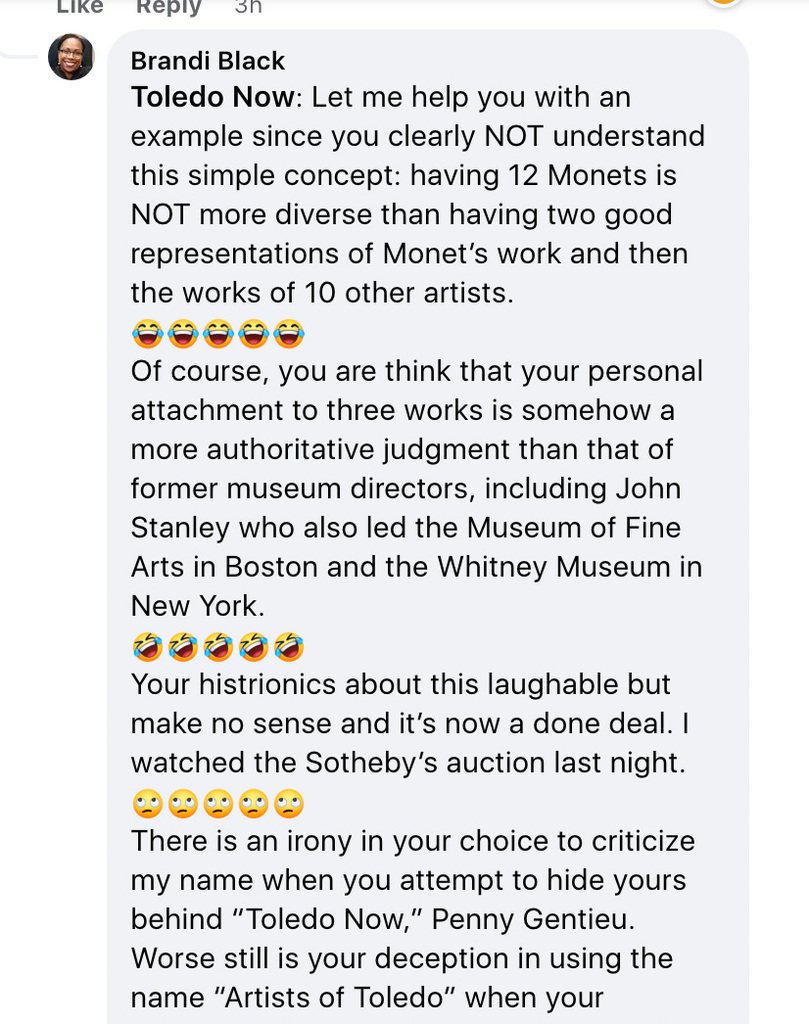
And speaking for the museum on Facebook was the charming troll-like, aptly-named “Brandi Black.” She appeared on top of every Blade article about the deaccession, and also on my Toledo Now page, posting sarcastic ad hominem and name-calling attacks on everyone who dared to question the sales of the paintings. She used the face of Supreme Court Justice, Ketanji Brown Jackson. Not everyone would recognize the honorable judge’s friendly face. Judges are meant to be behind the scenes, after all. They are not celebrities. “Brandi Black” changed her Facebook moniker picture to Ketanji Brown Jackson (from a white cartoon face) on the day before Adam Levine announced the deaccession. Hmmm…. Did the museum actually hire her, or was she just volunteering? Only the Brand Director knows for sure. Either way, she certainly made the museum look bad!
How strange that Brandi Black’s May 18 comment on The Blade Facebook post for their article, CONTROVERSY SURROUNDS TOLEDO MUSEUM OF ART SALE OF THREE PAINTINGS, mentions 12 Monets, John Stanley and the Museum of Fine Arts, and that Brandi Black personally watched the Sotheby’s auction — all at once!
What are the odds?
Check out this article about the rental of 21 Monet paintings to a Las Vegas casino by the Institute of Fine Arts, Boston, during the time that John Stanley was the COO of that museum.
A museum’s stellar Impressionist collection rented out to a casino!!
How interesting to find out that John Stanley was the COO at the Institute of Fine Arts, Boston when they rented out 21 French Impressionist Monet paintings from the museum’s stellar collection to a Las Vegas casino, the Bellagio, for a generous rental fee.
The owner of the Bellagio casino, Steve Wynn, is an avid collector of French Impressionist art; such articles are easy to find on Google.
Is it possible that the sale of our valuable French Impressionist paintings could have been prearranged?
The Libbeys lost a child – a baby boy – in 1895. After that, they poured their hearts into making a great, democratic art museum for all of the people of the city of Toledo – it’s our inheritance. It’s our museum.
It’s our museum!
The trustees are expected to be good stewards of our museum. The least they can do is to take care of our art and heritage and not sell it off. Our museum is not to be used as a catalog of artwork for sale. After this deaccession tragedy, shouldn’t we be seriously safeguarding our multiple Rembrandt and van Gogh oil paintings and other valuable paintings from being casualties of a future corrupt deaccessioning, now that we know that such a travesty is not only possible, but suspiciously probable, considering the circumstances surrounding the loss of our three valuable French Impressionist paintings this month?
P.S.
Why does the museum put flowers on the grave of the Libbeys, three times a year — on Easter Day, Memorial Day, and on November 13?
Because they have to – it’s in Florence Scott Libbey’s will. But I wonder, since Adam Levine and the museum trustees are making such swift and radical changes out from under the original intentions of the founders of our great, progressive museum — calling our museum out for being somehow socially unjust, when our museum has been the most democratic and forward-thinking museum of them all, selling artwork gifted by the Libbeys to make a new acquisition endowment, just how long will the trustees be keeping those flowers going on that grave?
P.P.S.
And what have they done to the Ward M. Canaday Gallery? There are no exhibitions in it anymore — they’ve had a movie playing in it for the past eight months. Are they going to sell the name of the gallery (their 2018 renovation construction plan illustrations replace the space with a generic name, capitalized, “Center Gallery”) to a philanthropist for a period of time until death puts the patron cold in the grave, at which time the museum will rinse and repeat? Will the Frederic and Mary Wolfe Gallery be at risk, as well? Is this part of Mr. Levine’s big money-making, blood-sucking, self aggrandizing plan to make our museum the envy of every museum in America?
The Toledo Museum of Art used to be the envy of every museum in America before the trustees diminished its great children’s art classes that served the entire Toledo area school system. Over 2,000 children of all ethnicities, chosen by the schools’ principals with recommendations from teachers, choosing children for the program on the merit of the child’s apparent proclivity for artistic creativity, attended art classes every Saturday during the school year, for nearly the entire 20th century. The Libbeys’ wills actually mention more in regard to the importance of education than they speak of art.
Not to mention that the museum killed the 96-year old tradition of the annual Toledo Area Artists Exhibition and got rid of the exhibition’s purchase award collection at the Toledo Museum of Art, banishing it to a closet in a Toledo high school. Included in the collection are works by such diverse local artists as Marvin Vines and Robert Garcia. Maybe the Director of Belonging and Community Engagement ought to look into this closet collection and bring the Toledo Area Artists Exhibition back. The Canaday Gallery seems to be readily available.
All the museum has to do to make itself enviable again is look back on its own history of how it engaged the community – check down in that memory hole and pull it back up.
The bodies are still warm.
A timeline journal of articles and events surrounding the deaccession:
The sacrificial Renoir painting of a nude, thrown in for good measure, even though it was worth less than 5% of the total sale, torn from Mrs. McKelvy's collection that she curated with a female eye and gave to the museum to belong to the community. Why did it have to go? Or was it just for show?
“These works of art were clear choices for the Museum to deaccession, due to very similar and/or higher quality works by the same artists represented in TMA’s deep European collection,” a museum representative told Hyperallergic. Hyperallergic.com, Elaine Velie, April 27, 2022
Controversial Unconscionable Deaccessions
by the Toledo Museum of Art
a timeline journal of the unconscionable deaccessions of the French Impressionist paintings, including articles in national publications, Artists of Toledo blog posts, comments and emails
April 23, 2022
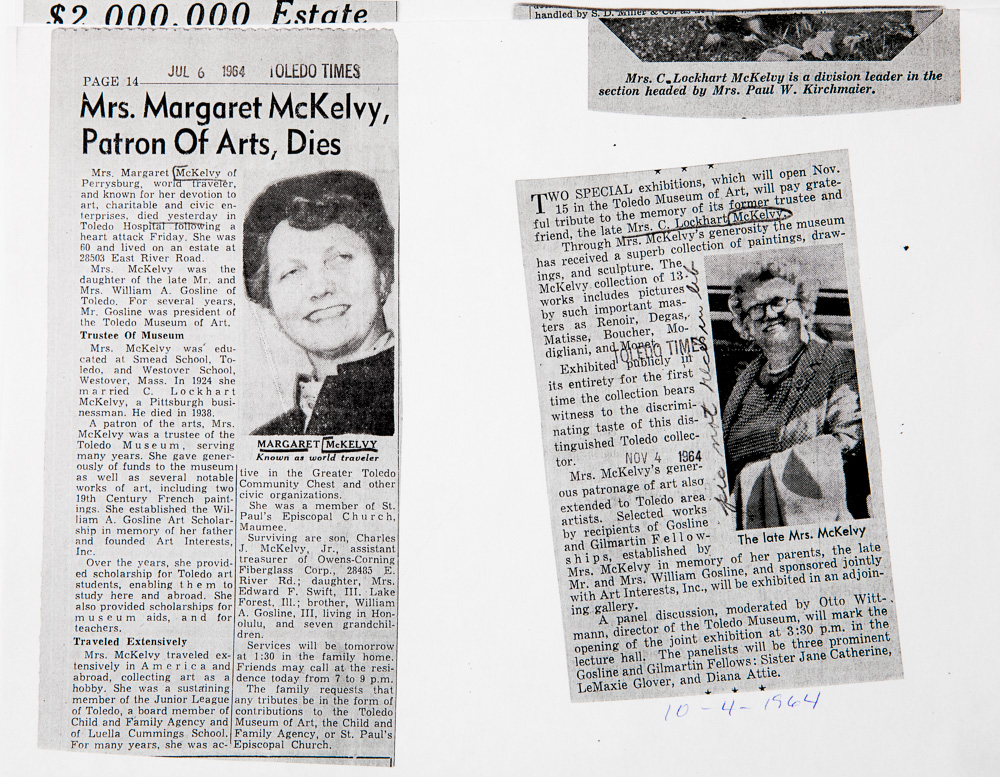
This is the story of the deaccession of three very popular paintings at the Toledo Museum of Art, and Mrs. McKelvy’s legacy. “She had the courage to acquire only works of art she liked and always considered that one day her collection would be the heritage of all of us in this community,” Director Otto Wittmann said in 1964 of the gift to the museum of her valuable French Impressionism collection, which she put together with an educated feminine eye. She was more than a collector, she supported local artists who went on to influence the very fabric of our community. For example, the great artists and teachers, LeMaxie Glover and Diana Attie. But the museum is selling her Renoir, without even a nod to her importance to our community. Maybe because she’s a woman….
Subject: The great art heist of 2022
From: penny gentieu
Date: 04/23/2022 12:01PM
To: rdurant@tps.org
Dear Dr. Durant,
Good afternoon! I wrote a new page on the website, Artists of Toledo. I would love for you to read it. It’s about the sale of our masterpieces through the perspective of one of the donors, Mrs. McKelvy, and how she helped to support talented Toledoans. We know how the Board feels, please consider how the community feels.
I would love to hear back from you. Thank you for your time.
Sincerely,
Penny Gentieu
Subject: Re: The great art heist of 2022
From: rdurant@tps.org
Date: 04/23/2022 12:12PM
Hello Mrs. Gentieu,
We appreciate this great testament of Toledo art history. I am sharing this with the TMA Education Committee and our TPS Foundation.
Thank you for sharing,
TPS/ Toledo Proud!
Sent from my iPhone
Subject: Re: The great art heist of 2022
From:Adam Levine <ALevine@toledomuseum.org>
Date: 04/24/2022 10:06AM
Thanks for sharing Dr. Durant.
Penny, as you may recall from our meeting of more than a year ago, I have an open door. I would have been delighted to discuss our decision-making with you, including the history of Mrs. McKelvy’s collection not included in your narrative, before you published this.
Have a wonderful weekend, all.
Best,
A
April 25, 2022
The Blade’s excellent editorial today about why the Toledo Museum of Art should keep its Cézanne, Matisse, and Renoir. Bravo, Blade!
Selling off Paul Cezanne’s Clairière (The Glade); Henri Matisse’s Fleurs ou Fleurs devant un portrait; and Pierre-Auguste Renoir’s Nu s’essuyant simply makes no sense. These and other proven lasting works draw people to the museum from near and far.
Every museum director retains the right to pursue their own paths as Adam Levine is doing. Yet the museum is an integral part of Toledo’s art culture. The museum is not in a vacuum. While privately maintained, the museum does represent Toledo to the outside world.
Fund-raising campaigns are a constant in the art world and a campaign to raise funds to diversify the museum’s collection makes more sense than throwing storied works into the market to be lost forever to Toledo.
Building a better, more inclusive future for museums does not need to come at the expense of the top tier of its current collection.
April 27, 2022
Covering the director’s memo mistake. A new blog post on Artists of Toledo. Our brand new woke Toledo Museum of Art. Guess what? Your new branding is old.
A very interesting article just published in Hyperallergic about the Toledo Museum of Art.
I remember that last year, Adam Levine was quoted as saying he wanted to better represent the population of our country, but now apparently he needs to reflect the entire world. “A collections audit indicated the greatest imbalances exist across gender, sexual orientation, race and ethnicity, nationality and geography, and material/medium,” reads TMA’s press release. “The newest additions reflect the Museum’s commitment to adding artworks of the highest quality that reflect the diversity of world history.” As if they need to impose the power that they have to influence the public about what kind of art is relatable to who.
We should do what they did when this happened in Baltimore — people made them withdraw the artwork from the auction. See the link in this article.
Baltimore Museum of Art uses COVID as cover to sell a Warhol. Floodgates open by art critic Christopher Knight published in the Los Angeles Times nine days before the Baltimore Museum pulled their paintings from the auction block. I have similar thoughts about our deaccession, that our director’s overzealous actions are covering director’s infamous George Floyd memo mistake and I wrote this last night: https://artistsoftoledo.com/…/covering-the-directors…/
But anyway, just one little interesting tidbit from Knight’s article:
“Deaccessioning concerns have been on the rise for many years. Alarmed, the American Alliance of Museums accepted a white paper on the subject last year.
The document is clear: Deciding whether to deaccession an object should be made ‘separate from the process of deciding how to use the proceeds.'”
Toledo Museum of Art decided what they were going to do, then they decided which paintings to deaccession….
I think most of the people running the museum are brand new. It’s like giving the keys to a Maserati to a kid with a learner’s permit. The museum doesn’t even have a curator who is a specialist of Impressionism. And of course nobody except for the historian really understands the depth of the art education ties to the community that made this museum so special. Nor do they understand the importance of such patrons as Mrs. McKelvy, who meant for her collection (including the Renoir they are selling) to be for the community’s benefit. She gave scholarships to many, including three artists who became beloved teachers — Sister Jane Catherine Lauer, LeMaxie Glover, and Diana Attie. McKelvy’s father was the third president of the museum, and her son Charles was a museum trustee until he died in 1999.
They love their off-site programming so much, they could take these three masterpiece paintings and put them on an art mobile that they should acquire next, from one of the many endowments they have, and they could drive it through the various neighborhoods that they so desperately want to reach out to, perhaps with some music over the loud speaker, and they could give away free ice cream as an enticement to look at the art. And that will promote equality and inclusion. Just a thought. Ha ha. I’m kidding again. P.S. These paintings could very well be lost to some rich billionaire in Russia or China, and we’ll never see them again. Maybe that’s their plan. So sad. And that’s no joke.
Why don’t they just change the name to the Promedica Museum of Mediocre Art and get it over with. Just kidding.
We have two Rembrandts, should we decide which one is better and sell the other one? Same with van Gogh — we are very rich with our two van Goghs, should we let one van Gogh go and buy an object from 12th Century Southeast Asia instead, because it’s “art without bias?” Are we too Miro-rich? I counted over 50 works by Miro.
Who gets to vote? The Cezanne painting is amazing, and the two Matisse oil paintings are equally as beautiful, in my opinion. As for the Renoir, it is important to our collection because it is the only painting we have that is representative of his late period. The removal of this painting breaks apart Mrs. McKelvy’s female-eye-curated collection of art that she gave to our community, (interesting that the Matisse they are keeping is also from her). Mrs. McKelvy was a great patron of Toledo artists, which matters very much, and to break up her collection is to break up her memory. I wonder what Diana Attie thinks, our great drawing teacher who got her start with a scholarship from Mrs. McKelvy. McKelvy’s father was President of the museum, and her son was a trustee until he died in 1999. I think this heritage means quite a lot to us as a community.
These are all highly popular valuable paintings that we should not be getting rid of, for any reason. Toledo Museum of Art is one of the most richly endowed museums in the country. The museum buys new art all of the time. They should just make do! And they should stop with the attention-getting theatrics already!
May 7, 2022
Pulitzer Prize winning art critic Christopher Knight’s commentary in the Los Angeles Times on the deaccessioning of our Matisse, Renoir and Cézanne.
Los Angeles Times, Christopher Knight, May 6, 2022
I know those paintings. As a graduate student in the mid-1970s, I was a fellow at the TMA. Back then, it never occurred to me that the word “permanent” in the museum’s stellar permanent collection apparently meant 67 years, max.
The marvelous Cézanne, a nearly abstract spatial structure built from flat, planar brushstrokes of green, blue and ochre, even has an irrevocable bid. An unidentified buyer has a murky financial interest in the sale and, if outbid, gets compensation from the auction house for putting up the irrevocable bid in the first place.
Coincidentally, a pivotal 1993 Kerry James Marshall painting, “Beauty Examined,” hits the auction block two days after Toledo’s pictures, consigned to Sotheby’s …… Marshall, as a Black American, insists that the legacy of white European painting is as much his as anyone’s. “Beauty Examined” seamlessly — and analytically — melds elements drawn from sources as diverse as Rembrandt, Charles White, Paul Gauguin and Yoruba court art.
Levine asserted that a Cézanne sale had been discussed internally for years, and market realities made the difference in pulling the trigger now.
The for-profit market today leads much of the nonprofit museum world around by the nose. But the core museum mission is collecting, researching and preserving great art, and a conservative strategy of privatizing irreplaceable public assets in the name of liberal progress is backward. The Toledo sale is unconscionable.
May 9, 2022
While the Art Institute of Chicago puts on a major Cézanne exhibition, our museum treats our precious art by Cézanne, Matisse, and Renoir like a stock portfolio, where the market conditions are ripe, and Adam Levine tells us it’s time to “pull the trigger.” Really insensitive considering that so many Toledo children are being murdered with guns.
Time for a new director, from Toledo this time, who cares about art and the people, and not his own personal agenda.
Thank you Jason Webber for writing about the Toledo Museum of Art deaccession tragedy again, and thank you for interviewing me and including the link to my “Open letter to the Toledo Museum of Art Trustees.” They are running the museum like a big corporate business instead of like an art museum that should be putting the art first. “This is the world we live in,” said John Stanley. It’s money, money money – we sure DO understand how it is in the world we live in – don’t we ever!
Diversity is achieved through addition, not through subtraction,” Mr. [Christopher] Knight said. “Removal of the works from the collection does nothing for diversity. There are ethical guidelines in the field that concern reasons for deaccession and increasing diversity is not among them. “I am a huge supporter of diversifying collections, but this is just a quick fix. It’s a high-profile fix. One could say that it’s performative rather than substantive. It looks like you’re doing something, when the question remains are you really doing something by taking great works of art out of a collection.”
Toledo artist Penny Gentieu recently posted an open letter to the TMA trustees advising them not to go through with the planned sale. In the letter, Ms. Gentieu stated she believed current museum Director Adam Levine’s emphasis on diversity was a public relations move designed as damage control to stave off criticism when the museum refused to publicly take a stance on the 2020 death of George Floyd at the hands of a Minneapolis police officer. Ms. Gentieu said she has not received a response from TMA about the letter.
“The Toledo Museum of Art has always been inclusive and diverse and free for all walks of life,” Ms. Gentieu said in an email. “The director, Adam Levine, made a colossal mistake after the George Floyd murder, telling the staff that they are remaining neutral. To cover up for his mistake, he dove headfirst into rebranding the Museum to be inclusive with diversity. So now his big plan to attract attention to himself is to sell off three great world-class paintings from our permanent collection.”
Former TMA director John Stanley, who serves on the art committee of the Museum board of trustees, said he thought the deaccession was “a brilliant idea” when it was presented by current TMA director Adam Levine.
“What’s their understanding of how these three paintings, in particular, relate to other paintings or objects by those artists in our collection,” [John Stanley] said.
“This is the world we live in,” Mr. Stanley said.
May 17, 2022
John Stanley of the Toledo Museum of Art said, to paraphrase, what do those people who oppose the deaccession of the Renoir, Cézanne and Matisse paintings know about art?
Well Mr. Stanley, we know what we like! The Metropolitan Museum in New York has a bunch of oil paintings by Renoir, Cézanne and Matisse. But they are not as cool as the Toledo Museum of Art, who now only has one of each.
And Christopher Knight, mentioned in the article, is a Pulitzer Prize winning art critic who won his prize in 2020 for his excellent criticism of the Los Angeles County Museum of Art. Google his articles — he’s a great writer with a great mind!
I guess the next thing the Toledo Museum of Art will do is divest itself of all the extra Rembrandts, van Goghs, Miros (of which they have 50 pieces alone!) etc., to make MORE big money.
When John Stanley, who was only an interim director at TMA after Director Brian Kennedy skipped out of his contract and the museum had to go looking for a new director on the quick, which turned out to be Adam Levine, was at the Whitney, how many Edward Hopper and Jasper Johns paintings did he deaccession, since they have so many?
The Tate Museum has how many Turners? They have nine rooms of them!
Saying that the TMA needed to divest themselves of multiple artworks by the same artist is a bunch of hooey! I’d like to see that in their museum guidebook! It’s merely an excuse to make a boatload of money.
“This is the world we live in,” said Mr. Stanley. Not a convincing reason to sell off major artwork. I don’t think these paintings have any bias, either. These paintings are biased, really? They certainly have beauty. But biased? Au contraire!
I just wonder who has them now, since we will probably never see them again.
Mr. Stanley said of the deaccession, what do those people who oppose the sale know about how the painting relates to the sculpture in their collection? It was a brilliant idea! “This is the world we live in.” Did they throw in the Renoir late-period nude oil painting just for show, as a symbolic gesture – the sacrificial painting? A distraction?
May 18, 2022
Wonder how it turned out that the two most valuable paintings were bought by the same buyer? Who was it? And what did they have to do with the museum before the paintings were put up for auction? A fair question. It needs to be investigated, as a matter of public trust.
The Toledo Museum of Art sold three works to fund future acquisitions that realized US$59.7 million, with fees. In addition to the Cézanne, which sold just above a high estimate range, the museum sold Henri Matisse’s Fleurs ou Fleurs devant un portrait, for US$15.3 million, with fees, after a more than seven-minute bidding battle, to the same bidder who purchased the Cézanne—a collector on the phone with Helena Newman, Sotheby’s worldwide head of impressionist and modern art.
A museum’s stellar Impressionism collection rented out to a casino!!
Is it a “brilliant idea,” as TMA John Stanley was quoted in The Blade May 16 article, Controversy surrounds Toledo Museum of Art sale of three paintings regarding the sale of our Cézanne, Matisse and Renoir, for an art museum to rent out 21 French Impressionist paintings from their stellar collection to a casino in Las Vegas? Well yes, apparently John Stanley thought that was a “brilliant idea” as he arranged it as COO at the Museum of Fine Arts Boston, in 2003. Wow. Artwork meant for the public used in a Las Vegas casino for a percentage of the admissions revenue.
Now we have the unconscionable sales of popular, valuable and famous paintings from our museum, with the Cézanne and Matisse paintings sold to the same buyer, shrouded by Sotheby’s secrecy, a broken chain of provenance, the public blindfolded as paintings are ripped from the permanent collection. Public trust flies out the window.
In 2022, our three famous French Impressionist paintings were sold for $59 Million. And that was just the beginning.
Visitor at the Toledo Museum of Art examining a sculpture by Aristide Maillol (1861-1944), Le Monument à Debussy, with Henri Matisse’s Fleurs ou Fleurs devant un portrait hanging in the background.
April 29, 2022
Dear Honorable Trustees of the Toledo Museum of Art:
What are you doing to our museum? As members and visitors, you now racially profile us by zip code and categorize us by age. Our art is profiled through subjective categorization with your study determining that “a collections audit indicated the greatest imbalances exist across gender, sexual orientation, race and ethnicity, nationality and geography, and material/medium.”
Please explain how you determine the sexual orientation of a painting? If you did another audit to look into the sexual preferences of the artists that are already in the museum, I’m sure you would find a lot of diversity.
A few decades ago, the museum stopped doing their great Saturday classes for about 2,500 Toledo public school children, a very diverse group by the way, and then wondered why young people were not coming to the museum. And so they started a 24-47 membership category. Short lived because the members got older. So they switched their focus from age to race.
So many categories, and statistics show an imbalance, so you deaccession our best paintings and use them as currency. Fast and easy money when you sell the famous ones. Why don’t you do a fundraiser instead? Or are you just trying to make a point at the expense of our valuable French Impressionist paintings?
Perhaps you don’t appreciate the gifts the museum has been given because you didn’t have to pay for them. And after a great donor and supporter of black, white, and even female local artists, such as Mrs. C. Lockhart McKelvy is dead, say 50 years or so, you don’t need to remember her, either. In fact, why bother remembering the 110th anniversary of the opening of the new building, because it fell on Dr. Martin Luther King Jr. Day this year, a day which you opened the museum on a Monday, for maybe the first time ever. The museum’s anniversary was not in the program; it was not to be remembered or embraced, it could not be part of the communal memory. It somehow was a conflict of interest, you couldn’t figure out how to honor the museum on Martin Luther King Day, as if they can’t go together. So fervent you are to push away your history, because it’s just too white, like the building that you apologize for being so off-putting.
Somehow, a press release was leaked to a TV station, who did announce the museum’s anniversary that day. But it seems you made sure that no one who worked at the museum that day knew, or let on that they knew, that little fact, in the museum’s effort to promote “diversity.” (I was there that day, and I asked about their anniversary, and nobody knew.) So our history gets pushed down the memory hole. We are told that we need a realignment. We need “unconscious bias training” and experts are brought in. We need to sell our masterpieces because, face it, they are just too white. Too French!
But isn’t all of this just overcompensation for Director Adam Levine’s infamous George Floyd memo mistake? Could it be that Levine is running amok and that we are just too nice to say, hey, stop it! I think it’s obvious to many that this wild publicity stunt that draws world attention to Adam Levine is a stepping stone for his next position, and that we will be left with a museum collection that doesn’t actually speak to our community or reflect the museum’s own rich history.
We just had a director whose program was visual literacy — how to look at art. And now we have a director who tells us what art we should be relating to, according to our genetics and personal heritage. Wow! He’s telling us that if you are black, you shouldn’t relate to our French Impressionist paintings, since they were done by white European men. Even though the Impressionist movement was such a historical artistic break-through, and has led to other important movements, and that these paintings are so accessible and have influenced all kinds of artists regardless of the color of their skin.
Unfortunately for Levine’s attempt to imply that somehow the museum is not inclusive and diverse is the overwhelming proof of the museum’s longstanding history of inclusion and diversity.
Adam Levine is using us like an anthropology project, and he’s applying some heady mathematics. Not to mention psychology, writing this to us in his April 8 announcement of the deaccessioning: “As Edward Drummond Libbey put it in 1912: ‘Let the multitudinous array of the mediocre be relegated to the past and in its place be found the highest quality, the best examples and the recognition of only those thoughts which will stand for all time.’”
As if our three beloved, popular, and very valuable, paintings, that until very recently hung on the walls, paintings that people came to see, are being deaccessioned because they are mediocre. Yet they will bring $62 million. And Toledoans are so nice, letting Adam Levine remake the museum because of ethnic and sexual orientation results from an audit (to draw attention away from his memo mistake). He conveniently erases our progressive and inclusive history, projecting a sense of shame on us for having our magnificent French Impressionist collection, which he projects on the museum itself. As if the museum cannot buy art fast enough to make up for the so-called diversity inequities. But actually that has been what the museum has been doing for the past many years, if you look at the new art and the shows. There have been ethnically diverse shows covering the world since the beginnings of the museum.
We were always taught to only buy art that we love. It takes courage, as Otto Wittmann said of Mrs. McKelvy’s collection. But today, the museum seems to have forgotten that principle. Instead, they do audits and make graphs; they profile and compartmentalize. They tell us what to like on the basis of our background or age or sexual orientation, that certain art should speak to us when other art should not. Instead of bringing us together, they pull us apart, and needless to say, love of art doesn’t have anything to do with it.
Adam Levine should not be selling off our three French Impressionist masterpieces by MATISSE, RENOIR, AND CÉZANNE to raise even more money in the name of diversity when we just had a major fundraiser in 2017 that brought in $43 million, not to mention the numerous endowments the museum already has for buying art, and the Art Ambassadors, the Georgia Welles Apollo Society, and the Libbey Circle who also buy new art.
Let’s save these three great French Impressionist paintings. Let’s not allow our great collections to be used by the director to get attention in the art world, to make his statement – all in the name of damage control. Our museum is already inclusive and diverse and it does not need to be rebranded.
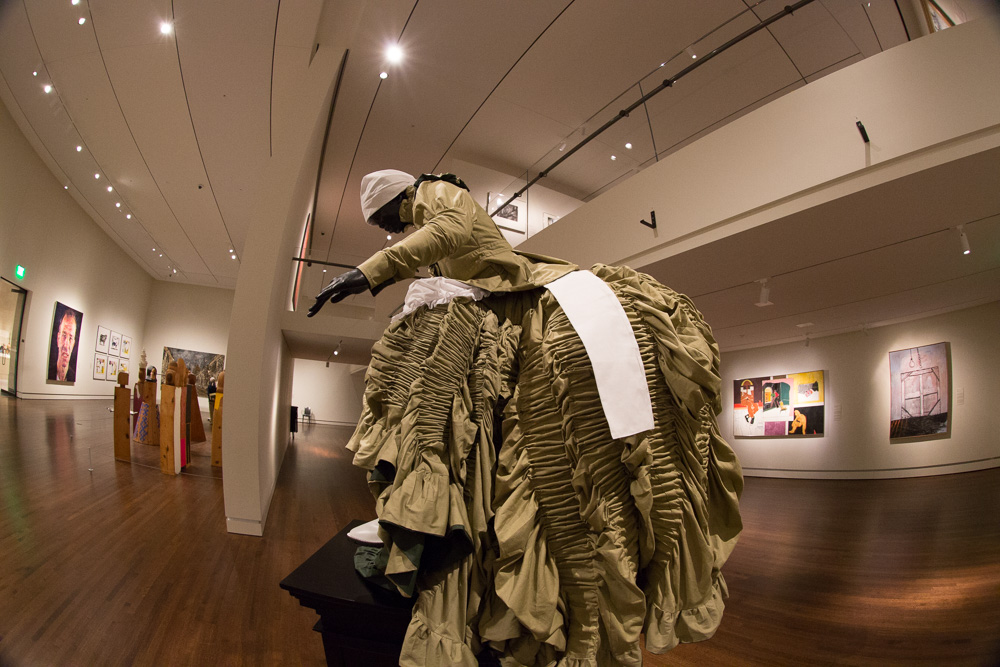
Mary Sibande (South African, born 1982), Rubber Soul,
Monument of Aspiration, 2011, Toledo Museum of Art
Gift of The Georgia Welles Apollo Society, 2013.160
Our brand new woke Toledo Museum of Art
guess what? Your new branding is old.
“We will develop an inclusive brand voice and experience that inspires all people and awakens their connection to the deep human story we all share.” Gary Gonya, Director of “Brand Strategy”
That’s what all museums do.
From the beginning of the Toledo museum, there have been people of all ethnicities and walks of life attending art classes and participating in art shows, and shows that speak to everybody, and to act as if we haven’t been inclusive is insulting.
Toledo has always been diverse, and to imply that Toledo has not been diverse is incorrect. Adam Levine, the new director, is the one who wrote the infamous memo after the George Floyd murder stating that the museum’s position on that should be neutral. We certainly were outraged! As I venture to guess were most people in Toledo.
Adam Levine does not have to overcompensate for his mistaken memo by trying to assert that the museum members and patrons and contributors were ever the least bit not for diversity or inclusive. Our history at the museum has always encouraged diversity through their century of Saturday art classes for Toledo Public School system students and others. The TAA show has always been inclusionary since the beginning. The history of shows at the museum defies their argument that somehow the museum is not inclusive or diverse – that is completely false.
There is overwhelming proof that the museum has always been all for diversity and their free open-door policy has alway been like that. The door is open and it’s free, and it was made that way by the progressive founders in 1901, and has stayed that way for 121 years.
The museum does not need to be rebranded because of the new director’s mistaken memo, and Adam Levine should not be selling off our three French Impressionist masterpieces by MATISSE, RENOIR, AND CÉZANNEto raise even more money in the name of diversity when we just had a major fundraiser in 2017 that brought in $43 million, not to mention the numerous endowments the museum already has for buying art, and the Ambassadors, the Georgia Welles Apollo Society, and the Libbey Circle who also buy new art.
Enough already with the overcompensation for the mistake he made with his memo.We have more than enough money to buy new diversified art, as the museum has been doing all along, (see list below showing new acquisitions in just the past eight years) without selling our French Impressionist masterpieces. Unless he’s just selling them to make a statement.
If they really want to be more inclusive and accessible, they could make their parking lot free.
Maybe we need some diversity in our directors. How about someone from Toledo? I’d even be happy with a woman.
Saint Francis of Paola (2003) by Kehinde Wiley (American, born 1977) hanging in the 2014 museum show, Speaking Visual: Learning the Language of Art. It was acquired by the museum in 2005.
Here are some of the shows from the past few years that would be considered diverse and inclusive:
2013
Crossing Cultures: Contemporary Aboriginal Australian Art
2014
INSIGHT: CONTEMPORARY SENSORY WORKS Works of art by three major contemporary artists—Pinaree Sanpitak of Thailand, Magdalene Odundo of Kenya, and Aminah Robinson of theUnited States
PEOPLE GET READY: 50 YEARS OF CIVIL RIGHTS
2015
A COLLABORATION WITH THAI ARTIST PINAREE SANPITAK
Guest Artist Pavilion Project (GAPP) resident Pinaree Sanpitak, The Hammock
2016(focusing on “representation” shows)
Indigenous Beauty: Masterworks of American Indian Art from the Diker Collection
The Rise of Sneaker Culture
2017
Kara Walker, Harper’s Pictorial History of the Civil War (Annotated)
Doreen Garner, GAPP artist
2018
Glorious Splendor: Treasures of Early Christian Art
Fired Up: Contemporary Glass by Women Artists
The Mummies:From Egypt to Toledo
EXPANDED VIEWS: NATIVE AMERICAN ART IN FOCUS
2019
Global Conversations: Art in Dialogue
Life is a Highway: Art and the American Culture
Anila Quayyum Agha: Between Light and Shadow
Expanded Views II: Native American Art in Focus
Mel Chin
2020
Yayoi Kusama: Fireflies on the Water
Mirror, Mirror: The prints of Alison Saar
Thornton Dial: Trip to the Mountaintop
Picture ID: Contemporary African American American Works on Paper
New, “diverse” acquisitions include:
2013
Seven Sisters: Tjungkara Ken acrylic on linen
2015
Nam June Paik (South Korean, 1932- 2006), Beuys Voice
2016
Kara Walker (American, born 1969), 15 prints from the portfolio Harper’s Pictorial History of the Civil War (Annotated)
Alfredo Jaar (Chilean, born 1956), Be Afraid of the Enormity of the Possible
Silvia Levenson (Argentinian, born 1957), Strange Little Girl #7
Gajin Fujita (American, born 1972), Hood Rats
Saibai Island, Torres Strait (Northern Islands, Australia), Mask
Alice Neel (American, 1900–1984), Nancy and the Rubber Plant
2017
Ancient Roman, Season Sarcophagus. Marble, about 280–290 CE
Ancient Roman, Bust of a Flavian Matron. Marble, late 1st–early 2nd century CE
Alison Saar (American, born 1956), Topsy and the Golden Fleece
Joyce Scott (American, born 1948), Nuanced Veil
Agus Suwage (Indonesian, born 1959), Keberangkatan
Wendy Red Star (American, Crow, born 1981), iilaa/ee =car (goes by itself)+ ii =by means of which+ daanniili = we parade
William Villalongo (Amencan, born 1975), Beautiful Boys.
LaToya Ruby Frazier (American, born 1982), 2 photographs from the series, Flint is Family: a. Shea at work driving bus 38, Route 45 for Flint Community Schools Transportation, First Student Co. b. Shea Zion departing Flint Ml for Mississippi at 4 a.m. on June 25th, 2016
2020:
Thornton Dial (American, 1928-2016), Trip to the Mountaintop
Adam Levine came to the museum as director in April 2020.
FROM THE TOLEDO MUSEUM OF ART’S MISSION STATEMENT:
COMMUNITY RELEVANCE: We will be an integral member of our community and will be responsive to issues of community concern and importance, particularly as they relate to the arts.
VALUES: As individuals, we pledge that our relationships with one another and with our audiences will be governed by: Integrity; Respect; Trust; Cooperation; Positive Approach; and Self-Discipline.
A tribute to the Mrs. McKelvys of the Toledo Museum of Art
From the introduction of The Collection of Mrs. C. Lockhart McKelvy
Written by Otto Wittmann, Director, Toledo Museum of Art, 1964
Margaret Gosline McKelvy was one of Toledo’s great benefactors, yet she was so modest and so reticent that few knew all that she did for the community in which she lived. Her joyous and lively interest in the arts and people expressed itself in two ways that profoundly affected this community through its Art Museum. Her father, William A. Gosline, Jr., who was President of the Museum from 1934 to 1947, had taught her to love and collect art. She had the courage to acquire only works of art she liked and always considered that one day her collection would be the heritage of all of us in this community. Her acquisitions were planned to supplement the collections of the Art Museum yet they remain a very personal expression of her strong and sure taste. Her collection will strengthen and enrich the Art Museum, giving pleasure to all who visit it.
Mrs. McKelvy liked young people and helped many to obtain the education necessary to pursue a useful life. In the arts she gave scholarships to promising young artists, so that they could become technically proficient. Many became art teachers, and are now benefiting countless children through their teaching. With typical modesty, Mrs. McKelvy gave these scholarships either through the Museum, as Gosline Scholarships, honoring her father, or through the Toledo Board of Education, as Gilmartin Scholarships, honoring Elizabeth C. Gilmartin, former Supervisor of Art Education in Toledo’s public schools. Few knew the name of the donor.
Mrs. McKelvy was a lifelong resident of our community, served on the boards of many charitable institutions in addition to being a Trustee of this Museum. The delightful and personal collection of works of art given to the Museum by Mrs. McKelvy is recorded in this catalogue. Her pictures and objects will give pleasure to many. Her generous and lighthearted spirit will live on in these works of art and in the hearts of all those whom she helped, and who are now helping others to learn from and enjoy the arts.
A collection of valuable French Impressionism and other French art which was made from a woman’s point of view, Mrs. McKelvy used her critical feminine eye to collect art with the intention of giving it to the Toledo Museum of Art. And now the museum is selling her Renoir.
Check out Mrs. McKelvy’s bequeathed collection that was published in this booklet by the Toledo Museum of Art in 1964:
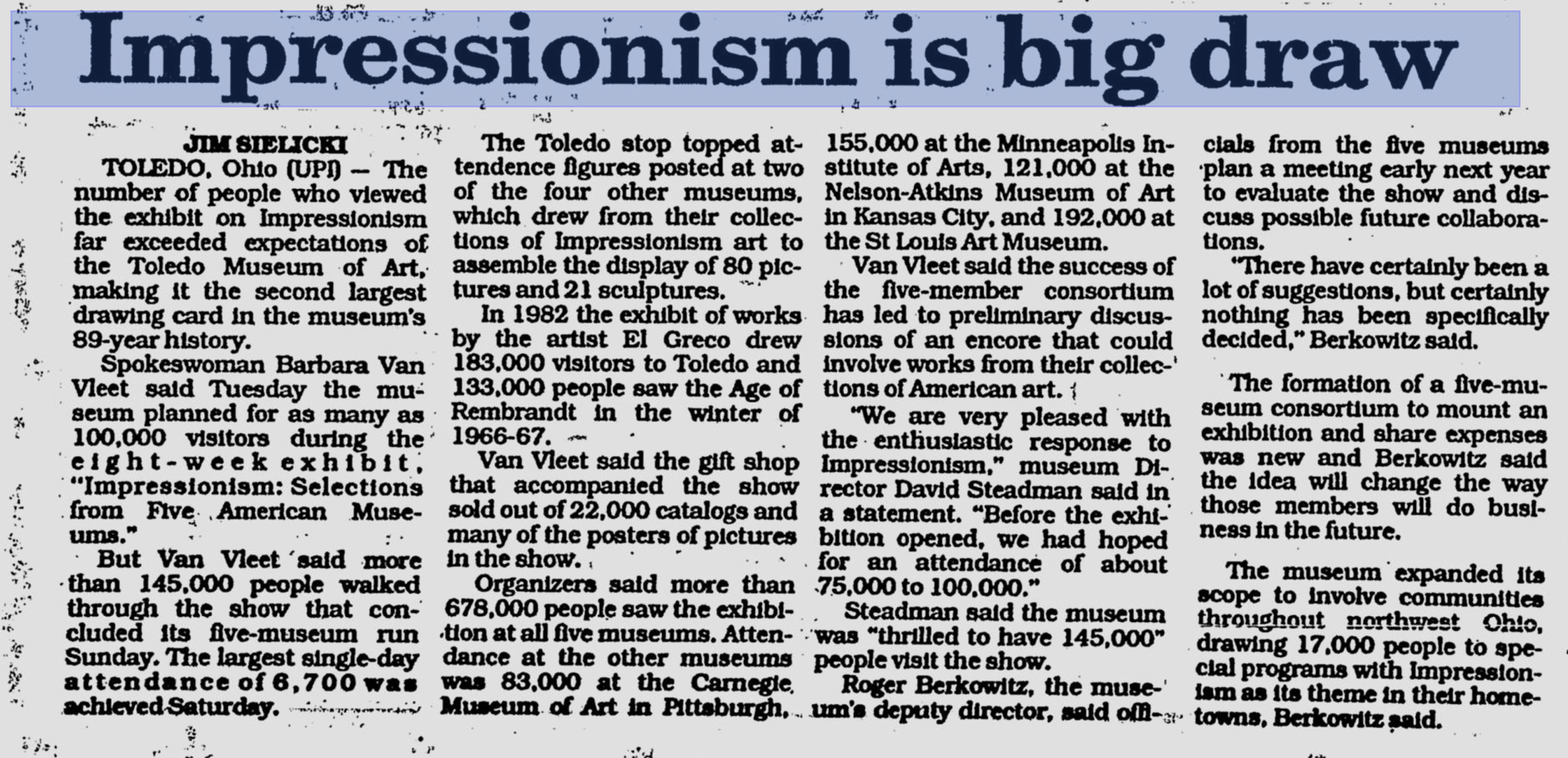
UPI article about the museum’s 1990 Impressionism show, which got the second highest attendance of any show in the history of the Toledo Museum of Art. But they are going to sell three of these most popular paintings for a 12th century object from Southeast Asia, perhaps, according to the museum’s Brand Strategy Director, Gary Gonya.
The Great Art Heist of 2022
Goodbye, Matisse, Renoir, and Cézanne. The new director of the Toledo Museum of Art, Adam Levine, tells us that you are no good for the museum anymore, that we have too many of you, that you are not even that good, that you don’t serve the community fairly, even though you are so popular, that people go to see you first when they visit the museum, and 6,700 people came to see you in the Impressionism show on the Saturday after Thanksgiving one year.
Matisse, Renoir, and Cézanne brought the community together. The Matisse, Renoir, and Cézanne are great works of art that the Toledo community loved and made us proud of our Toledo Museum of Art. They are part of the fiber of the museum that is us, the diverse and artistic Toledo community that makes up the Toledo Museum of Art.
LeMaxie Glover at work, Blade photo, courtesy of Karen Glover
Mrs. Margaret McKelvy, LeMaxie Glover’s benefactor, bequeathed The Bather by Pierre Auguste Renoir to the Toledo Museum of Art. It was part of her curated personal collection of French art.
“She always considered that one day her collection would be the heritage of all of us in this community.” – Otto Wittmann, Director, 1964
And now they are getting rid of a major painting from her collection under the guise of diversity.
Could it be that the new museum director is using us, making half of us feel ashamed that we have so much French and European art, and planting the seed that the other half needs to question whether or not French and European art really speaks to them, as if it should only speak to people of French and European descent? Could it be that it is the director who cannot relate to the art in our art museum, since his expertise is in ancient art, anthropology, and mathematics?
If it were not for Mrs. McKelvy’s generous support of LeMaxie Glover, our local art community would not be as diverse as it is today. Our museum has always been progressive and welcoming to every person in this community, no matter what ones’ personal heritage.
LeMaxie Glover was influenced by the impressionistic work of Renoir, as were many art students in Toledo. LeMaxie Glover learned his craft and his art at the Toledo Museum of Art School of Design, and Mrs. McKelvy gave him a scholarship to Cranbrook Academy of Art. McKelvy was an important patron of Glover’s. In return, LeMaxie Glover was not only one of Toledo’s best sculptors, but he also served unselfishly as an art teacher at Woodward and Scott High Schools for many years, helping generations of Toledo youth appreciate and create art.
Pugilist, LeMaxie Glover 1967, terra cotta. Collection of Karen Glover. Photo by Penny Gentieu
As if they need to sell our masterpieces in order to buy more art, anyway.
It makes a good story in Art News
The museum can buy more diverse art without selling their French Impressionist masterpieces, with the $4 million that they can spend on art every year from the income of the Libbey endowment alone. Many Toledoans treasure the masterpieces in our museum. Selling off these paintings to get a quick $40 million to buy “diverse” art (with their eye on a 12th century object from Southeast Asia) is foolish. They could do a fundraiser. The museum curators often add one hundred or more artworks each year. Do they really have sell our venerable, valuable French Impressionist masterpieces from important collections to buy more art? They will be losing the support of the bequeathing community.
Perhaps in the future, donors should loan, instead of bequeath their great works of art to the museum, so when a new director comes along and wants to deaccession it, the artwork can be given to another museum that might appreciate it, without the first museum getting to cash it in. I wonder how Mrs. McKelvy’s heirs feel about the museum’s deaccessioning of her Renoir. At least if it’s going to be monetized, Mrs. McKelvy’s many descendants should benefit, not the new museum director who is actively diminishing her legacy and erasing the museum’s rich history.
In his April 8 letter to museum members about the sale of the three paintings, Adam Levine went into detail about the Libbey Endowment Fund but didn’t even mention Mrs. McKelvy, whose Renoir was given directly by her, and not bought with the funds of the Libbey Endowment, as were the other two paintings.
It must be a very touchy subject these days among Toledo’s wealthy patrons who are thinking about bequeathing art. Because the artwork is wanted today, but “get it the hell out of here” tomorrow, as their memory will be. (That is, depending on the whim of the new museum directors, who are not Toledoans, and will probably be getting the hell out of here as soon as they can, too. Lately, since 2005 or so, directors of the Toledo Museum of Art tend stay around for only seven years.)
Our lives begin to end the day we become silent about things that matter.
Dr. Martin Luther King, Jr.
Dedication of "Save The Children," a sculpture by Paxton Cooper, in front of the Bancroft-Kent Center, now the Wayman Palmer YMCA. Vice President Walter Mondale, U.S. Representative Ludlow Ashley and Toledo Mayor Doug DeGood, October 25, 1979. Where does the art begin, and the politics end? Photo @ Penny Gentieu
The Bancroft-Kent Center was a public-private urban renewal project that was built in 1978 in the Warren-Sherman neighborhood, near downtown Toledo. I was Toledo’s “city photographer” at the time, and I took these photos. I came across them recently while scanning my archive of negatives. Having totally forgotten what it was I had photographed, I managed to piece the story together, one that resonates today.
This was the ground-breaking ceremony for the Bancroft-Kent Center on October 31, 1978: community development director, Wayman Palmer on the left, Toledo city council members Sandy Isenberg in the center and Bill Copeland, second to the right.
My boss was Ted Reams, the city public information director, standing on the podium smoking a pipe as the city officials announce the project at the groundbreaking in 1978. Downtown Toledo is in the background.
They built the building in the middle of a residential side street, North 14th Street. The dilapidated houses on the opposite side of the street were ready to be torn down.
The next year, I was free-lancing, and Toledo Trust hired me to cover an event, with the Vice President, Walter Mondale, coming in to help commemorate. It was the dedication of the sculpture, Save The Children in front of the new Bancroft-Kent Center.
Members of the community gathered in front of the Bancroft-Kent Center at 2053 North 14th Street for the dedication of Save The Children.That’s me on the right, taking these photos, captured in the Blade.Dedication of Save The Children by Paxton Cooper, installation at Bancroft-Kent Center, which is now the Wayman Palmer YMCA. Vice President Walter Mondale is approaching the microphone.From left to right: Wayman Palmer at the microphone, Vice President Walter Mondale, U.S. Representative Ludlow Ashley and Toledo Mayor Doug DeGood, two secret service agents, among the people in the back are the judges of Save The Children, I realized, with Save The Children in between.That could be the artist, Paxton Cooper waving from behind Save The Children, whom Wayman Palmer is pointing out. Sitting just beyond Wayman Palmer is William Norris, CEO of Control Data Corporation, who saw business opportunities in social responsibility. (CDC had just won a many-million-dollar settlement from their anti-trust lawsuit against IBM.)
The judges of Save The Children lined up behind it are Robert Page, Project Architect, Samborn, Steketee, Otis & Evans (SSOE); Susan Reams, founder of the “1% For Art” program and Chairman of the Design Review Board; Roger Mandle, Director, Toledo Museum of Art; and who I believe are Richard Boers, Commissioner, Forestry & Open Space Planning, and Prudence Hicks, Representative of Warren-Sherman neighborhood. The Scott High School choir is in the background.
The Blade article on it:
The Bancroft-Kent Center was renamed the Wayman D. Palmer Community YMCA after Wayman Palmer died in 1984. A beloved community leader, see his obituary here: Palmer Wayman Toledo Blade Nov 12 1984.
Wayman D. Palmer YMCA Today
Photographed in December 2021, the front of the building faces the side street, North 14th Street, with the parking lot having to be entered one street over, on Franklin Street, through the Woodruff Village housing project on a road carved out named Wayman Palmer Court.
I drove by the building in December to see if this was the building I had photographed 42 years ago, and clearly it was, but Save The Childrenwas gone! So I checked with the Arts Commission, the agency in charge of public art, and they kindly provided me with information.
I discovered that Save The Children was the very first “1% For Art” installation. I used to work for the Arts Commission during that time, so I vaguely remember when the program started. It was a big deal. The city passed an ordinance for the allocation of 1% of the cost of new public buildings to be used for buying and installing public art.
The sad news is that Save The Childrenwas deaccessioned and removed in 1989. It was made of materials that did not hold up, and it fell apart.
bad feng shui
Fast forward 42 years, during which time I moved away for a photography career in New York and returned. In September 2021 a new YMCA was announced for the Warren-Sherman neighborhood. It will cost over $20 million and have a swimming pool. It’s something the community says is badly needed. It will be built this time facing the main street, Bancroft, with the parking lot approachable from Bancroft. That’s good because now you can only get to the parking lot from one street over, to the west of N. 14th street, having to enter it on a road built through a public housing project. When I was there in the middle of the day, there were only three cars in the parking lot.
Save The Children
The failure of Save The Childrenforetold the failure of the building itself. Perhaps the architects, art supporters, and politicians should have had a better approach, as the front entrance was tucked away on a side street and closed, limiting personal interaction with the sculpture, Save The Children, which was quietly removed after 10 years.
It’s weird to have witnessed the ground-breaking of this new community center and the fanfare of the Save The Children dedication with the Vice President of the United States being present to honor it, only to see a few decades later, the emptiness of such grand gestures, along with the emptiness of the building itself. The building is getting torn down after only 42 years. It will be replaced, they say, by a really great building, but for the generations of children that have not been saved, it’s too bad that Save The Children and the Bancroft-Kent Center could not have fulfilled that promise.
With all of the heart-breaking shootings and killings of innocent children that Toledo is experiencing, I hope the current committee of judges for the new building’s “1% For Art” will consider installing a new Save The Children, one that will persevere.
Installation of Save The Children by Paxton Cooper at the Bancroft-Kent Community Center in 1979. Please try it again.
Isaac Paul Rader, famous for his paperback cover illustrations, is “entirely a Toledo product.”
He learned his craft by taking classes at the Toledo Museum of Art; his teacher was Karl Kappes. At the tender age of 14 (he might have been 15), he won top prize in the fourth annual Toledo Area Artists Exhibit at the Toledo Museum of Art. That made him famous – his museum win was a true legend enduring all of his life and written about in his obits!
He moved to Detroit, where, in his twenties, he made a name for himself as the premiere artist for official portraits of judges.
Then he moved to New York and became a magazine illustrator. His paperback covers, created in the 1960’s, are highly collectable.
Google Images screenshot, 2022The Toledo Blade, June 26, 1986Detroit Free Press, June 10, 1986Toledo Times, March 28, 1921, Isaac Rader “entirely a Toledo product.”Toledo Blade March 1921, The Carpenter by Isaac Rader. An oil painting of his father at work, painted life-size.
The first prize going to a 15-year old caused quite a stir in Toledo — but he had to win. His stunning painting, which was painted life-size, was better than any other entry. The jury included Nina Spalding Stevens (head of the art school and wife of the museum director) and Blake-More Godwin (who would become the next museum director, in 1927.)
That was the last year the Federation did their own judging. For every Toledo area artist show after that, the Federation utilized judges from out of town (until the last two, in 2013 and 2014, which were judged by the museum director and associate director– we know what happened after that…)
Another reason to bring back the real Toledo Area Artists Exhibition at the Toledo Museum of Art, to help Toledo artists become famous like Isaac Paul Rader!
Subject: May Show Season
Date: 04/06/2022 11:19AM
To: ALevine@toledomuseum.org, rsewell@toledomuseum.org
Dear Adam and Rhonda,
I just posted a new-found artist, Isaac Paul Rader, on artistsoftoledo.com – I thought you might be interested. At age 14, he won top prize in the TAA show, and went on to have quite a career as an artist. Just an example of the missed opportunities for young Toledo artists without the museum’s annual area artists show. It means something to be shown at the Toledo Museum of Art – it can really change one’s life!
It’s exciting to see the changes at the museum — how is the Community Gallery coming along?