
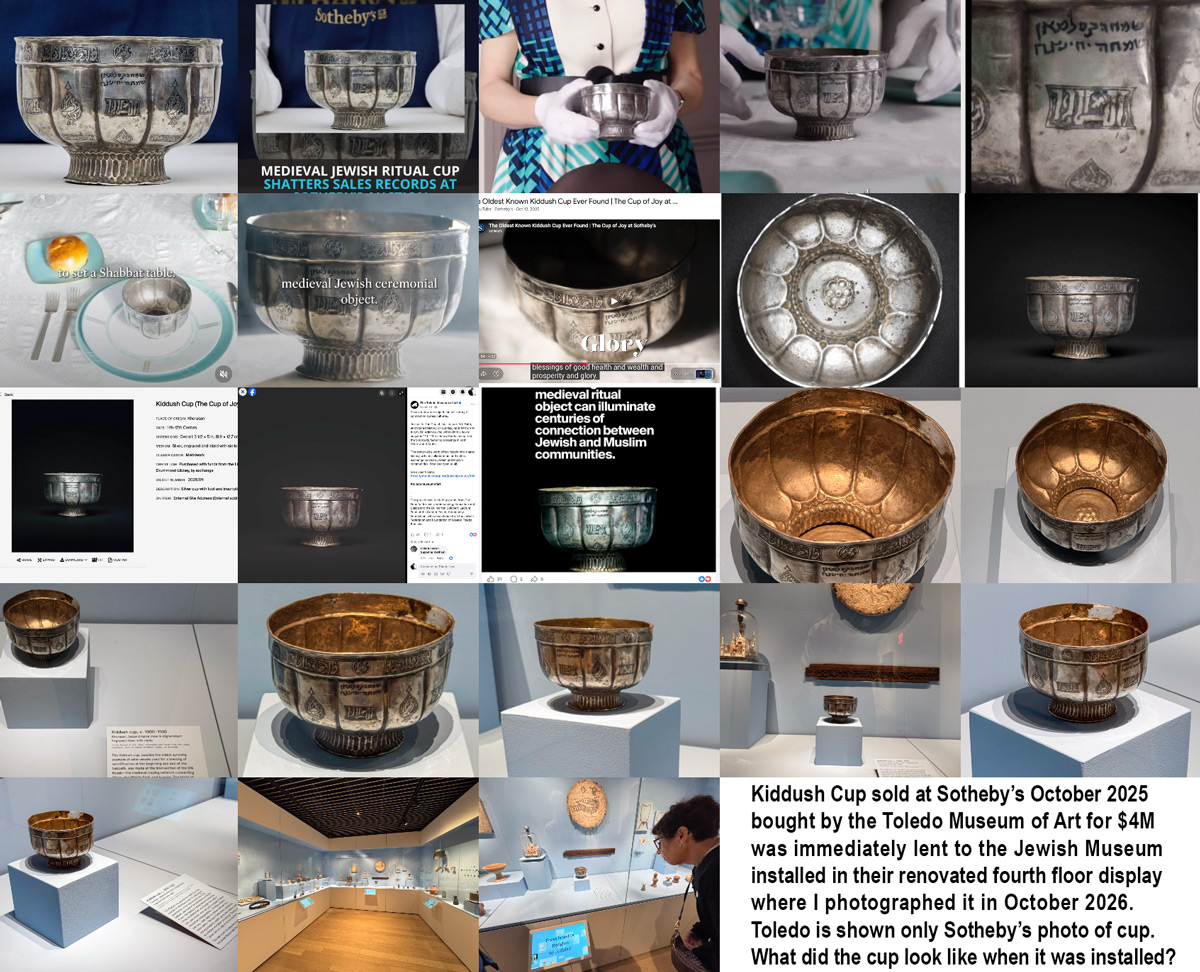
“The Cup of Joy” was its marketing name.
Toledo bought “The Cup of Joy;” Toledo bought the story.
$4 million hammer price shattered auction records
Toledo Museum of Art bought it and immediately lent it to the Jewish Museum in New York for long term display in their just-renovated museum.
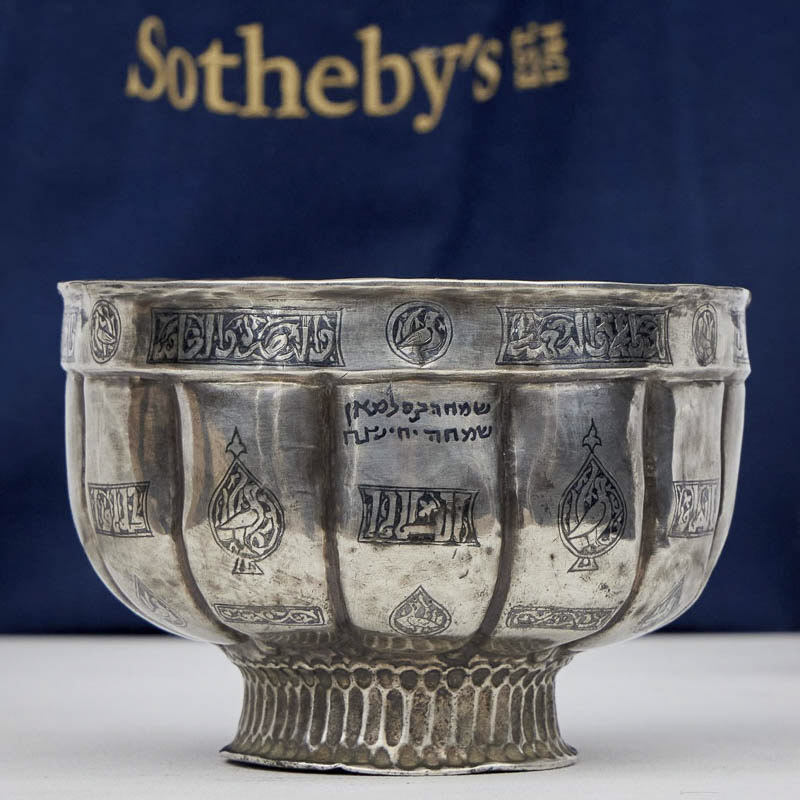
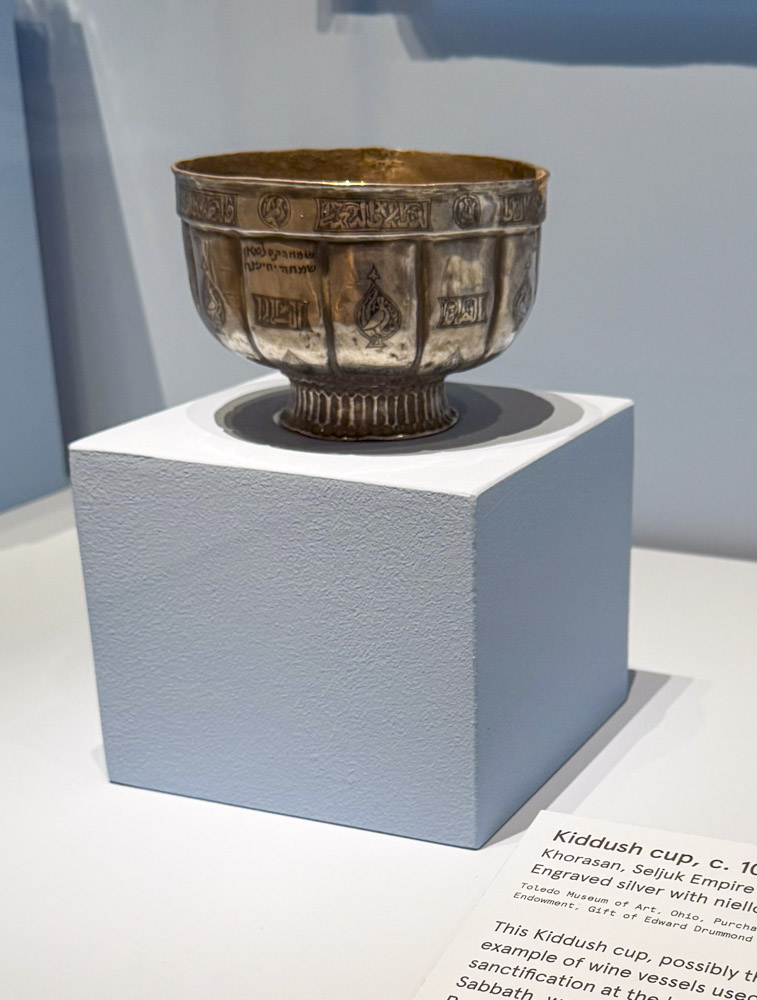
But what happened to the cup after it went on display to make it so yellow?
If it was a natural patina, it would have photographed that way in the marketing photos. Is it a thin tarnish layer, yet so evenly a brassy yellow-gold especially on the inside of the bowl? Is it the interaction of the silver with its environment, a brand new freshly painted display case in the newly renovated fourth floor of the museum? One thing is clear, it’s definitely not the lighting.
For four million dollars, the public has a right to know.

Now in the collection of the Toledo Museum of Art, Toledo is shown only one photo of the ancient kiddush cup — the Sotheby’s photo, misrepresenting the condition it is in today, one year after the purchase. For an ancient, fragile little cup having such a big price tag – $4M – more than the museum’s usual entire annual art budget – and two times as much as what it got for the Professional Building, why isn’t it on display for Toledoans in the Glass Pavilion? It doesn’t take up much room, after all, and it’s considered such a prized possession.
Adam Levine bought the story and took it on the road.
He got plenty of national press for the $4M hammer price. That helps him – but does it help the people of Toledo, for whom Edward Drummond Libbey, whose funds were used for the cup, funded this art, and intended the art to be on display in the Toledo Museum of Art?
Who needs the cup when $4 million gets you the story?

On April 19, Adam Levine didn’t show the actual cup when telling the story of the cup to Toledoans.

On October 27, one week before a contentious senatorial election, he will be telling the story of the cup at a university north of Detroit. Is he using Toledo’s new acquisition to influence an election?

On December 7, Adam Levine will be giving a talk at the Jewish Museum with the director, James S. Snyder, tickets are $24.
 “Since assuming directorship in 2020, Dr. Levine has led the museum through a period of significant growth…” Oh really, when the attendance never recovered after the pandemic and now the entire main building of the museum is pretty much closed, for years, to fix the HVAC and reinstall the art? Great art has been sold, and the renovated museum will have less gallery space, with no additional storage, on a smaller campus, since the Professional Building was sold last year for $2 million.
Financial growth decoupled from public engagement and exhibition output – a disconnect between visitors and revenue — and Levine is lauded by that being called significant growth! The museum campus is made smaller, art is loaned and sent on world tours for years, and meanwhile an entire generation in Toledo is growing up without the benefit of the only art museum within 50 miles.
Compared to the Jewish Museum, the Toledo Museum is about the same size, same budget, same number of objects, but the difference between the two is that the Jewish Museum managed to completely renovate and reinstall two floors while still remaining open to the public on the other two floors, and the Jewish Museum did it for $15 million — they are transparent about it – unlike Toledo, with Adam Levine refusing to answer the question that the public has a right to know: How much is the renovation costing?
Who benefits from the way this charitable asset is being used, and where is the Toledo public’s benefit in the arrangement?
To recap:
TMA spends $4 million acquiring a major object.
The object is not exhibited in Toledo; it is loaned to a prominent New York museum. The TMA director is invited to New York to speak about it. The program’s description prominently markets his credentials and his tenure at TMA, but not how great the museum itself is. The object becomes a vehicle for discussing Adam Levine’s leadership and his transformation of our beloved museum.
What public benefit does TMA receive from this particular disposition of a $4 million acquisition, and what was the basis for deciding that the object should be loaned immediately to an institution outside Toledo rather than first being exhibited to the Toledo community?
Levine is scheduled to discuss the “Cup of Joy” in Michigan immediately before the November 3, 2026 U.S. Senate election, in a state where the election has received national attention because Democratic nominee Abdul El-Sayed could become the first Muslim U.S. senator.
It makes you wonder whether this new acquisition advances the Museum’s public and institutional purposes, or does it primarily provide substantial professional and reputational benefit to its director? The circumstances warrant examination because the $4 million acquisition was not initially made available to the Toledo public, was instead placed on loan outside Toledo, and now is serving as the subject of a high-profile program in which the Museum’s director is the featured speaker and his personal leadership biography is prominently presented.
Is TMA is operating its charitable assets primarily in accordance with its public obligations, or according to the interests and ambitions of Adam Levine?
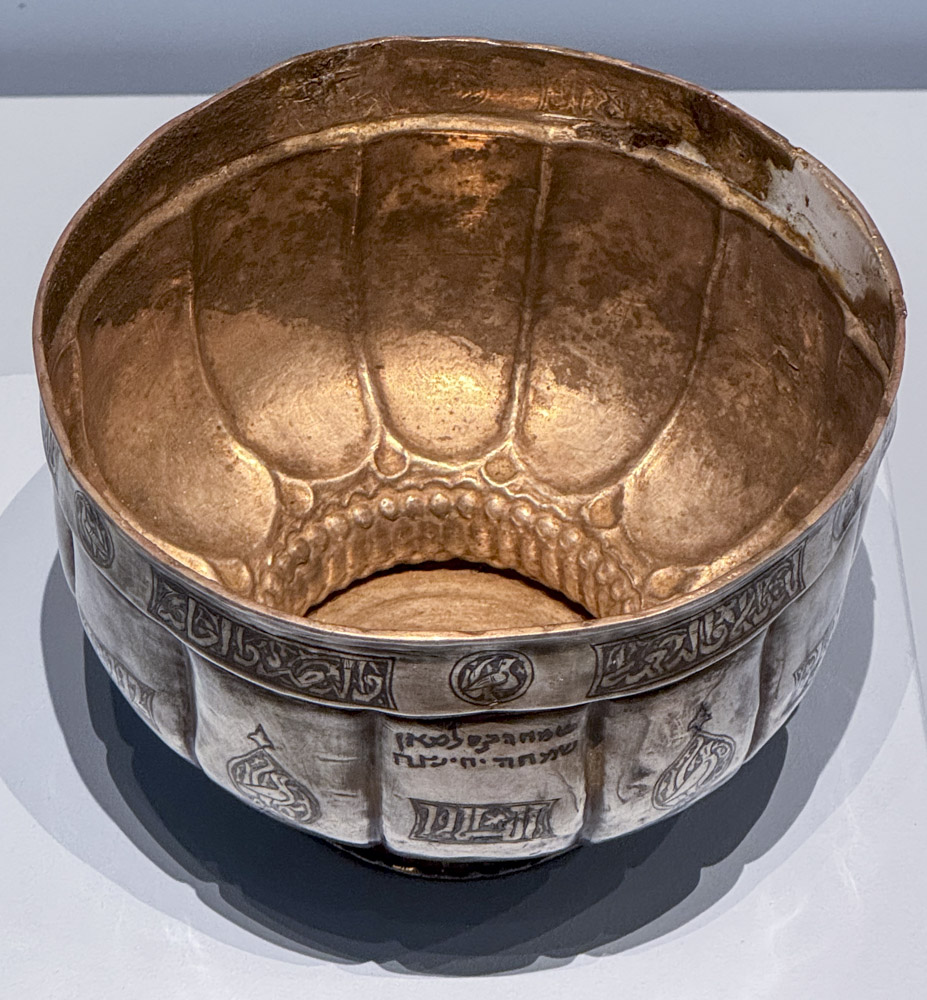
And what’s up with the color?